Saint Leonardo Murialdo
October 26, 1828 - March 30, 1900
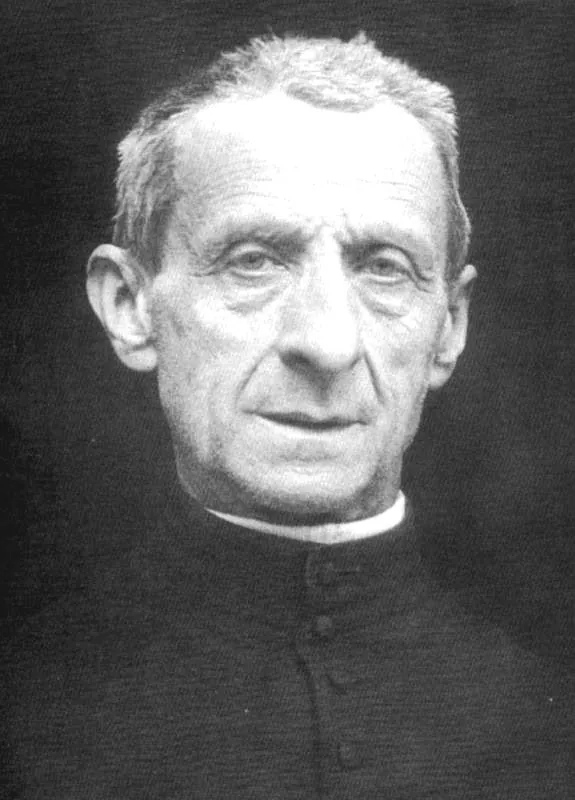
- Feast day
- May 18, as his congregation keeps it 5; Vatican News marks him on March 30, the day he died 7
- Ordained
- September 20, 1851 1
- Rector of the Artigianelli
- The Turin college for poor and abandoned boys, from 1866 until his death 26
- Beatified
- November 1963, by Paul VI 4
- Canonized
- May 3, 1970, by Paul VI 4
Saint Leonardo Murialdo was a Turin priest who in 1866 agreed to run a college for orphaned and abandoned boys that was deep in debt, and stayed with it for the thirty-four years he had left. 26 His rule for whom to take in was short: "the poorer and more abandoned he is, the more he is one of ours." 2 He founded the Congregation of St Joseph for those boys in 1873, and outside its walls he worked with one of the first Catholic workers' associations in Piedmont. 56
A crisis, and a return to the light
He was born in Turin on October 26, 1828, which Benedict XVI calls "the Turin of St John Bosco and likewise of St Joseph Cottolengo." 1 The English Vatican texts call him Leonard; his own congregation calls him Leonardo. 15 The sources describe his family differently. Benedict XVI says he was "the eighth child of a simple family." 1 John Paul II says he grew up in "a well-to-do family and a loving home," Paul VI calls his family comfortable, and the congregation says his father was a rich stockbroker who died in 1833. 245
His mother sent him to board with the Piarist Fathers at Savona, where he stayed from 1836 to 1843. 5 There, Benedict XVI says, he went through "a profound existential and spiritual crisis" in adolescence and came home sooner than planned. 1 His "return to the light," as he himself put it, came some months later through a general confession, and at 17 he decided to become a priest. 1
He was ordained on September 20, 1851. 1 John Paul II notes that even before ordination he had been caring for poor boys on the outskirts of Turin and for young inmates of the juvenile prison. 2
The oratories, and Don Bosco
His first work was in the city's oratories, the Sunday gathering places for boys of the poor suburbs. He began by helping his cousin Roberto Murialdo, also a priest, at the oratory of the Guardian Angel in Borgo Vanchiglia. 6 Don Bosco noticed him there, Benedict XVI says, and persuaded him to take on the new Oratory of San Luigi at Porta Nuova. 1 The dates differ a little: John Paul II has him at the Guardian Angel from 1851 to 1856 and then at San Luigi for eight years, and the congregation gives 1857 to 1865 for San Luigi. 26
In his first talk to the San Luigi boys he promised to be among them "not as a superior, but as a friend." 6 He added a weekday school for boys who otherwise spent the week in the street, and Salesian clerics from Valdocco came on Sundays to help. 6 Benedict XVI says that there he visited the poorest families in their homes, and that Bosco wanted him along when Pius IX received Bosco in 1858. 1
In 1865 he left for a year of study at the seminary of Saint-Sulpice in Paris, where John Paul II says he also went to learn about institutions for working-class youth. 26 He meant to come back to the oratories. 6
The Artigianelli
The Collegio Artigianelli had been founded in 1849 by Don Giovanni Cocchi to take in orphaned, poor and abandoned boys and train them in a trade; the name means "young craftsmen." 26 In 1866 its rector, Pier Giuseppe Berizzi, was recalled to his own diocese and begged Murialdo to replace him. 6 The congregation is blunt about what he was taking on: an institution with large debts and no secure income, since most of the boys were there for free. 6 John Paul II says the bishop called him to it, and he accepted. 2
There were about 150 boys when he arrived, and later 180 to 200. 6 After elementary school they went into the workshops at about twelve, and over his rectorate the shops grew to about a dozen trades, from printing to shoemaking. 6 The cost of trained staff led, in the early years, to an effort to take fewer free boys and more paying ones. 2 He took the debt on himself instead, left his brother's house and moved into the college. 2 He told the boys in 1869: "It is only because of affection for you that I did not refuse to direct your college." 2
John Paul II quotes the motto he gave himself: "Poor and abandoned: these are the two essential requirements for a young man to become one of ours; and the poorer and more abandoned he is, the more he is one of ours." 2 He wanted to know each boy's family, and testimony John Paul II quotes says he "took personal care of the more ignorant young men or those who were the slowest to learn." 2 He was clear about what the trade was for: "Our programme is not only to make our young men intelligent and diligent workers... but on the contrary, to make them sincere and honest Christians." 2 Grown up, they remembered him as "an affectionate father, a true father, a loving father." 2
The Congregation of St Joseph
He founded the Congregation of St Joseph in Turin on March 19, 1873, first called the Pious Turinese Society of St Joseph. 23 Benedict XVI gives its aim from the start as "the formation of youth, especially the poorest and most neglected." 1 At the canonization in 1970, Paul VI counted about 850 members in roughly a hundred houses, with a women's branch, the Murialdine Sisters. 4 Francis wrote in 2022 that it works in Europe, America, Asia and Africa. 3
The works kept multiplying around the college. In 1878 he opened an agricultural colony at Rivoli, with land bought by his nephew, the engineer Carlo Peretti. 6 The same year he opened a family home for young men who had finished their training and started work with no family to go home to; the congregation calls it the first of its kind in Italy. 56
Workers and the press
His congregation calls him "one of the animators of the Catholic Workers' Union." 5 The union was founded in Turin on June 29, 1871, as one of the first Catholic workers' societies in Piedmont. 6 Members got medical care and a daily payment when illness stopped their wages, at a time when nothing else provided either. 6 Murialdo joined it from its beginnings and served among its ecclesiastical assistants. 6 Its newspaper, La Voce dell'Operaio, first appeared in 1876, printed in the Artigianelli workshops, and survives as the Turin diocesan weekly La Voce e il Tempo. 6 Through the Opera dei Congressi he also worked for the Catholic press and for small lending libraries. 56
In his canonization homily, published in Italian, Paul VI called Murialdo a promoter of the first Catholic workers' unions and recalled that in December 1869 he petitioned the Lanza-Sella government for laws on the work of children and women in factories. 4 Francis wrote that "farsightedness also typified his commitment to another social emergency, linked to the world of work," and quoted his own maxim: "New times need new works." 3
Mercy at the center
Benedict XVI puts the heart of his spirituality in "his conviction of the merciful love of God." 1 Murialdo "always considered himself a man whom God in his mercy had pardoned." 1 His Spiritual Testament says it plainly: "Your mercy surrounds me, O Lord... Just as God is always and everywhere, so there is always and everywhere love, mercy is always and everywhere." 1
John Paul II says he celebrated Mass "with deep reverence and unusual slowness, even when situations disturbed his calm," and that his contemporaries knew where to find him: "if he was not in his room, he could be found in church." 2 He died in Turin on March 30, 1900. 14 Paul VI, who beatified him in November 1963, canonized him on May 3, 1970. 4
What is Saint Leonardo Murialdo the patron saint of?
None of the sources consulted names a patronage for him, so this page does not claim one. 12345 His congregation takes its name from Saint Joseph, and Francis writes that Murialdo worked "inspired by Saint Joseph"; John Paul II calls him "a fervent apostle of youth." 234 Those describe his work, not a formal patronage.
Saint Leonardo Murialdo's feast day
Praying with Saint Leonardo Murialdo
He said himself that he had been "at the bottom of the abyss" as a young man, and that God came there to find him. 1 Benedict XVI says he saw his whole life as "continuously immersed in God's infinite mercy." 1 The college, the congregation and the workers' union all came after that crisis. 1
He did not go looking for the Artigianelli. He came home from Paris meaning to go back to the oratories and was handed a debt. 6 When there was pressure to solve it by taking in fewer boys who could not pay, he moved into the building and carried the cost himself. 2 John Paul II says that before this he had given the boys "something," and now he gave them "everything." 2
His rule of admission ran against every financial pressure on the place: the poorer and more abandoned a boy was, the more he belonged there. 2 And what he wanted for the boys went beyond a trade. He wanted them to be good workers and, in his own words, "sincere and honest Christians." 2
He also looked past the college gate, to the workers those boys would become: mutual aid when they fell sick, a newspaper, and a petition on child labor in 1869. 46 John Paul II says he "prayed both day and night," and Francis remembered a man who kept saying that "we are in good hands." 23
Saint Leonardo Murialdo, pray for us.
Sources
- 1.Benedict XVI, General Audience of 28 April 2010, "Saint Leonard Murialdo and Saint Joseph Cottolengo," Saint Peter's Square.
- 2.John Paul II, Letter to the Congregation of Saint Joseph on the First Centenary of the Death of the Founder, St Leonard Murialdo, March 28, 2000.
- 3.Francis, Letter to the Father General of the Congregation of Saint Joseph on the 150th Anniversary of Its Founding, March 2, 2022.
- 4.Paul VI, Homily for the Canonization of Leonardo Murialdo, May 3, 1970 (Italian text).
- 5."The Life of St. Leonard Murialdo," Congregation of St Joseph (Josephites of Murialdo).
- 6."Stage of His Life," Congregation of St Joseph (Josephites of Murialdo).
- 7."Më 30 mars kalendari kujton shën Leonardin Murialdo, meshtar," Vatican News (Albanian edition), March 30, 2026.
Saints to turn to next
Others in this collection who are turned to for some of the same things.
- Saint Andrew Corsinic. 1302 - January 6, 1374ConversionPoverty and simplicityWork and vocation
- Saint CajetanOctober 1480 - August 7, 1547Work and vocationPoverty and simplicityConversion
- Saint John Francis RegisJanuary 31, 1597 - December 1640Work and vocationPoverty and simplicityConversion
- Saint Odo of Clunyc. 879 - November 18, 942ConversionWork and vocationPoverty and simplicity