Saint Simeon of Jerusalem
Died c. 106-107
- Age at death
- One hundred and twenty, according to Hegesippus 1
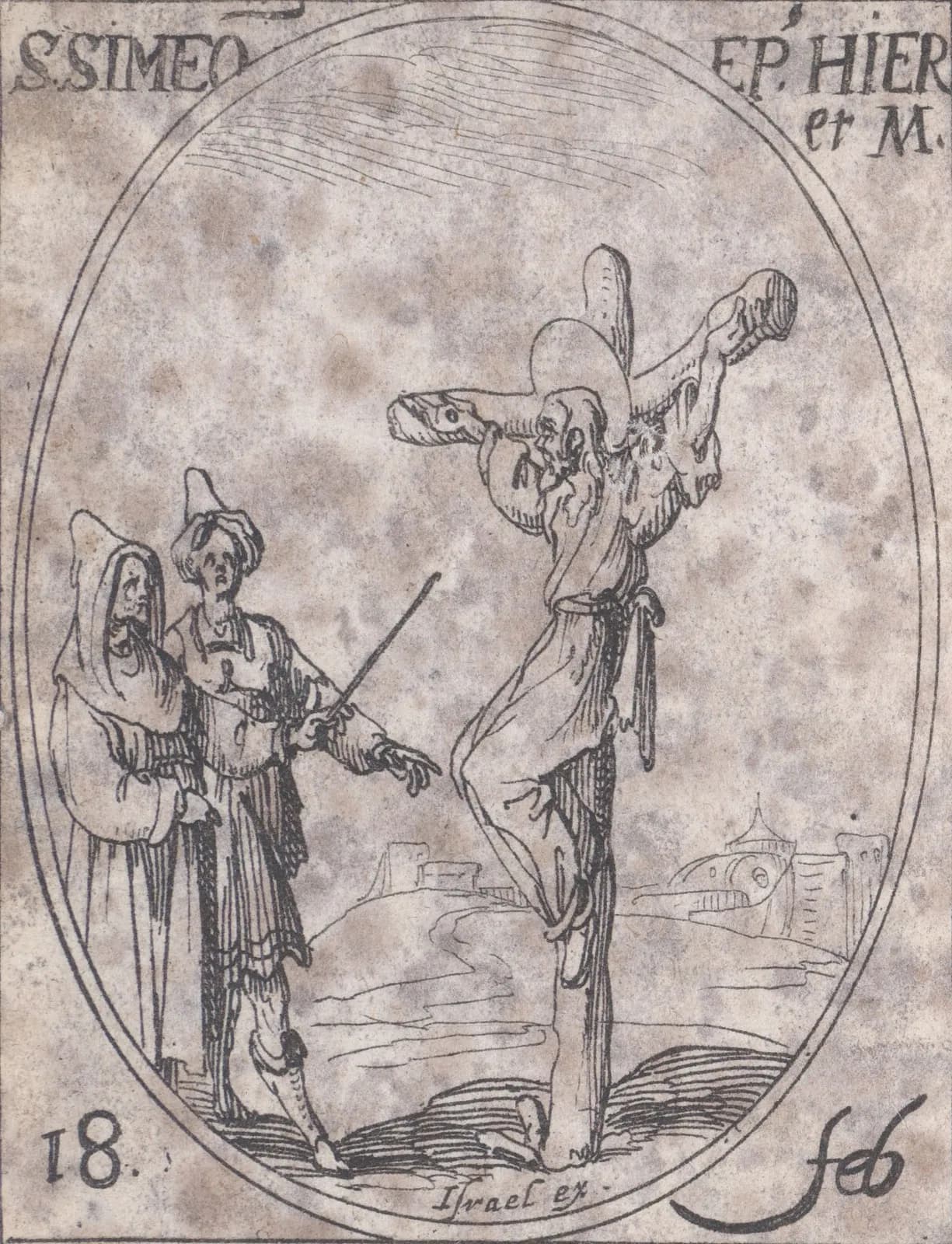
Saint Simeon, son of Clopas, was the second bishop of Jerusalem, chosen to succeed James, and by the earliest account a cousin of Jesus himself. 12 Under the emperor Trajan he was denounced as a descendant of David and a Christian, tortured for many days and crucified. 1 The historian who records it, Hegesippus, says he was a hundred and twenty years old. 1
One witness, quoted by another
Simeon is known almost entirely from Hegesippus, an early Christian writer whose five books of Memoirs Eusebius had in front of him, and from the passages of them that Eusebius copied into his Church History. 2 "Hegesippus, whose words we have already quoted in various places, is a witness to this fact also," Eusebius writes when he comes to Simeon's death, and he quotes him at length. 1 Vatican News says plainly that little of Simeon's life is known with certainty. 7
Of the early bishops of Jerusalem as a group, Eusebius admits, "The chronology of the bishops of Jerusalem I have nowhere found preserved in writing; for tradition says that they were all short lived." 2 For Simeon, though, Hegesippus names his father, tells how he was chosen, says who accused him and why, names the governor, and describes how he died. 12
A cousin of the Lord
Eusebius calls him "Symeon, the son of Clopas, of whom the Gospel also makes mention," and adds: "He was a cousin, as they say, of the Saviour. For Hegesippus records that Clopas was a brother of Joseph." 1 In the passage Eusebius copies from Hegesippus's fourth book, Simeon is "the son of the Lord's uncle, Clopas." 2 Eusebius notes that the Gospel mentions Mary, the wife of Clopas, and he reasons from that and from Simeon's great age that he "was one of those that saw and heard the Lord." 1
Florentine Bechtel, in the 1907 Catholic Encyclopedia, takes up the question of the "brethren of the Lord." The Gospels name four of them, James, Joseph, Simon and Jude. 5 "About Simon nothing certain can be stated," Bechtel writes. "He is identified by most commentators with the Symeon, or Simon, who, according to Hegesippus, was a son of Clopas, and succeeded James as Bishop of Jerusalem." 5 Some identify him instead with the Apostle Simon the Cananean, or the Zealot. 5 If he is Hegesippus's Symeon, Bechtel concludes, he was a cousin of Jesus, not a brother. 5
Chosen after James
James, the first bishop of Jerusalem, was killed about the year 63, Adrian Fortescue writes in the encyclopedia. 4 Eusebius reports what was said of the choice of his successor: the apostles and disciples still living "came together from all directions with those that were related to the Lord according to the flesh," and "They all with one consent pronounced Symeon" worthy of the see. 1 Hegesippus adds that "All proposed him as second bishop because he was a cousin of the Lord." 2
Not everyone accepted it. Hegesippus says that a man named Thebuthis, "because he was not made bishop, began to corrupt" the church, and he traces a line of heresies from him. 2 Until that time, Eusebius says in summing up Hegesippus, the church "had remained a pure and uncorrupted virgin." 1
Eusebius places the election after the martyrdom of James "and the conquest of Jerusalem which immediately followed." 1 Fortescue has Simeon already bishop when the city was destroyed in 70, and says he probably went then with the others to Pella. 4 Eusebius tells how the church of Jerusalem, warned by a revelation before the war, left the city for Pella in Perea. 1
The descendants of David
After the fall of Jerusalem, Hegesippus says, Vespasian ordered that all of the line of David be sought out, "in order that none of the royal race might be left among the Jews." 1 Under Domitian the grandsons of Jude were brought before the emperor on the same charge, showed him their workers' hands and their small farm, and were let go as harmless. 1
Simeon's turn came under Trajan. Certain heretics, Hegesippus writes, "brought accusation against Symeon, the son of Clopas, on the ground that he was a descendant of David and a Christian; and thus he suffered martyrdom, at the age of one hundred and twenty years, while Trajan was emperor and Atticus governor." 1 His accusers, he adds, were themselves arrested as belonging to the family of David when the search was made. 1
Hegesippus's second account is fuller. Simeon was accused before the governor Atticus, "And after being tortured for many days he suffered martyrdom, and all, including even the proconsul, marveled that, at the age of one hundred and twenty years, he could endure so much. And orders were given that he should be crucified." 1 Eusebius sums it up: he "suffered a death similar to that of our Lord." 1
Eusebius gives no year. Fortescue dates the crucifixion to about 106 or 107. 4 Eusebius counts fifteen bishops of Jerusalem, all of Hebrew descent, from James to the siege under Hadrian, when the Jews rebelled again; Simeon is the second name on the list. 2
What is Saint Simeon the patron saint of?
Saint Simeon's feast day
Saint Simeon's feast day is April 27 in the current Roman Martyrology, which commemorates him at Jerusalem that day as, according to tradition, the son of Clopas and a relative of the Savior, ordained bishop after James, who after many torments under Trajan won the crown of martyrdom by crucifixion in his old age. 3 Vatican News keeps him on April 27 too. 7
The older Martyrology kept him on February 18: "At Jerusalem, the birthday of St. Simeon, bishop and martyr, who is said to have been the son of Cleophas, and a relative of the Saviour according to the flesh." 6 It adds that all who were present, "and the judge himself, wondered that a man one hundred and twenty years of age could bear the torment of crucifixion with such fortitude and constancy." 6
Praying with Saint Simeon
Simeon reached back further than almost anyone in the church of his day. If Eusebius is right, he had seen and heard Jesus; he followed James as bishop, and Fortescue has him leading the church of Jerusalem when the city fell. 14
He was arrested for his family as much as for his faith. The charge was that he was of David's line and a Christian, and the search that caught him caught his accusers too. 1
The account of his death is short and hard. An old man was tortured for days and then crucified, as his cousin had been. 1 Hegesippus records that everyone, the proconsul included, marveled at what he could endure, and then that the order was given for the cross. 1
Saint Simeon of Jerusalem, pray for us.
Sources
- 1.Eusebius, Church History, Book III, chapters 5, 11, 12, 20 and 32, trans. Arthur Cushman McGiffert, Nicene and Post-Nicene Fathers, Second Series, Vol. 1 (Buffalo, NY: Christian Literature Publishing Co., 1890), New Advent.
- 2.Eusebius, Church History, Book IV, chapters 5 and 22, trans. Arthur Cushman McGiffert, Nicene and Post-Nicene Fathers, Second Series, Vol. 1 (1890), New Advent.
- 3.Roman Martyrology, entry for April 27, "San Simeone, vescovo e martire," as printed in "Santo del giorno," Conferenza Episcopale Italiana (in Italian).
- 4.Adrian Fortescue, "Jerusalem (A.D. 71-1099)," The Catholic Encyclopedia, Vol. 8 (New York: Robert Appleton Company, 1910).
- 5.Florentine Bechtel, "The Brethren of the Lord," The Catholic Encyclopedia, Vol. 2 (New York: Robert Appleton Company, 1907).
- 6.The Roman Martyrology, entry for February 18 (Baltimore: John Murphy & Co., 1897), translated from the Roman edition of 1845, Internet Archive.
- 7."S. Simeón, obispo de Jerusalén y mártir," Santo del día, April 27, Vatican News (in Spanish).
Saints to turn to next
Others in this collection who are turned to for some of the same things.