Saint Simeon Bar Sabbae
Martyred in Persia on Good Friday, c. 341
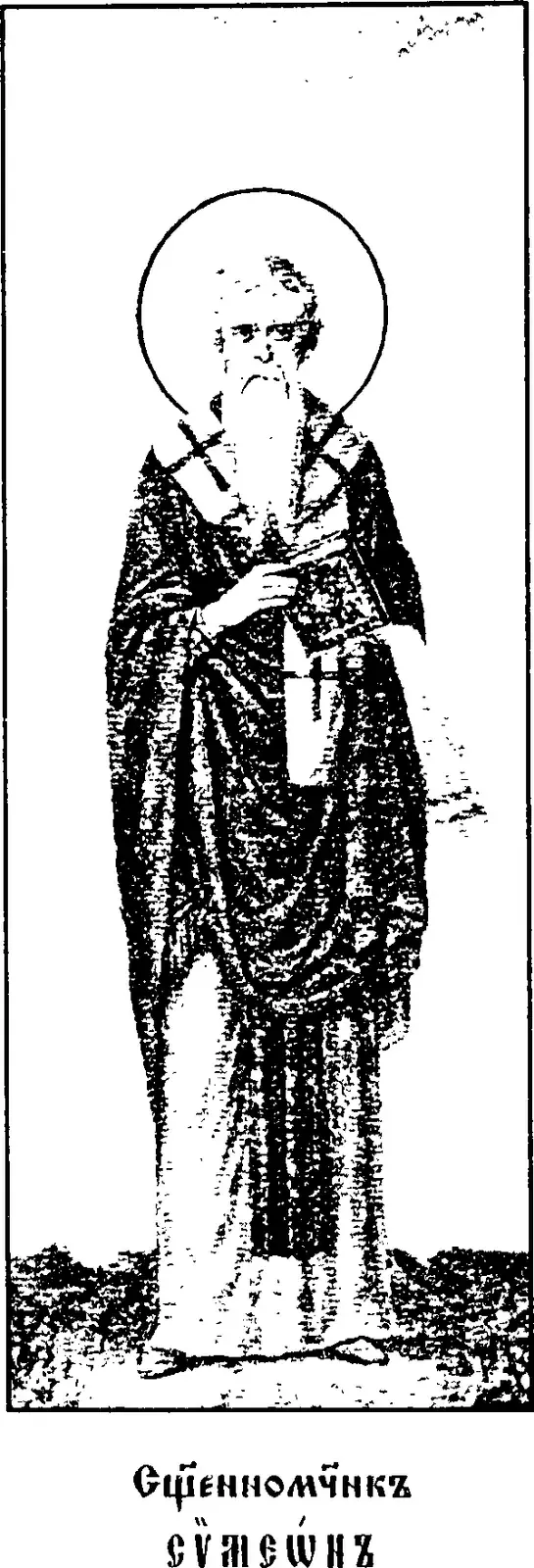
- Also called
- Symeon, in Sozomen 1; Barsaboe, in Butler 2; Simeone bar Sabas, in the current Martyrology 4; Barsabae 3
Saint Simeon Bar Sabbae was the bishop of Seleucia and Ctesiphon, the twin capitals of the Persian kings on the Tigris, and was beheaded on a Good Friday under King Shapur II after refusing to worship the sun. 124 The king had about a hundred of his bishops, priests and clerics killed in front of him first, and Simeon spent their last moments encouraging each of them; then he was executed himself. 14 The Roman Martyrology keeps him on April 17. 4
The son of the fuller
Butler, abridging the Syriac Acts of his martyrdom, says Simeon was "surnamed Barsaboe, signifying the son of a fuller, from the trade of his father, according to the custom of the Orientals." 2 He was born at Susa, the old capital of the Persian kings. 23 He became a disciple of Papa, bishop of Seleucia and Ctesiphon, the two royal cities that faced each other across the Tigris, about thirty kilometers southeast of present-day Baghdad, katolsk.no adds. 23 The bishops of that see held the primacy over the whole Church in Persia, and Butler notes that Simeon is said to have been the first to bear the title Catholicos. 2
How he came to the see is told differently. Butler says Papa made him his coadjutor in 314 and died in 326. 2 The Norwegian bishops' saints database (katolsk.no) gives a stormier story: a council at Seleucia deposed Papa in 315 and consecrated Simeon, his archdeacon, in his place, but Papa recovered from a stroke, won an appeal, and ruled twelve more years with Simeon as his auxiliary, dying in 327 or 328. 3 es.catholic.net dates the appointment to 324. 6 At the Council of Nicaea in 325, Butler says, the see was represented by a priest named Sciadhustes, who later succeeded Simeon; katolsk.no says it was Simeon himself who went. 23
The great persecution
Butler counts three persecutions of Christians in the reign of Shapur II and calls the third, which began in his thirty-first year and lasted until his death, "of all others the most cruel." 2 Sozomen explains why it fell first on Simeon: the Magi, the priestly guardians of the Persian religion, together with the Jews, accused him before the king of being "a friend of the Cæsar of the Romans," and of passing Persian affairs to him. 1
Shapur at first crushed the Christians with taxes. 12 katolsk.no and es.catholic.net say he doubled them, and that Simeon, knowing how poor most of his people were, refused to collect the money. 36 Butler has him write to the king instead: "As Jesus willingly offered himself to death for the whole world, and by dying redeemed it, why shall I be afraid to lay down my life for a people, with the care of whose salvation I am charged?" 2 The king ordered priests and deacons put to death and churches torn down, and had Simeon brought to him in chains. 12
Before the king
The Acts, as Butler gives them, take him under guard through his native Susa, where he asked not to be led past a great church lately turned into a synagogue, for fear the sight would make him faint, and on to Ledan, where the king was staying. 23 There he refused to prostrate himself, as he had always done before. Asked why, he answered, in Sozomen's words: "Formerly I was not led away bound in order that I might abjure the truth of God, and therefore I did not then object to pay the customary respect to royalty; but now it would not be proper for me to do so; for I stand here in defense of godliness and of our opinion." 1
The king offered him gifts and honor if he would worship the sun, and threatened him and all the Christians if he would not. 12 In Butler's version Simeon answered that the sun itself "mourned at the death of Christ its Lord and the Creator of men, who rose again glorious, and ascended into heaven." 2 Shapur sent him back to prison, hoping a night would change his mind. 12
Usthazanes
At the palace gate sat an old eunuch, the king's foster-father and chamberlain, whom Sozomen calls Usthazanes. 12 He was a Christian who had lately worshiped the sun to please the king. 1 When he rose to greet Simeon, the bishop turned his face away. 12 The old man went home, put off his white robe for the black of mourning, and sat at the gate weeping: "Woe is me! What must not await me since I have denied God; and on this account Symeon, formerly my familiar friend, does not think me worthy of being spoken to, but turns away and hastens from me." 1
He told the king he was a Christian and would not worship the sun again, and was condemned to be beheaded. 12 His one request was that a herald announce that he died for no crime but for being a Christian, so that those he had shaken by giving way might be steadied by his death; Shapur granted it, thinking it would frighten the rest. 12 The current Martyrology tells it differently, placing his martyrdom in the palace of Artaxerxes, Shapur's brother, in the province of Adiabene, at the first outbreak of the persecution. 4
Good Friday
When the news reached the prison, Simeon gave thanks. 12 Butler says he spent that night in prayer, asking "that I may drink this cup on this day, and at the hour of your passion. May all know that Simeon was obedient to his Lord and was sacrificed with him." 2 The next day, Sozomen says, was "the sixth day of the week," the day, immediately before the festival of the resurrection, on which "the annual memorial of the passion of the Saviour is celebrated." 1 Brought back before the king, Simeon refused again. "The table is ready prepared for me," Butler has him say, "and the happy hour of my banquet calls me." 2
About a hundred prisoners were led out with him, bishops, priests and clergy of every rank; Butler counts five bishops among them. 12 They were offered their lives once more if they would worship the sun, and none accepted. 12 The king had them executed before Simeon's eyes, and while the sword fell he stood among them, showing them, Sozomen says, "from the sacred Scriptures that a death like theirs is true life; whereas to live, and through fear to deny God, is as truly death." 14 He was killed last. 14 With him died two old priests of his church, Abdechalas and Ananias, according to Sozomen, Butler and the 1897 Martyrology; katolsk.no notes that most sources put their deaths four years later. 1235
As Ananias undressed he began to tremble. 12 Pusices, the overseer of the king's craftsmen, called to him: "O old man, close your eyes for a little while and be of good courage, for you will soon behold the light of Christ." 1 He was arrested on the spot, killed by having his tongue pulled out through a wound in his neck, and his daughter, a consecrated virgin, was put to death after him. 15
After his death
The killing did not stop with him. 1 Sozomen and the 1897 Martyrology describe a wider slaughter across Persia the following year, again on the day of Christ's passion, and among those who died was Simeon's sister Tarbula, a consecrated virgin, who with her servant was tied to stakes and sawn in two. 15 Sozomen gives the number of named martyrs under Shapur as sixteen thousand, and says the rest could not be counted. 1
The date is disputed. Butler and katolsk.no give April 17, 341. 23 katolsk.no reports that the Bollandists placed the martyrdom in 349 and Ruinart in 345. 3 Butler says Maruthas, the bishop he credits with writing the Acts, carried Simeon's relics to his own city, which took the name Martyropolis; katolsk.no places them at Tagrit and adds that some reached the monastery of Liesborn in Germany through Charlemagne. 23
What is Saint Simeon Bar Sabbae the patron saint of?
Saint Simeon Bar Sabbae's feast day
Saint Simeon Bar Sabbae's feast day is April 17. 34 The current Roman Martyrology, as the Italian bishops print it, commemorates on that day the passion of the bishop of Seleucia and Ctesiphon, imprisoned with more than a hundred clergy and beheaded on Good Friday after all of them. 4 It joins to him the many martyrs who died across Persia afterward, Usthazanes among them. 46
Older editions kept him on April 21. 35 The 1897 Martyrology says there that he was "first macerated a long time in a dungeon with one hundred other confessors," and Butler writes that the Roman Martyrology named him on the 21st while the Greek Menaea kept the 17th and the menology of the Emperor Basil the 14th. 25 katolsk.no says the Syrian churches keep April 14, the Melkites April 30, and the Assyrian Church of the East August 17. 3
Praying with Saint Simeon Bar Sabbae
Simeon's last act as a bishop was to stand among his own clergy while they were killed, one by one, and speak to each of them. 14 The king meant the sight to break him, katolsk.no says. 3 The sources remember him instead talking to his men about death and resurrection until his own turn came. 12
The story of Usthazanes sits in the middle of his. Simeon's silence toward an old friend who had given way seems hard, and in the Acts it is what brings the man back. 12 Usthazanes asked only that people be told why he died, so that his fall would not be the last thing they remembered of him. 1
The night before he died, Simeon asked to die on the day and at the hour of Christ's passion, and Sozomen records that he died on Good Friday. 12 Pusices, a craftsman's overseer with no part in the trial, gave his life for a sentence of encouragement to a trembling old priest. 1
Saint Simeon Bar Sabbae, pray for us.
Sources
- 1.Sozomen, Ecclesiastical History, Book II, chapters 9-12 and 14, trans. Chester D. Hartranft, Nicene and Post-Nicene Fathers, Second Series, Vol. 2 (Buffalo, NY: Christian Literature Publishing Co., 1890), via New Advent.
- 2.Alban Butler, "St. Simeon, Bishop of Ctesiphon, and His Companions, Martyrs," April 17, in The Lives of the Fathers, Martyrs, and Other Principal Saints, Vol. IV (Dublin: James Duffy, 1866), Internet Archive.
- 3."Den hellige Simeon Barsabae av Selevkia-Ktesifon (d. 341)," Den katolske kirke (katolsk.no), Catholic Diocese of Oslo (in Norwegian).
- 4.Roman Martyrology, entries for April 17, "San Simeone bar Sabas, vescovo," Santo del giorno, Conferenza Episcopale Italiana (in Italian).
- 5.The Roman Martyrology, April 21 and 22 (Baltimore: John Murphy Company, 1897), Internet Archive.
- 6."Simeón Bar Sabas, Ustazades y compañeros, Santos," Santoral, Catholic.net, from santiebeati.it (in Spanish).
Saints to turn to next
Others in this collection who are turned to for some of the same things.