Saint Silverius
Birth unknown - c. 537
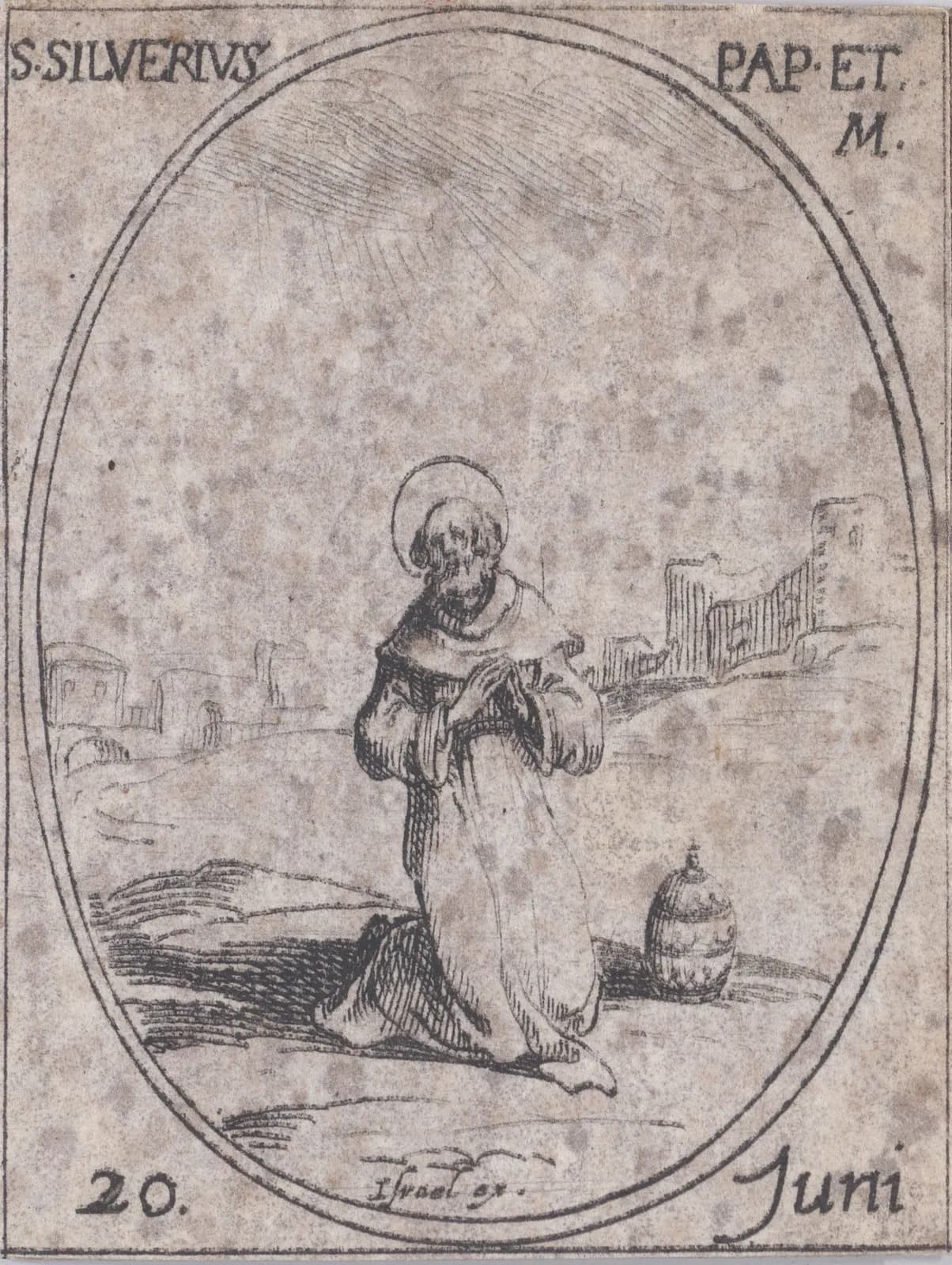
- Pope
- From June 536 to March 537; consecrated probably on June 8, 536 1
Saint Silverius was a subdeacon of Rome, the son of a pope, who was made bishop of Rome in 536 under pressure from the Gothic king of Italy and deposed the next year by the Byzantine general who had taken the city. 12 Accused with a forged letter of plotting to open the gates to the Goths, he was stripped of his vestments, dressed as a monk and sent into exile, and he died a prisoner on a small island off the Italian coast. 123 The Church keeps him as a pope and martyr. 3
A subdeacon elected pope
Silverius was the son of Pope Hormisdas, who had been married before he became one of the higher clergy. 1 katolsk.no, the saints database of the Catholic Diocese of Oslo, says he was born at Frosinone in Campania. 2 Nothing is known of the year. 1 He entered the service of the Roman Church and was a subdeacon when Pope Agapetus died at Constantinople on April 22, 536. 1
Two powers wanted to choose the next pope. The Empress Theodora, who favored the Monophysites, hoped to see the Roman deacon Vigilius elected; he was then at Constantinople as the pope's representative, and Johann Peter Kirsch, in the 1912 Catholic Encyclopedia, says he had given her the guarantees she wanted. 14 Theodahad, the Ostrogothic king of Italy, wanted no pope tied to Constantinople, and he moved first. 1 By his influence the subdeacon Silverius was chosen. 1 katolsk.no puts it more bluntly: the king forced the clergy to elect him. 2
It was, Kirsch says, "unusual" to elect a subdeacon bishop of Rome, and many of the clergy opposed it. 1 Theodahad suppressed the opposition, and after Silverius was consecrated, probably on June 8, 536, all the Roman presbyters gave their consent to his election in writing. 1 katolsk.no says they did so for the sake of the Church's unity. 2 One source, katolsk.no notes, suggests the king had been bribed. 2 Kirsch knows the charge from the first part of the Life of Silverius in the Liber Pontificalis, which says Silverius paid for the king's support; he calls the assertion "unwarranted" and puts it down to that writer's hostility to the pope and to the Goths. 1 The second part of the same Life, he adds, is favorable to him. 1
Between the empress and the Goths
Theodora now tried to win the new pope over. She wanted him in communion with Anthimus, the Monophysite patriarch of Constantinople whom Agapetus had excommunicated and deposed. 12 Silverius committed himself to nothing, and the empress resolved to remove him and give the see to Vigilius. 1 Vigilius hurried back to Rome, katolsk.no says, only to find Silverius already installed. 2
Italy was at war. The Byzantine general Belisarius took Rome in December 536, and Kirsch says the pope received him "in a friendly and courteous manner." 1 katolsk.no adds that Silverius, seeing that resistance was useless, had advised the city to surrender, and that the imperial army entered on December 10. 2 The Goths then deposed Theodahad, made Vitiges their king, and laid siege to Rome; the churches over the catacombs outside the walls were wrecked and the graves of the martyrs broken open. 12
Theodora turned to Belisarius. 1 katolsk.no says he summoned Silverius to his headquarters on the Pincian Hill and demanded that he restore Anthimus and give way on the Monophysite question, and that the pope refused. 2 The Roman Martyrology, which the Italian bishops print, gives the same reason for everything that followed: he would not restore Anthimus. 3
The forged letter and the exile
Belisarius's wife Antonina, Kirsch says, persuaded her husband to act as the empress wished. 1 A forged letter was produced in which the pope was said to have offered to leave one of the city gates secretly open for the Goths. 1 katolsk.no observes that the truth was nearly the reverse: he had joined the Senate in urging the Romans to surrender to the imperial army without a fight, hoping to spare the city a massacre. 2
In March 537 he was arrested. 1 Kirsch says he was "roughly stripped of his episcopal dress, given the clothing of a monk and carried off to exile in the East." 1 katolsk.no dates the banishment to March 11 and says a subdeacon announced to the clergy that Silverius was no longer pope. 2 Under pressure from Belisarius, Vigilius was made pope in his place: elected on March 29, says katolsk.no, and consecrated and enthroned that day, says Kirsch. 24 In his article on Vigilius, Kirsch says the new pope is said to have been promised the papacy and a large sum of money by Theodora, and that, whatever exaggeration the charges contain, "the manner of his elevation to the See of Rome was not regular." 4
Silverius was taken to Patara in Lycia, on the southwest coast of what is now Turkey. 12 Its bishop soon became convinced that the exile was innocent, traveled to Constantinople, and laid the proofs before the Emperor Justinian. 1 katolsk.no records his argument: there were many kings in the world, but only one pope. 2 Justinian ordered a new inquiry. If the letter proved to be forged, Silverius was to be restored; and he was allowed to return to Italy. 12
Death on the island
He never reached his see. Vigilius arranged to have his predecessor handed over to him, acting, Kirsch says, in agreement with Theodora and with the help of Antonina. 14 Silverius was taken to a small island in the Tyrrhenian Sea and kept in close confinement. 1 Kirsch names the island as Palmaria; a note added to his article by the New Advent editor says the Liber Pontificalis points instead to Palmarola, a much smaller island near Ponza. 1 katolsk.no and Vatican News also name Palmarola. 25 The Italian text of the Martyrology names Palmarola too, but places it in Liguria, which is where Palmaria lies. 3 katolsk.no says his abdication seems to have been forced from him there on November 11, 537. 2
He died of the hunger and harsh treatment he suffered. 123 Kirsch says the year is unknown but that he probably did not live long on the island; katolsk.no gives the likely date as December 2, 537. 12 He was buried on the island, and his remains were never moved. 1 The Liber Pontificalis, Kirsch reports, says believers who visited his grave called on him, and katolsk.no says the grave soon became a place of healings. 12 The earliest written proof of his cult that Kirsch knows is a list of saints from the eleventh century, and katolsk.no says it was from then that he was honored as a martyr for the orthodox faith. 12
What is Saint Silverius the patron saint of?
Vatican News calls Saint Silverius the patron of Palmarola, the island where he died. 5 The Catholic Review, the newspaper of the Archdiocese of Baltimore, calls him the patron saint of Ponza, the larger island near Palmarola, and says that it was to Ponza that he was exiled. 16 Neither source names a wider patronage.
Saint Silverius's feast day
Saint Silverius's feast day is December 2 in the current Roman Martyrology, which enters on that day the death of "san Silverio, papa e martire." 3 The older date is June 20. Kirsch, writing in 1912, says the Roman Martyrology of his time recorded the feast on June 20, the day the Liber Pontificalis gives for his burial, and katolsk.no says that date stood in the Roman calendar until 1969. 12 Vatican News lists him on December 2. 5
Praying with Saint Silverius
Nobody chose Silverius for his sanctity. He was a junior cleric whom a Gothic king found convenient, and he came to office under suspicion of having bought it. 12 The sources agree that what he did with the office, under pressure from an empress and an army, was to refuse. 123
His refusal cost him everything that could be taken. He lost his see, his vestments and his freedom, and a successor installed by force took his place and then took charge of him as a prisoner. 14 When an emperor ordered his case reopened, the order did not save him. 1
He has no recorded words. What survives is a bishop of Patara crossing the sea to argue for a stranger he believed innocent, and the people who came to an island grave to pray. 12 The Church remembers him on the day he died there. 3
Saint Silverius, pray for us.
Sources
- 1.Johann Peter Kirsch, "Pope St. Silverius," The Catholic Encyclopedia, Vol. 13 (New York: Robert Appleton Company, 1912), with the New Advent editor's note.
- 2."Den hellige pave Sylverius ( - 537)," Den katolske kirke (katolsk.no), Catholic Diocese of Oslo (in Norwegian).
- 3.Roman Martyrology, entry for December 2, "Transito di san Silverio, papa e martire," as printed in "Santo del giorno," Conferenza Episcopale Italiana (in Italian).
- 4.Johann Peter Kirsch, "Pope Vigilius," The Catholic Encyclopedia, Vol. 15 (New York: Robert Appleton Company, 1912).
- 5."s. Silverio, papa," Santo del día, 2 de diciembre, Vatican News (in Spanish).
- 6."St. Silverio," Catholic Review, Archdiocese of Baltimore, January 19, 2012.
Saints to turn to next
Others in this collection who are turned to for some of the same things.