Saints Sergius and Bacchus
Martyred c. 303
- Shrine
- Resafa (Rhesapha, Rosafa), on the Syrian frontier near the Euphrates, a bishopric from shortly after 431 235
- In art
- Soldiers in military dress, with palm branches in their hands 1
- Patrons of
- The desert nomads, says katolsk.no, regarded Sergius as their special patron 4
Saints Sergius and Bacchus were officers in the Roman army on the Syrian frontier who were put to death for their faith under the emperor Maximian, about the year 303. 16 Bacchus died under the lash and Sergius was beheaded, and his tomb at Resafa, near the Euphrates, drew so many pilgrims that the town took his name: Sergiopolis. 126 Their feast is October 7. 5
Two officers on the frontier
The 1912 Catholic Encyclopedia gives their rank exactly. "They were officers of troops on the frontier, Sergius being primicerius, and Bacchus secundarius." 1 The 1897 English edition of the Roman Martyrology calls them "noble Romans," and Alban Butler's Lives of the Saints "illustrious officers in the army." 36
Everything else about their arrest comes from the account of their martyrdom, and the encyclopedia introduces it with a warning: "According to the legend, there were high in esteem of the Caesar Maximianus on account of their bravery, but this favour was turned into hate when they acknowledged their Christian faith." 1
The Norwegian bishops' saints database, katolsk.no, tells a scene from the same tradition. Once, it says, they refused to go into a temple of Jupiter with Maximus; ordered to come in, they obeyed, but when they were ordered to sacrifice to Jupiter they refused again, and that settled their fate. 4 They were first humiliated by being dressed in women's clothing and led through the streets of Arabissus, and then sent to Resafa, in Syria. 4
The lash, the nailed shoes and the sword
The 1897 Martyrology tells their deaths in two sentences each. "Bacchus being scourged with rough sinews until his body was all mangled, breathed his last in the confession of Christ. Sergius had his feet put in shoes full of nails, and, as he persevered in the faith, was sentenced to undergo capital punishment." 6
The encyclopedia gives the same story and repeats that it is the legend's. Bacchus died of the beating, while Sergius "had much more suffering to endure; among other tortures, as the legend relates, he had to run eighteen miles in shoes which were covered on the soles with sharp-pointed nails that pierced through the foot. He was finally beheaded." 1 katolsk.no adds an interval: Bacchus died of the scourging at Resafa, and a week later Sergius was tortured again and then beheaded. 4
The encyclopedia dates the martyrdom to the persecution of Diocletian, "about 303." 1 katolsk.no also gives about 303, with 305 as a possibility. 4
What is certain, and what is legend
None of the sources treats the torments as history, and none doubts the martyrdom. The encyclopedia says plainly that "their martyrdom is well authenticated by the earliest martyrologies and by the early veneration paid them, as well as by such historians as Theodoret." 1 Butler, who knew the same evidence, lists the ancient writers who honored them: Theodoret, John Moschus in the Spiritual Meadow, Evagrius, Saint Gregory of Tours, Bede "and other ancient Martyrologists." 3
Butler is just as plain about what is missing. Their church in Rome has been famous since the seventh century, he writes, "nevertheless no authentic acts of their martyrdom have reached us." 3 The page follows both of them: the rank, the deaths and the shrine as the sources state them, and the nailed shoes as a story the Church has long told.
Resafa, which became Sergiopolis
Siméon Vailhé's article on Sergiopolis, in the same encyclopedia, describes the town before the martyrs made it famous. Its old name, Rhesapha, means a causeway or paved road in Arabic; a Roman milestone calls it Strata Diocletiana; and when Sergius died there it held a Roman fortress. 2 It is commonly identified, Vailhé adds, with the Reseph named in the Second Book of Kings and in Isaiah. 2 The current Roman Martyrology places the martyrs "in the region of Rusafah in Syria near the river Euphrates." 5
Butler says that their tomb there "was famous for miracles in the year 431," when Alexander, bishop of Hierapolis, built "a stately church in their honour." 3 Vailhé tells the same year from the other side: shortly after 431 John of Antioch gave the town a bishop of its own, over the protests of the metropolitan of Hierapolis, who said he had spent three hundred pounds of gold on its church. 2
The sources disagree about who raised the town highest. Butler says Justinian, out of respect for the relics, fortified it, called it Sergiopolis, and made it the metropolis of the province. 3 Vailhé gives the metropolitan title to the emperor Anastasius I (491-518), whose favors also earned the town the name Anastasiopolis, and credits Justinian with its walls. 2 By the sixth century, Vailhé says, the metropolitan of Sergiopolis had five suffragan sees. 2
Vailhé also records one of its bishops in a hard year. When the Persian king Chosroes besieged the town in 543, Bishop Candidus ransomed twelve hundred captives for two hundred pounds of gold. 2 A metropolitan named Simeon is recorded there as late as 1093, which proves, Vailhé writes, "that Christianity continued to exist even under Mussulman domination." 2 In 1912 its walls still stood, more than sixteen hundred feet long and about a thousand wide, with the ruins of a church with three apses inside them. 2
Churches from Constantinople to Rome
The place where Sergius rests, says the 1897 Martyrology, "on account of the signal miracles wrought in it, is honored by a great concourse of Christians." 6 katolsk.no calls it one of the greatest places of pilgrimage in the East, and says many churches were dedicated to Sergius, sometimes together with Bacchus. 4 "In the East, Sergius and Bacchus were universally honoured," says the encyclopedia. 1
Justinian built churches in honor of Sergius at Constantinople and at Acre, according to the encyclopedia, and the one at Constantinople, "now a mosque, is a great work of Byzantine art." 1 Butler says the emperor built many churches in their honor across the provinces of the East. 3
In Rome they have had a church since the seventh century. 134 Butler names two more Roman churches under their title in his day, one of which, belonging to the Russian college, held a portion of their relics "brought from Syria in the croisades," and he says the cathedral of Saint Vitus at Prague received relics of them from the emperor Charles IV in 1354. 3
Two soldiers on horseback: how they are painted
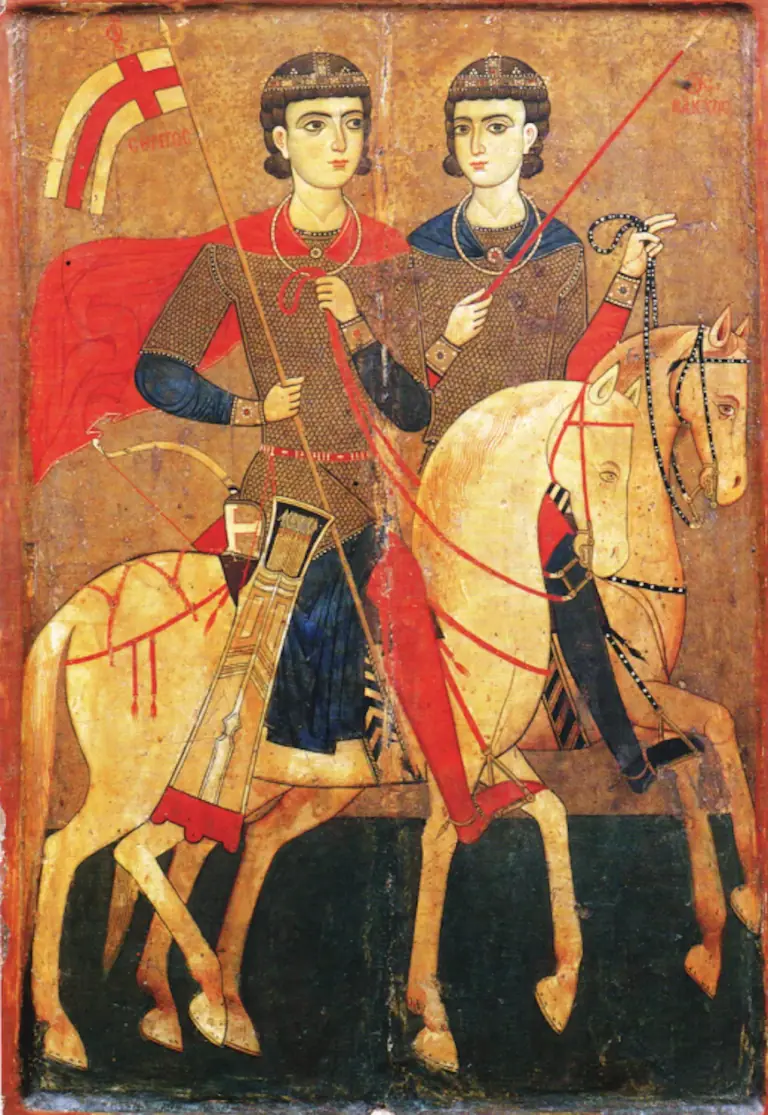
The encyclopedia says that "Christian art represents the two saints as soldiers in military garb with branches of palm in their hands." 1 The icon on this page, painted in the thirteenth century and kept at Saint Catherine's Monastery on Mount Sinai, shows them as soldiers without the palms. They ride side by side in mail shirts and jeweled caps, Sergius in front with a cross on his pennon and Bacchus behind him with a red lance, and the Greek letters beside each head give their names.
What are Saints Sergius and Bacchus the patron saints of?
Saints Sergius and Bacchus's feast day
The feast of Saints Sergius and Bacchus is October 7. The current Roman Martyrology, as the Italian bishops print it, commemorates them on that day, and Vatican News lists them there as martyrs of Syria. 57 The 1897 Martyrology, both encyclopedia articles, Butler and katolsk.no give the same date. 12346 In today's calendar October 7 is the memorial of Our Lady of the Rosary, and the two martyrs are among the other saints the Martyrology names for the day. 5
The same day has always carried two other martyrs, Marcellus and Apuleius, whom the 1897 Martyrology places at Rome and the encyclopedia says were converted by the miracles of Saint Peter. 16 katolsk.no reports another version in which Sergius and Bacchus suffered together with them, but the encyclopedia and the Martyrology keep the two pairs apart. 146
Praying with Saints Sergius and Bacchus
They were soldiers who had done well in the army, and the encyclopedia says their standing turned to hatred when they confessed the faith. 1 Everything they had earned was taken from them at once. In the scene katolsk.no tells, they went as far as the temple door when ordered to and stopped at the sacrifice. 4
The sources do not let their deaths be tidy. Bacchus died first, under the lash, and Sergius went on alone, by katolsk.no's account for a week more, through a torment the Martyrology describes in a single line. 46
What followed was a city. A frontier fort became a place where bishops ransomed captives and pilgrims came from across the East, and it took the martyr's name. 26 The encyclopedia rests the certainty of their martyrdom on exactly that: the early martyrologies, and the honor paid them from the start. 13
Saints Sergius and Bacchus, pray for us.
Sources
- 1.Klemens Löffler, "Sergius and Bacchus," The Catholic Encyclopedia, Vol. 13 (New York: Robert Appleton Company, 1912).
- 2.Siméon Vailhé, "Sergiopolis," The Catholic Encyclopedia, Vol. 13 (New York: Robert Appleton Company, 1912).
- 3.Alban Butler, "SS. Sergius and Bacchus, MM.," October 7, in The Lives of the Fathers, Martyrs, and Other Principal Saints, Vol. X (Derby: Richardson and Son, 1842), Internet Archive.
- 4."De hellige Sergius og Bacchus," Den katolske kirke, the saints database of the Catholic Church in Norway, katolsk.no (in Norwegian).
- 5.Roman Martyrology, entry for October 7, "Santi Sergio e Bacco, martiri," Santo del giorno, Conferenza Episcopale Italiana (in Italian).
- 6.The Roman Martyrology, October 7 (Baltimore: John Murphy Company, 1897), Internet Archive.
- 7."Ss. Sergio y Baco, mártires de Siria," Santo del día, 7 de octubre, Vatican News (Dicastery for Communication) (in Spanish).
Saints to turn to next
Others in this collection who are turned to for some of the same things.