Saint Sabas
439 - December 5, 532
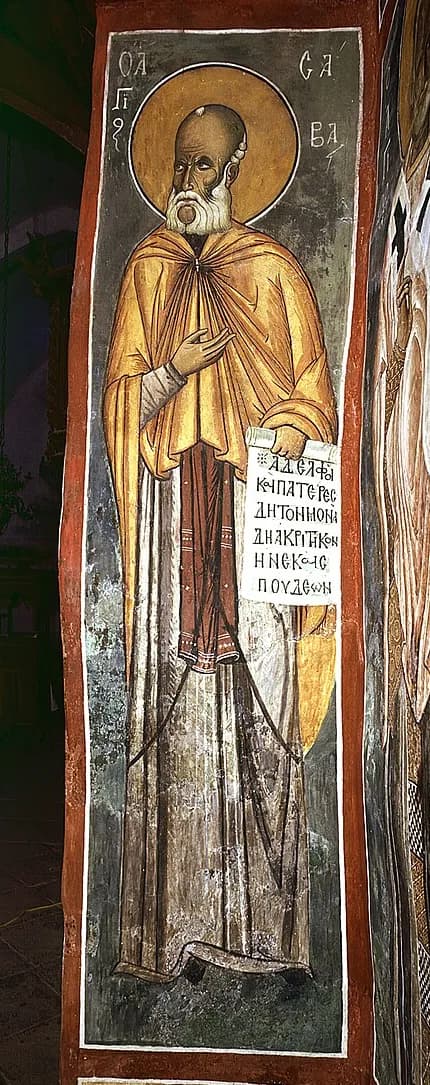
- Ordained priest
- 491, by Patriarch Salustius of Jerusalem 1
- Journeys to Constantinople
- To Emperor Anastasius in 511 and to Justinian in 531 1
Saint Sabas was a Cappadocian monk who came to the desert outside Jerusalem as a young man and in 483 founded a colony of hermits in the gorge of the Cedron that still stands and still carries his name, Mar Saba. 13 He wanted to live alone in a cave, and he spent decades instead governing other men who wanted the same thing, some of whom rebelled against him. 23 He died on December 5, 532, and that day is his feast. 15
A child in a Cappadocian monastery
He was born in 439 at Mutalaska, near Caesarea in Cappadocia. 12 Alban Butler, who follows the Life written by the monk Cyril of Scythopolis in the sixth century, names his parents as John and Sophia and says his father was an army officer who was posted to Alexandria and took his wife with him, leaving the boy and the family estate with an uncle. 2 The uncle's wife treated the child harshly. After three years he went to another uncle, and the two men fell into lawsuits over who should manage the estate. 2 Franciscan Media says he "was abused and ran away several times." 3
He ended up in a monastery three miles from home, which Butler calls Flavinia and Catholic Culture the monastery of Saint Flavian. 24 The encyclopedia and Catholic Culture both say he was eight. 14 His uncles later tried to bring him out, offering him his property and a marriage, and he would not go. 23
One story from these years gave him his emblem. Working in the garden, he picked an apple to eat outside the proper time, decided it was a temptation, trod it into the ground, and vowed never to eat an apple again. 24 Catholic Culture notes that he is pictured as an abbot with one. 4
Jerusalem and Saint Euthymius
The encyclopedia dates his arrival in Jerusalem to 456. 1 Butler and Franciscan Media say he was eighteen, and Butler adds that he went with his abbot's leave to see the holy places and the solitaries who lived near them. 23 He spent a winter in the monastery of Passarion, where the monks wanted to keep him, and then went to Saint Euthymius, whose solitary way of life he preferred, and begged with tears to be taken as a disciple. 2
Euthymius thought him too young for a laura, which Butler describes as "a cluster of separate cells or hermitages in a desert," and sent him to a monastery about three miles off that served as a kind of novitiate for it. 2 There he worked all day, carried the wood and water, nursed the sick, and prayed a good part of the night. 23
At thirty he was allowed to spend five days of each week alone in a cave. Butler says he left on Sunday evening with a bundle of palm twigs and returned on Saturday morning with fifty baskets, ten for each day. 2 The encyclopedia says he lived five years in a cavern as a disciple of Euthymius. 1
The laura in the gorge
After Euthymius died, Butler says, discipline in the monastery slackened, and Sabas left for the desert farther east. 2 Four years later he settled in a cave high above the brook Cedron. He reached it by a rope he had hung down the rock face, ate the wild herbs that grew there, and walked five miles for water. Local people who noticed the rope began bringing him bread, cheese and dates. 23
He had five years of that. Then men started asking to live under his direction, and after refusing at first he gave way. 23 The encyclopedia dates the foundation to 483 and places it in the gorges of the Cedron southeast of Jerusalem. 1 Butler says it began with seventy men and soon had a hundred and fifty, each shown where to build his cell, with a small chapel in their midst. 2 The Roman Martyrology credits him with a new form of the hermit life, in which solitaries gathered under a single superior, and counts seven monasteries of his. 5
His mother, once widowed, came to live under his direction, and with the money she brought he built a guesthouse for strangers, another for the sick, and a hospital at Jericho. 2
A superior some of his monks did not want
He was not a priest and did not think a monk should aspire to be one. A faction among his monks complained of him to the patriarch of Jerusalem. 2 The encyclopedia says they "opposed his rule and demanded a priest as their abbot," and that Patriarch Salustius answered in 491 by ordaining Sabas himself. 1 Butler says he was fifty-three. 2
The same patriarch put him over all the hermits of Palestine, and Saint Theodosius over the monks who lived in community. 2 The encyclopedia gives the year as 494. Butler, a few lines later, says the patriarch died in 493. 12 Every year after the Epiphany, Sabas disappeared into the desert until the end of Lent, which Franciscan Media says distressed his monks. 23
The complaints did not stop, and Sabas did something unusual for a founder. He left. Butler gives his reasoning: "we must resist the devils, but yield to men for the sake of peace." 2 In a cave near Scythopolis, in Butler's telling, he found he was sharing quarters with a lion, which tugged at his clothes while he recited the night psalms and went away for good when he told it there was room for both of them. 2 Disciples gathered around him there too, and again near Nicopolis. 2
A new patriarch, Elias, ordered him back to his laura. According to Butler and Franciscan Media the rebels then walked out, sixty of them, and settled in some ruined cells, where Sabas sent them money and helped build their church until they came around. 23 The encyclopedia tells it the other way: the opposition continued, and Sabas "withdrew to the new laura which he had built near Thekoa." 1
Two emperors
The encyclopedia calls him a strenuous opponent of the Monophysites and the Origenists, and says he went in person to Emperor Anastasius in 511 and to Justinian in 531. 1 The Martyrology remembers him for defending the faith of the Council of Chalcedon. 5
Butler says he was seventy on the first journey and so shabbily dressed that the palace guards let the other abbots in and kept him out. He stood in a corner reciting psalms until he was sent for. Invited to request something for himself, he asked only that the emperor "restore peace to the church and not disturb the clergy." 2 He stayed the winter, and Butler says it was at his repeated entreaties that the emperor spared Patriarch Elias. 2
He was about ninety when the patriarch Peter sent him to Justinian on behalf of the Christians of Palestine after a Samaritan revolt and its repression. 23 He declined a revenue for his monasteries, and asked for tax relief for the province, a hospital for pilgrims in Jerusalem and a fort to protect the monks from raiders. All of it was granted. 2 When the hour for prayer came in the middle of the council, he walked out to say it. A companion objected. "My son," Sabas answered, "the emperor does his duty, and we must do ours." 2
Death and the monastery after him
He fell ill soon after getting home. The patriarch had him carried to a nearby church and nursed him with his own hands, but Sabas asked to be taken back to his laura, named his successor, and spent his last four days in silence. 2 He died on the evening of December 5, 532. 12 Butler makes him ninety-four. 2
A book of rules for worship through the year, the Typicon of Saint Sabas, and a monastic rule both carry his name, and the encyclopedia calls his authorship of each doubtful. 1 Catholic Culture says that when the Arabs took Jerusalem, monks of his fled to Rome and brought his veneration with them, and the encyclopedia notes that the Basilica of Saint Sabas on the Aventine is named for him. 14 His laura was restored in 1840, and Orthodox monks live in it today. 13
What is Saint Sabas the patron saint of?
None of the sources consulted for this page names Saint Sabas as the patron of any group, place or cause, and the page does not supply one. 1234 Catholic Culture lists the titles the Eastern Church gives him: "God-bearer, the Saint, Citizen of the Holy City, Star of the Desert, Patriarch of Monks." 4
Saint Sabas's feast day
Saint Sabas's feast is December 5, the day he died. The Catholic Encyclopedia states it, the current Roman Martyrology enters him on that day, and Vatican News lists "St. Sabas, Abbott" on its calendar for December 5. 156 Butler notes that he is commemorated on that day "both in the Greek and Latin Calendars." 2
Praying with Saint Sabas
The thing Sabas wanted is easy to state. He wanted a cave, a week's worth of palm twigs and nobody to talk to, and for a few years at a time he had it. 2 Each time, people found him. The men who saw his rope brought bread, then others asked to stay, and the hermit became the head of a hundred and fifty. 23
Franciscan Media draws the plain lesson that he is a model of "patient generosity" for anyone whose time is claimed by others. 3 The sources also show how reluctant he was. He refused the first disciples. He refused the priesthood until a bishop compelled him. He kept vanishing every Lent, and when his monks turned on him he walked away from his own foundation more than once. 23
What he did not do was fight for his position or write off the men who opposed him. He sent the rebels gold and a church. 23 In front of two emperors he asked for nothing for himself and a good deal for other people, and he left an imperial council in mid-session because it was time to pray. 2 Catholic Culture sums him up as an anchorite "who dedicated his life to prayer and manual labor." 4
Saint Sabas, pray for us.
Sources
- 1.Michael Ott, "St. Sabbas," The Catholic Encyclopedia, vol. 13 (New York: Robert Appleton Company, 1912).
- 2.Alban Butler, "St. Sabas, Abbot," from The Lives of the Fathers, Martyrs and Other Principal Saints, vol. III, EWTN Library.
- 3."Saint Sabas," Saint of the Day for December 5, Franciscan Media.
- 4."St. Sabbas," Liturgical Year calendar for December 5, Catholic Culture.
- 5."San Saba, abate," Santo del giorno, 5 dicembre (Roman Martyrology entry, in Italian), Conferenza Episcopale Italiana.
- 6."St. Sabas, Abbott," Saint of the Day, 05 December, Vatican News.
Saints to turn to next
Others in this collection who are turned to for some of the same things.
- Saint Agnes of Montepulcianoc. 1268 - April 1317PrayerWork and vocationDiscernment
- Saint Andrew Avellino1521 - November 10, 1608DiscernmentWork and vocationPrayer
- Saint Benedict of Anianec. 750 - February 11, 821DiscernmentPrayerWork and vocation
- Saint Benedict of Nursiac. 480 - March 21, 547PrayerWork and vocationDiscernment