Saint Romanus of Antioch
Died 303 or 304
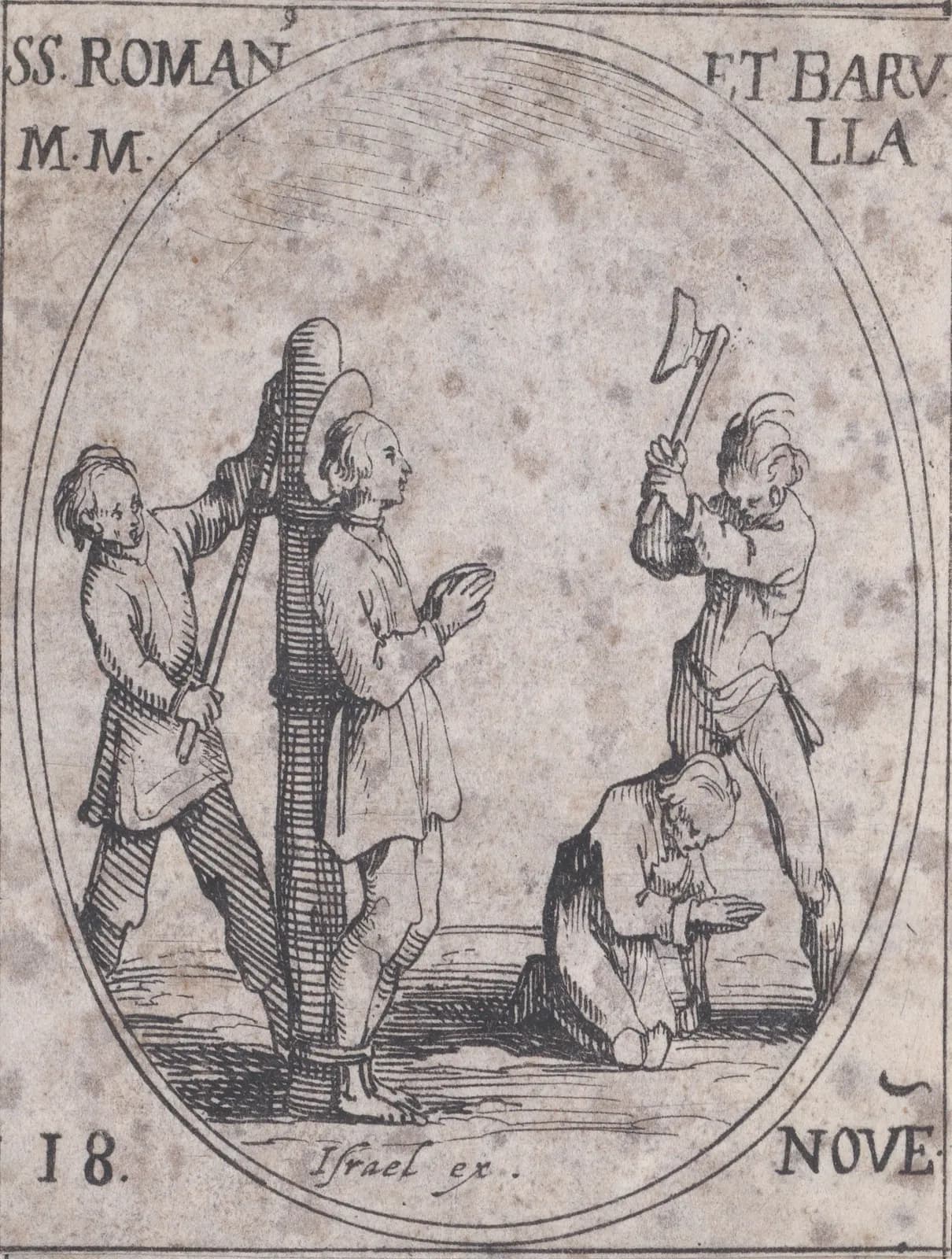
Saint Romanus was a deacon and exorcist of the church of Caesarea in Palestine, martyred at Antioch at the start of the Diocletian persecution. 25 Eusebius, who lived through that persecution, records that he publicly rebuked Christians lining up to sacrifice, was condemned to the fire, had his tongue cut out, and was strangled in prison. 2 The poet Prudentius gave him a long hymn and a child martyr at his side, and the Church keeps his feast on November 18. 14
A deacon at Antioch
Eusebius of Caesarea opens his book on the martyrs of Palestine with the first edict of Diocletian, in the spring of the nineteenth year of his reign, ordering churches leveled and the Scriptures burned. 2 Romanus, he says, "was a native of Palestine, a deacon and exorcist in the parish of Caesarea." 2 He died far from home, at Antioch, and Eusebius counts him among the Palestinian martyrs all the same, "as he was a native of Palestine." 2
Eusebius did not see what happened at Antioch. William Cureton, who translated the longer Syriac version of the book in 1861, points out that Eusebius was living at Caesarea when Romanus died and was evidently eager to claim the deacon for his own country. 3 Cureton adds that there are separate accounts of Romanus in Syriac, Greek and Latin. 3
Where is the fire for me?
In the Greek text, Romanus was present when the churches were being destroyed and saw "many men, with women and children, going up in crowds to the idols and sacrificing." 2 He "could not endure the sight, and rebuked them with a loud voice." 2 The Syriac gives his words. He went in with the crowd before the judge and cried out, "Whither are ye being carried, oh men? Are ye all stooping down to cast yourselves into the abyss?" 3 The current Roman Martyrology tells it the same way: seeing Christians obey the decrees and hurry to the shrines of the idols, he urged them aloud to stand firm. 1
He was arrested and sentenced to be burned, and Eusebius says he took the sentence "with cheerful countenance and most ready mind." 2 Tied to the stake with the wood heaped around him, while the executioners waited for the emperor before lighting it, he called out, "Where is the fire for me?" 2 He was taken back before the emperor and sentenced instead to have his tongue cut out. 2 The Syriac says it was Diocletian who stopped the fire, because the martyr's "insolence and folly were not suitable for punishment by fire." 3 Kirsch, in the Catholic Encyclopedia, names the emperor present at Antioch as Galerius. 5
Eusebius stresses that Romanus "put out his tongue readily, and offered it with the greatest alacrity to those who cut it off." 2 The Syriac goes further: after his tongue was taken, he "forthwith, by the gift of God spake out valiantly," greeting his friends and exhorting everyone to worship God alone. 3 Cureton notes that the Greek leaves this miracle out, though other accounts repeat it. 3
Prison and death
The Greek text says he was thrown into prison and "suffered there for a very long time." 2 When the emperor's twentieth anniversary came near and prisoners everywhere were being released by custom, Romanus "alone had both his feet stretched over five holes in the stocks, and while he lay there was strangled, and was thus honored with martyrdom, as he desired." 2 The Syriac has him stretched on the rack again and strangled. 3 The current Martyrology says he was strangled in prison with a noose. 1 Kirsch dates his death to 303 or 304. 5
Prudentius and the child
The Latin poet Prudentius gave Romanus a hymn of more than eleven hundred lines in his Crowns of the Martyrs. 4 In his version Romanus is a man of old noble family, and when the prefect Asclepiades marches on the church in the time of Galerius, Romanus runs ahead to warn the people and stiffen them to resist. 4 The prefect spares him the rack because of his rank and has him beaten with leaded whips instead, and Romanus answers that the only nobility worth having is to be born of God. 4 The 1897 Martyrology follows Prudentius here, with Asclepiades breaking into the churches and Romanus exhorting the Christians to stand. 6
Prudentius then adds an episode Eusebius does not have. 45 Romanus asks the prefect to let a child of seven or younger judge between Christ and the gods, and a small boy, not long weaned, is taken from the crowd. 4 Asked whether to worship one Christ or a thousand gods, the boy smiles and says God must be one, and Christ is that God; asked who taught him, he says his mother. 4 The prefect has him whipped until he bleeds. 4 When he cries out that he is thirsty, his mother tells him he will soon drink from the living spring, and reminds him of the infants of Bethlehem, of Isaac, and of the mother of the seven Maccabees. 4 He is sentenced to the sword. His mother carries him to the place, kisses him once, asks him to remember her in heaven, and sings a verse of the psalm, "Precious in the sight of the Lord," as she catches his blood in her cloak. 4
Prudentius does not name the boy, as his nineteenth-century editor notes. 4 The older Roman Martyrology calls him Barula, a small boy who "was scourged and beheaded" before Romanus. 6 Kirsch calls him Barulas, and judges that Prudentius "has introduced legendary features into his account" and that his joining of the two martyrdoms "is probably arbitrary." 5 The current Martyrology names Romanus alone. 1
The rest of the hymn returns to Romanus. A sudden downpour puts out his pyre; a surgeon named Aristo cuts out his tongue, and when Romanus keeps on speaking, Aristo protests to the prefect that he did his work honestly and cannot explain how a mute man has become eloquent. 4 Romanus tells his judge that Christians would live without bloodshed if they were let alone, and conquer if they were put to death; then he is dragged back to his cell and strangled. 4
What is Saint Romanus of Antioch the patron saint of?
Saint Romanus of Antioch's feast day
Saint Romanus of Antioch's feast day is November 18. 156 Kirsch gives that date, and the current Roman Martyrology keeps him on it as a martyr at Antioch and a deacon of the Church of Caesarea. 51 Eusebius himself says he died on the same day as Alphaeus and Zacchaeus at Caesarea, which he gives as the fifteenth day before the Kalends of December, November 17. 2 The older Martyrology commemorated the boy Barula with him on November 18. 6
Praying with Saint Romanus
What set Romanus off was not the persecutors. It was watching his own people, men and women and children, file up to the altars of the gods because they were afraid. 2 He spoke up in front of the judge, and that was enough to condemn him. 23
His one recorded sentence at the stake is a question, "Where is the fire for me?" 2 When they took the fire away, they took his tongue, the instrument of the offense, and both the Syriac account and Prudentius insist that he went on speaking. 34
Prudentius ends his hymn by saying that an angel wrote down every wound in a book that will be read at the judgment. 4 Then he prays for himself: when he stands among the goats on the left, as he expects to, he hopes Christ will hear that Romanus is asking for him, and move him to the right among the lambs. 4
Saint Romanus of Antioch, pray for us.
Sources
- 1.Roman Martyrology, entry for November 18, "San Romano, martire," as printed in "Santo del giorno," Conferenza Episcopale Italiana (in Italian).
- 2.Eusebius of Caesarea, The Martyrs of Palestine, chapter 2, trans. Arthur Cushman McGiffert, Nicene and Post-Nicene Fathers, Second Series, Vol. 1 (1890), New Advent.
- 3.Eusebius of Caesarea, History of the Martyrs in Palestine (the longer Syriac recension), trans. William Cureton (London, 1861), with the translator's preface and notes, tertullian.org.
- 4.Prudentius, Peristephanon X, in Aurelii Prudentii Clementis quae exstant carmina, ed. Albert Dressel (Leipzig, 1860), with the editor's notes, Internet Archive (in Latin).
- 5.J. P. Kirsch, "Sts. Romanus," The Catholic Encyclopedia, Vol. 13 (New York: Robert Appleton Company, 1912).
- 6.The Roman Martyrology, November 18 (Baltimore: John Murphy Company, 1897).
Saints to turn to next
Others in this collection who are turned to for some of the same things.