Saint Restituta
d. 3rd or early 4th century
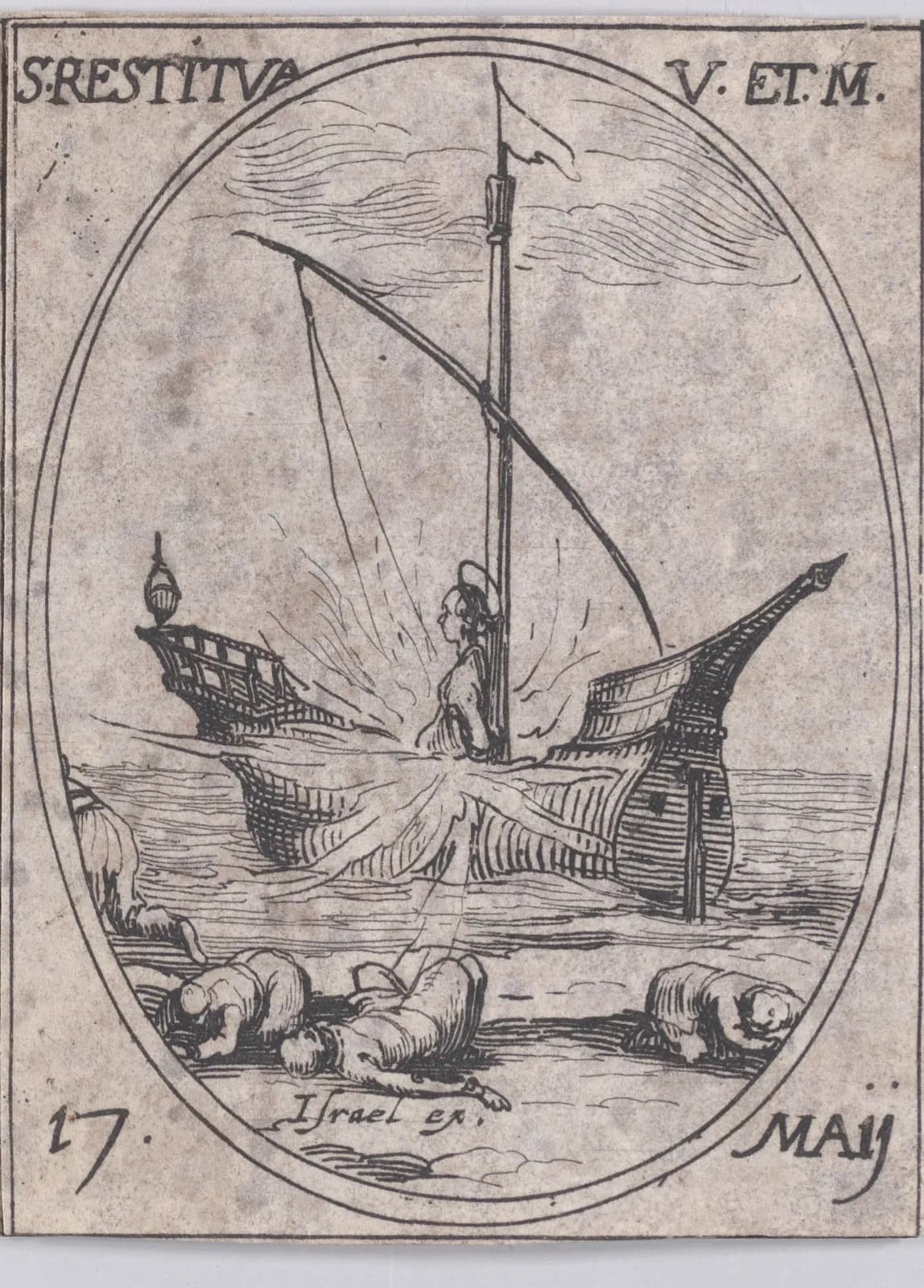
- Emblems
- A martyr's palm, a lily, a bunch of grapes 1
Saint Restituta was a virgin martyr of Roman Africa, remembered in the Roman Martyrology on May 17 with a single line and no details. 12 Her cult crossed the sea to Italy, most likely with Christians fleeing the Vandals, and she became the patroness of the island of Ischia in the Bay of Naples. 13 The story told there, of a burning boat that carried her across the sea, is a medieval legend, and the island still acts it out every May. 1
What is known
The Roman Martyrology's entry for May 17 commemorates Saint Restituta, virgin and martyr, in Africa Proconsularis, the Roman province that is now Tunisia. 2 That is all it says. katolsk.no, the Norwegian bishops' saints database, is frank that historical data on the time and place of her martyrdom is lacking. 1
It gives two readings of who she was. The first makes her a pupil of the school of Saint Cyprian, bishop of Carthage, and one of the martyrs of Abitina. 1 The Spanish Catholic portal Catholic.net tells the same story and dates her death to 304. 3 katolsk.no's own heading, though, gives her death as "255?", and Cyprian himself died in 258, so the two halves of this reading sit uneasily together. 1
The Abitina martyrs died in Diocletian's persecution. katolsk.no says that in spite of the emperor's order of 303, Christians from Abitina and from nearby Carthage and Bizerte went on meeting every Sunday in the house of Octavius Felix to celebrate the Eucharist with the priest Saturninus. 1 Forty-nine of them were arrested and taken in chains to Carthage, where on February 12, 304, they were questioned before the proconsul Anulinus. 1 They confessed their faith under torture and were condemned, Restituta among them, and most of them died of hunger in prison. 1
The second reading, which katolsk.no attributes to other sources, makes her a different woman: the Restituta of the boat. 1 Later in the same article katolsk.no says that her relics actually came to Ischia in the ninth century from Tenizia near Carthage, where it seems clear she was martyred at the beginning of the fourth century. 1
The legend of the burning boat
The story most people know comes from late medieval Passions, which katolsk.no says filled out the little that was known. 1 The one that survives is by a subdeacon named Peter, and dates from the tenth century. 1
In katolsk.no's summary of the legend, Restituta and her companions worshiped Christ in caves until a tyrant named Proclinus arrested her and ordered her to honor his gods. 1 She refused, and he had nails driven into her feet and had her whipped. 1 Then she was put aboard a wooden boat filled with tow and smeared with resin and pitch, and taken out to sea, with her executioners following in a second boat. 1
From here the versions part. In one, when they set the fire, she was left unharmed and the flames destroyed the other boat and the men in it. 1 She thanked God, who sent an angel to go with her across the sea, and she asked to enter eternal peace and died quietly. 1 In another, the flames turned on the executioners while her soul rose peacefully to heaven, and the boat drifted away with her body. 1
Both versions bring the boat to the same place. An old tradition, katolsk.no says, holds that the angel steered it to the island of Aenaria, now Ischia, and that it came ashore at the spot then called "ad ripas," now the bay of San Montano. 1 A Christian woman named Lucina, warned by the angel in a dream, went down to the beach and found the body whole and shining. 1 She gathered the people and buried Restituta at the foot of Monte Vico in Lacco Ameno, where there are remains of an early Christian basilica and now a sanctuary in her name. 1 The beach, the story adds, is said to have bloomed with white lilies when the boat touched it. 1
How the cult crossed the sea
Whatever the boat was, katolsk.no ties the spread of her cult in Italy to history: to the persecution of the Catholics of North Africa by the Arian Vandal king Geiseric, which began in 429 and which Bishop Victor of Vita described. 1 Where the exiles from Carthage found refuge, it says, devotion to the African martyr began. 1 Catholic.net makes the same point more simply: wherever the Africans went, they brought her cult with them. 3
Naples was one of those places. Umberto Benigni, in the 1911 Catholic Encyclopedia, notes that Saint Gaudiosus, "fleeing from the persecutions of the Vandals in Africa," landed at Naples in the time of Bishop Nostrianus, about 450, and died there. 4 katolsk.no lists the other places that keep her memory: Lacco Ameno on Ischia, Palermo, Cagliari, Oristano, Calenzana on Corsica, and Oricola in the province of L'Aquila. 1
In Cagliari, on Sardinia, a cave on Via Sant'Efisio holds the crypt of Santa Restituta, with an altar and her statue. 1 katolsk.no says remains believed to be hers were found there in 1614, and that scholars think they were brought by African bishops whom the Vandal king Thrasamund sent into exile, and connect them with the Abitina martyrs. 1
Naples and Ischia
At Naples, katolsk.no says, a basilica dedicated to her was first built by the emperor Constantine. 1 Benigni, describing the cathedral, is more careful, saying that its "chapel of St. Restituta is said to date from the time of Constantine." 4 katolsk.no adds that her relics are said to be in the cathedral of Naples. 1
Her feast is kept with more solemnity on Ischia, where she is patroness of the island and above all of Lacco Ameno. 13 katolsk.no says Lacco Ameno already had a Christian community in the fifth century, and that its festival is the oldest patronal feast on the island. 1 The celebration runs from May 8 to May 18. 1 On the beach at San Montano the miraculous arrival is acted out every year before hundreds of onlookers, and on May 17 her statue is carried in procession over the sea. 1 On May 18 it is carried through the streets, covered in gold and jewels given by the faithful, and the feast ends at midnight with fireworks. 1
The legend reached French literature too. In 1842 the poet Alphonse de Lamartine wrote "Le lis du golfe de Santa Restituta dans l'île d'Ischia." 13
What is Saint Restituta the patron saint of?
Saint Restituta's feast day
Praying with Saint Restituta
The Church remembers almost nothing about Restituta for certain, except that she was a young woman of Africa who died for Christ. 12 Even her century is uncertain. 13
What carried her name across the sea was not a chronicle but refugees. katolsk.no and Catholic.net both describe her cult as something exiled African Christians took with them, a martyr from home kept alive in a strange country. 13
The island that received her has kept her for over a thousand years, and every spring its people go down to the shore to watch her arrive again. 1 However much of the legend is true, the devotion itself is real, and both sources trace it back to people who had been driven out of their own country. 13
Saint Restituta, pray for us.
Sources
- 1."Den hellige Restituta av Kartago (d. 255?)," Den katolske kirke (katolsk.no), Catholic Diocese of Oslo (in Norwegian).
- 2.Roman Martyrology, entry for May 17, "Santa Restituta, vergine e martire," as printed in "Santo del giorno," Conferenza Episcopale Italiana (in Italian).
- 3."Restituta, Santa," Catholic.net (in Spanish).
- 4.Umberto Benigni, "Naples," The Catholic Encyclopedia, Vol. 10 (New York: Robert Appleton Company, 1911).
Saints to turn to next
Others in this collection who are turned to for some of the same things.