Saint Quirinus of Siscia
Died June 4, 303, 304 or 309
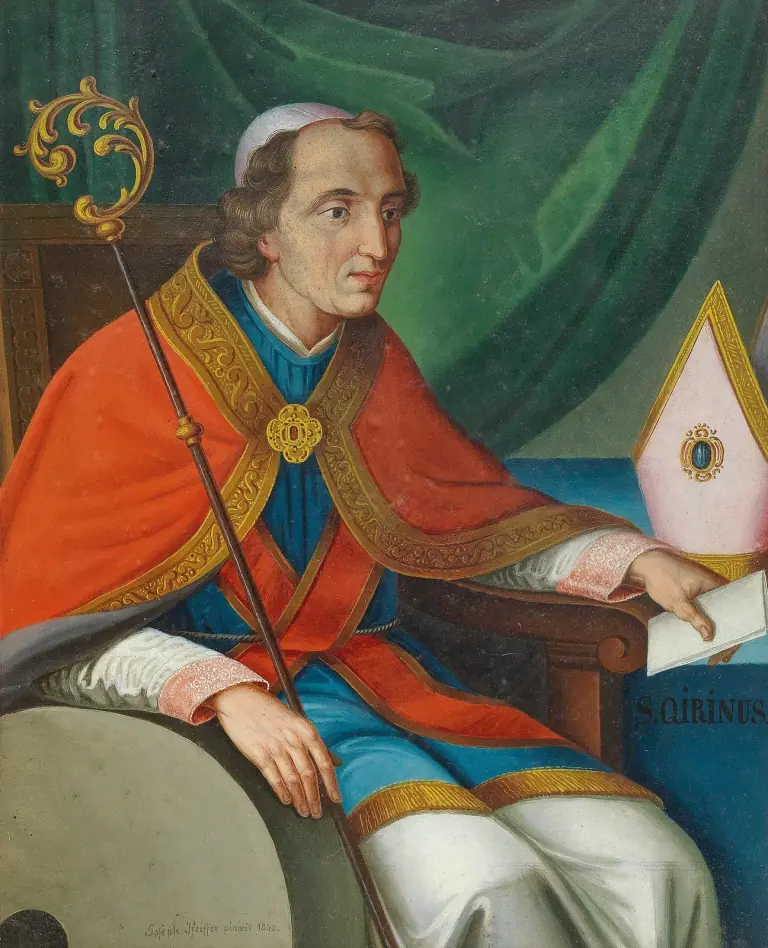
- Died
- Drowned at Sabaria, now Szombathely in Hungary, with a millstone at his neck 134; on June 4, 303 or 304, says Butler 1; in 309, say the Catholic Encyclopedia and santiebeati 23
Saint Quirinus was the bishop of Siscia, now Sisak in Croatia, who was arrested in the persecution under Diocletian and his colleagues, refused to sacrifice, and was thrown into a river at Sabaria with a millstone tied to his neck. 134 His Acts, which the Catholic Encyclopedia calls genuine, say that he floated, went on preaching to the Christians on the bank, and prayed until he was allowed to sink. 12 His feast is June 4. 4
The bishop of Siscia
Siscia stood on the river Save in the Roman province of Pannonia. By Butler's day it had shrunk to a village, and the bishop's see had moved to Zagreb. 1 Of Quirinus's life before his arrest nothing is told. Butler gathers the early witnesses to his death: Prudentius, who wrote a hymn for him and calls him an eminent martyr; Fortunatus, who ranks him among the most illustrious martyrs of the Church; and Jerome's Chronicle, which mentions him under the year 309. 1 santiebeati gives the chronicle notice of 309 to Eusebius, and calls the Passion of Quirinus very old and, taken as a whole, reliable. 3
Kirsch, in the 1911 Catholic Encyclopedia, warns that several martyrs of the name were honored in the early Church and were later confused with one another. He separates five of them and says of this one that "the genuine Acts of the martyrdom of the saint are still in existence." 2
Before Maximus
When Quirinus heard that Maximus, the chief magistrate of the town, had ordered his arrest, he left Siscia. He was followed, caught and brought back. 13 Maximus asked where he had been running to. "I did not fly, but went away to obey the order of my master," the bishop said, and quoted the Gospel: when they persecute you in one city, flee to another. 1
The magistrate told him the emperors' orders would find him anywhere and that his God could not help him now. Quirinus answered, "The God whom we adore is always with us wherever we are, and can always help us. He was with me when I was taken, and is now with me." 1 Maximus put incense in front of him and told him that old age had weakened his wits. "That disgrace I account my glory," Quirinus said, "and that death will purchase me eternal life." 1
He was beaten with clubs. Maximus offered to make him a priest of Jupiter if he gave way. "I am now performing the true function of a priest," Quirinus replied, "in offering myself a sacrifice to the living God." He said he hardly felt the blows, and that he was ready for worse, so that those in his care might be encouraged to follow him. 1
The jailer and the road
He was taken back to prison in heavy chains. There, the Acts say, he thanked God for the insults he had borne and asked that the other prisoners might know he worshiped the true God. At midnight a great light filled the prison, and the jailer, Marcellus, threw himself at the bishop's feet in tears and asked him to pray for him. Quirinus instructed him and "signed him in the name of Jesus Christ." 13
Maximus had no authority to put him to death. After three days he sent him to Amantius, governor of the province of First Pannonia. 13 Quirinus was led in chains through the towns along the Danube until he met the governor, who ordered him taken on to Sabaria. 1 On the way some Christian women brought him food, and as he blessed it, Butler says, the chains fell from his hands and feet. 1
The millstone
At Sabaria, Amantius had him brought into the theater, read out the record of the hearing at Siscia, and asked whether he still held to it. "I have confessed the true God at Siscia: I have never adored any other," Quirinus said. "Him I carry in my heart, and no man on earth shall ever be able to separate me from him." 1 The governor tried promises and appealed to his age, and then sentenced him to be thrown into the river with a millstone at his neck. 13
The crowd had gathered on the banks. Instead of sinking, Butler writes, the old man stayed a long time above the water with the stone still at his neck, urging the Christians to hold firm and not to fear torments or death. 1 Then he began to fear he would lose the martyr's crown, and prayed: "Grant me what now remains, and is to be preferred to all things, the happiness of dying for thee, Jesus Christ my God." 1 He sank. The Acts put it in one line, which Butler gives in Latin and in English: he "with difficulty obtained by his prayers to be drowned." 1 The 1897 Martyrology tells it the same way. 5
Which river it was depends on the source. Butler calls it the Sabarius, a small river at Sabaria; santiebeati says the Sava. 13 Kirsch and both Martyrologies say only that he was thrown into a river. 245
When it happened
The date of the year is not settled. Butler, following the historian Hanciz, puts the martyrdom on June 4, 303 or 304, and notes that Ruinart, who printed the Acts, put it in 309. 1 Kirsch gives 309, and santiebeati says he was arrested in 309. 23
The name of Galerius appears in the story, but not always in the same office. Butler, following Prudentius, takes Galerius for the governor of Illyricum and suggests it was another name for Amantius; the 1897 Martyrology also calls him the governor. 15 The current Martyrology says Quirinus died under the emperor Galerius. 4
From Sabaria to Rome
His body was found a little downstream and laid in a chapel on the bank, and later in a great church near the gate of Sabaria that led to Scarabantia. 13 When the barbarian invasions drove the people of Pannonia out at the beginning of the fifth century, they took his bones with them to Rome. 2 There they were placed in a vaulted chamber near the Basilica of Saint Sebastian on the Appian Way, where santiebeati says the pilgrim itineraries of the seventh century record him as much venerated. 23
Later reports diverge. Butler says the relics were moved in 1140 to the church of Saint Mary beyond the Tiber, and that Molanus placed them afterward in a monastery in Bavaria. 1 santiebeati says that reports of relics in Milan, Aquileia and Santa Maria in Trastevere are not reliable. 3
What is Saint Quirinus the patron saint of?
Saint Quirinus's feast day
Saint Quirinus's feast day is June 4. The current Roman Martyrology, as the Italian bishops print it, enters on that day the passion at Szombathely in Pannonia of Saint Quirinus, bishop of Siscia and martyr, thrown into the river with a stone tied to his neck for his faith in Christ. 4 The 1897 English edition of the Martyrology, Butler and Kirsch all keep the same day. 125
Praying with Saint Quirinus
He ran. When he heard the order for his arrest he left town, and when he was caught he did not apologize for it: he had gone, he said, because his master told him to. 1 The Acts tell it without embarrassment.
Once taken, he did not argue for his life. Each offer was answered plainly: the incense, the priesthood of Jupiter, the governor's appeal to his age. 1 He spoke of the people in his care more than of himself, and wanted his suffering to strengthen them. 1
The prison story belongs with the rest. In the middle of it a jailer asked him for prayer, and the bishop under sentence instructed him. 13
The ending is strange and the Acts let it stay strange. A man with a millstone round his neck, preaching from the water, afraid he would not be allowed to die. 1 What he asked for in the end was not rescue. 1
Saint Quirinus of Siscia, pray for us.
Sources
- 1.Alban Butler, "St. Quirinus, B. M.," June 4, in The Lives of the Fathers, Martyrs, and Other Principal Saints, Vol. 6 (London: J. Murphy, 1812), pp. 55-59, Internet Archive.
- 2.J. P. Kirsch, "Sts. Quirinus," The Catholic Encyclopedia, Vol. 12 (New York: Robert Appleton Company, 1911).
- 3.Antonio Borrelli, "San Quirino di Siscia, vescovo e martire," with the Roman Martyrology entry, Santi e Beati, santiebeati.it (in Italian).
- 4.Roman Martyrology, entry for June 4, "San Quirino, vescovo di Siszeck e martire," Santo del giorno, Conferenza Episcopale Italiana (in Italian).
- 5.The Roman Martyrology, June 4 (Baltimore: John Murphy Company, 1897), Internet Archive.
Saints to turn to next
Others in this collection who are turned to for some of the same things.