Saints Primus and Felician
d. about 297 or 304
- Died
- At Nomentum (Mentana), about 304 under Diocletian 1; about 297, says katolsk.no, which lists other dates from 286 to about 305 2
Saints Primus and Felician were two Christians of Nomentum, a town on the Via Nomentana outside Rome, who were killed in the persecution under Diocletian and buried near their town. 1 In 648 Pope Theodore had their bodies lifted out of their grave and carried into Rome, to the church of Saint Stephen on the Caelian Hill, where they still lie. 15 The story of their trial comes from a later Passio, which makes them brothers of about eighty who had kept the faith for decades before the persecution caught up with them. 24
What is known
The oldest witness is a list. The Martyrologium Hieronymianum gives, under June 9, the names of Primus and Felician, buried at the fourteenth milestone of the Via Nomentana near Nomentum, the modern Mentana. 1 J.P. Kirsch, writing in the 1911 Catholic Encyclopedia, notes that the entry comes from the catalogue of Roman martyrs of the fourth century, and concludes that the two were "evidently from Nomentum." 1 He dates their deaths to about 304, in the persecution under Diocletian. 1
Not every source agrees on the year or the distance. The Norwegian bishops' saints database (katolsk.no) puts their deaths about 297, and lists other dates given for them: 286, about 300, 303 and about 305. 2 The current Roman Martyrology, as the Italian bishops print it, places them at the fifteenth mile of the Via Nomentana. 3 katolsk.no follows that reckoning for the grave and adds that a church was raised in the sixteenth century over their prison at the fourteenth milestone. 2
Beyond the names, the place and the day, the early record is silent. The account that tells who they were and how they died is a Passio, which the University of Oxford's Cult of Saints database dates between the fifth and early seventh centuries and thinks was probably written at Nomentum itself. 4
The story of the Passio
katolsk.no retells the tradition. Primus and Felician were brothers of a patrician family, born at Rome or Nomentum early in the third century, who were baptized about 267. 2 Through the persecutions they visited Christians held in the dungeons, comforting and helping them where they could. 2 Having escaped the executioners through a long life, they were arrested when they were about eighty, scourged for refusing to sacrifice, and sent out to Nomentum to be judged by a magistrate named Promotus. 2
The Passio itself, as the Oxford database summarizes it, opens with pagan priests telling the emperors Diocletian and Maximian that the gods will give no help while these two keep the Christian faith. 4 The brothers are jailed, and an angel frees them; they thank God for releasing them as Peter was released. 4 Brought before the emperors, they refuse to sacrifice to Hercules and Jupiter and are beaten with rods. 4
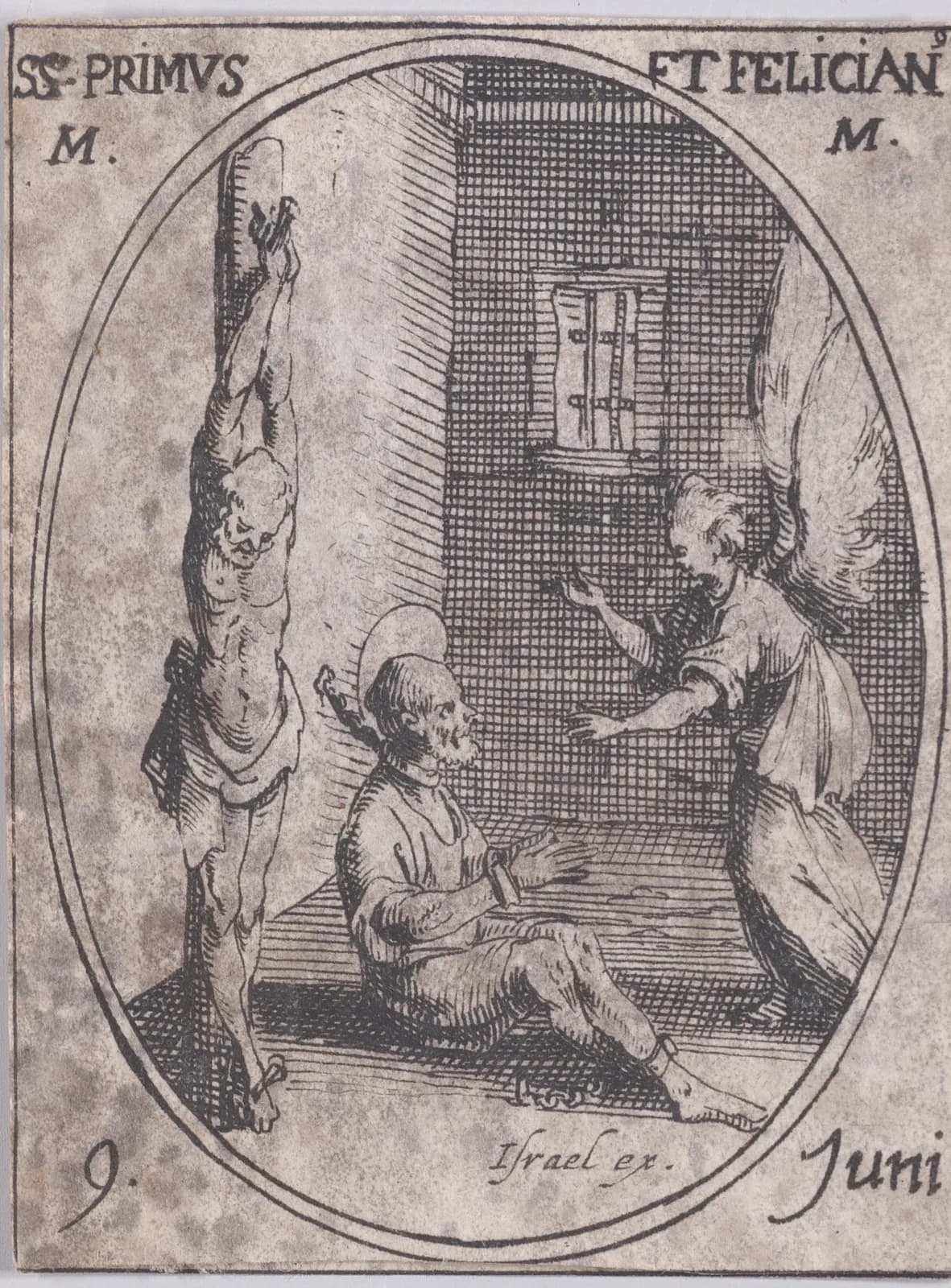
At Nomentum, Promotus separates them. He tells Felician to remember his age; Felician answers that he is eighty, that he has lived thirty years in the truth of Christ, and that God will care for his old age. 4 He is fixed to a post with nails through his hands and feet and left for three days without bread or water. 4 Then the governor tries the other brother: he tells Primus that Felician has sacrificed and become the emperors' friend. 4 Primus does not believe it, and katolsk.no notes that the same trick had already failed on Felician. 24 The Passio goes on to torches, molten lead and two lions and some bears that lie down at the martyrs' feet, until the governor gives up and has them beheaded. 4
The older Roman Martyrology compressed all of this into a sentence. In the 1897 English edition they "lived long in the Lord, and endured sometimes together the same, sometimes separately different and exquisite torments," and were "finally beheaded by Promotus, governor of Nomentum." 6 Kirsch does not retell the Passio at all; his article rests on the calendar, the grave and the translation. 1
From the Via Nomentana to the Caelian Hill
The Passio ends at the grave. Christians took the bodies by night to the sandpit by the Arcus Numentanus, kept vigil there for thirty days, and later built a basilica in their honor at the fourteenth milestone from Rome; the sick, it says, were healed there "to the present day." 4 katolsk.no says the ruins of that basilica could still be seen in the seventeenth century. 2
The next certain date is 648. The Liber Pontificalis, the early book of the lives of the popes, records under Pope Theodore that "levata sunt corpora sanctorum martyrum Primi et Feliciani, qui erant in arenario sepulta via Numentana": the bodies were lifted from the sandpit where they lay, brought into Rome, and laid in the basilica of Saint Stephen the first martyr. 5 Theodore gave the church three gold bowls, a silver panel before the confessio and two silver arches. 5 The same book describes him as a Greek, the son of a bishop from Jerusalem, and a lover of the poor. 5
Kirsch says the bones were placed under an altar raised in the martyrs' honor, "where they remain." 1 katolsk.no names the church as Santo Stefano Rotondo on the Caelian Hill, built under Pope Simplicius (468-83), and says Theodore laid his own father's remains there with them and had a mosaic made that can still be seen in the left-hand chapel. 2 It calls this translation of martyrs from outside the walls into a church within the city the first of its kind. 2 That is why the 1897 Martyrology places them "At Rome, on Mount Caelius." 6
Later legends
The cult traveled. katolsk.no records a Bavarian tradition that made Primus and Felician Roman legionaries who preached in the Chiemgau, where Primus found a healing spring in a forest; the spring at Adelholzen still bears his name, beside a chapel built in 1615. 2 In southern France their story was absorbed into the cult of Saint Caprasius of Agen, in which two brothers of these names join him on the way to execution. 2 None of this is in the Passio or in Kirsch. 14
What are Saints Primus and Felician the patron saints of?
Saints Primus and Felician's feast day
Saints Primus and Felician's feast day is June 9. 123 The Passio itself closes by giving their feast as the fifth day before the Ides of June, which is June 9, and the older Roman Martyrology kept them on the same day. 46 katolsk.no adds that the day was taken off the Church's universal calendar in the revision of 1969 and left to local and particular calendars, and that the 2004 edition of the Roman Martyrology still lists them under June 9. 2 The Italian bishops' edition carries them on that day as martyrs of the Via Nomentana. 3
Praying with Saints Primus and Felician
Almost everything vivid about these two comes from the Passio, and Kirsch leaves it aside entirely. 14 What is left is plain: two Christians of a country town, killed for the faith, buried near it, and kept on the calendar under the same day. 13
The Passio, for all its lions, gives them one line that does not need a miracle. Asked to think of his age, Felician answers that he is eighty and has belonged to Christ for thirty years. 4 The tradition katolsk.no follows imagines their long life spent in the prisons, among Christians who were waiting to die. 2
Then the story turns on a lie. The judge tells each brother that the other has given in, and each refuses to believe it. 24 Of all the tests in the story, it is the only one aimed at the trust between them.
Three and a half centuries later a pope remembered as a lover of the poor had them lifted out of a sandpit on the Via Nomentana and carried into the city. 5 They have lain on the Caelian Hill since 648. 12
Saints Primus and Felician, pray for us.
Sources
- 1.J.P. Kirsch, "Sts. Primus and Felician," The Catholic Encyclopedia, Vol. 12 (New York: Robert Appleton Company, 1911).
- 2."De hellige Primus og Felician av Nomentum (d. ~297)," Den katolske kirke (katolsk.no), Catholic Diocese of Oslo (in Norwegian).
- 3.Roman Martyrology, entry for June 9, "Santi Primo e Feliciano, martiri," as printed in "Santo del giorno," Conferenza Episcopale Italiana (in Italian).
- 4.The Martyrdom of Primus and Felicianus (BHL 6922), summary and partial Latin text from the Acta Sanctorum, The Cult of Saints in Late Antiquity database, record E02094, University of Oxford.
- 5.Liber Pontificalis 75, Life of Theodore, Latin text ed. Louis Duchesne (1886), The Cult of Saints in Late Antiquity database, record E01629, University of Oxford (in Latin).
- 6.The Roman Martyrology, June 9 (Baltimore: John Murphy Company, 1897).
Saints to turn to next
Others in this collection who are turned to for some of the same things.