Saint Potamiaena
d. c. 202-207
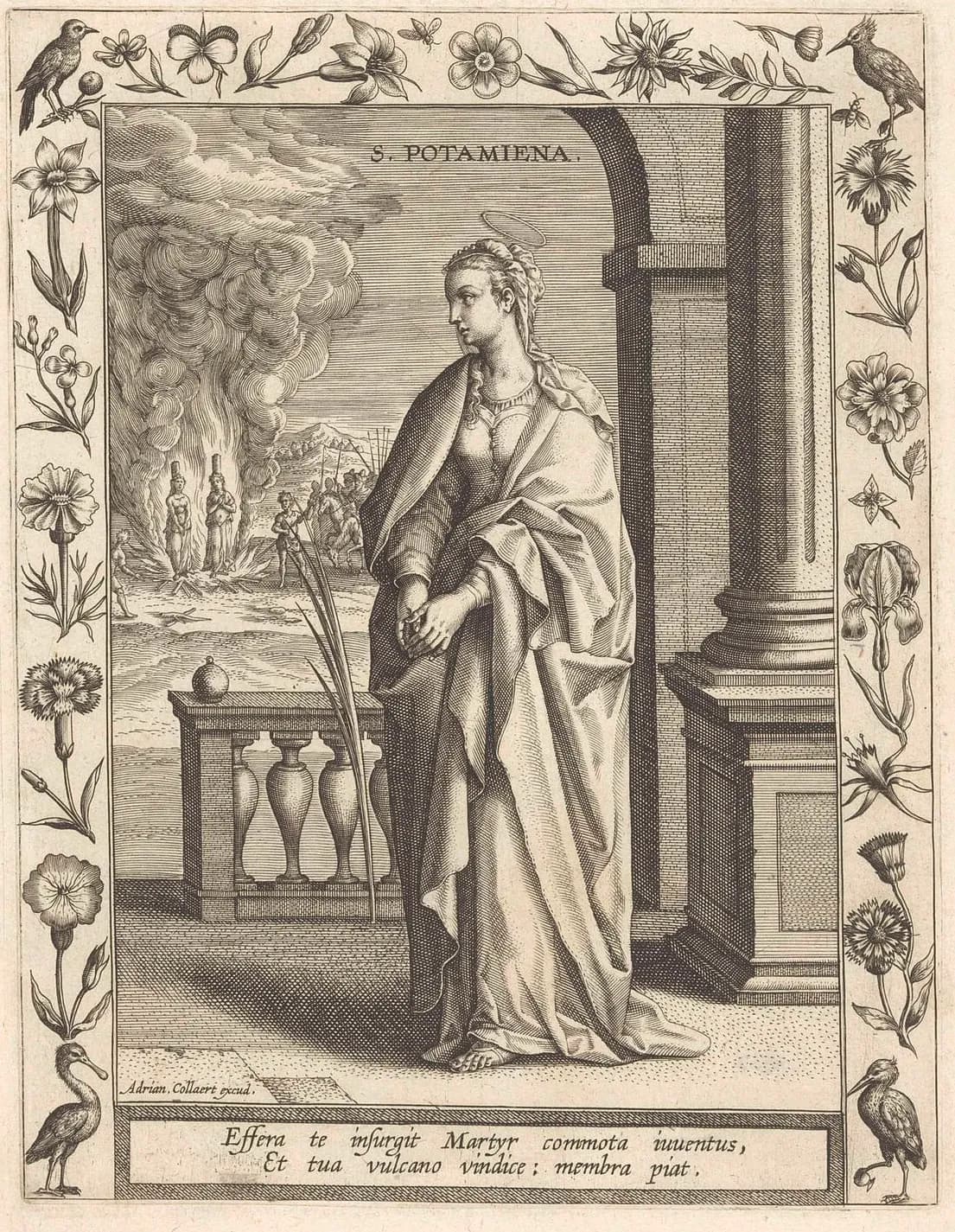
Saint Potamiaena was a young Christian woman of Alexandria who was put to death with her mother, Marcella, in the persecution under the emperor Septimius Severus. 15 Eusebius says she was still famous in Egypt in his day for what she suffered to keep her virginity, and he tells how the soldier who led her to execution, Basilides, became a Christian and was beheaded soon after. 1 A second account by Palladius, written much later, sets her under a different emperor and tells the story differently. 7
Alexandria under Severus
Eusebius opens the sixth book of his Church History with the persecution of Septimius Severus, which he says fell especially hard on Alexandria, where Christians were brought from all over Egypt to be tried. 1 Among them was Leonides, the father of the young Origen. 18 Ferdinand Prat, writing on Origen in the 1911 Catholic Encyclopedia, says Origen was barely seventeen when the persecution broke out. 8
With the teachers of the faith driven out of the city, Origen took charge of the catechetical school while still in his eighteenth year, during the persecution under Aquila, the governor of Alexandria. 1 Pagans came to him for instruction, and Eusebius lists those of his pupils who were martyred: Plutarch, Serenus, Heraclides, Hero, a second Serenus, and a catechumen named Herais who, in Origen's phrase as Eusebius reports it, received "baptism by fire." 1 Origen went with them to their deaths and greeted them with a kiss, and was nearly killed by the crowd for it. 1
Then Eusebius writes that "Basilides may be counted the seventh of these," and tells Potamiaena's story under his name. 1 The Roman Martyrology, which keeps these martyrs together on one day, calls them all distinguished disciples of Origen, Potamiaena among them, and katolsk.no, the saints database of the Catholic Diocese of Oslo, calls her his pupil. 35 Eusebius himself does not say in so many words that she studied with him. 1
Eusebius's account
Eusebius calls her "the celebrated Potamiæna, who is still famous among the people of the country for the many things which she endured for the preservation of her chastity and virginity." 1 He says she was in the full flower of mind and body, and that after many tortures she was put to death by fire together with her mother, Marcella. 1
He gives what he had heard of her trial. The judge, Aquila, after torturing her, threatened to hand her over to the gladiators to be abused. 1 Asked for her decision, she thought briefly and "made a reply which was regarded as impious," and was sentenced at once. 1 Eusebius does not record her words, and katolsk.no notes that they are lost. 13
Basilides, one of the officers of the army, led her to execution. 1 When the crowd jeered at her he drove them back, "showing her much pity and kindness." 1 She told him to take courage, because after her death she would pray to her Lord for him, and he would soon be repaid. 1 Then, Eusebius says, she bore her death nobly: burning pitch was poured slowly over her body until she died. 1 "Such was the conflict endured by this famous maiden," he ends. 1
Basilides
Not long afterward, Eusebius continues, Basilides' fellow soldiers asked him to swear an oath, and he answered that he could not swear at all, because he was a Christian. 1 They took it for a joke until he kept saying it; then he was brought before the judge, confessed again, and was imprisoned. 12
Christians came to the prison to ask what had happened to him. 1 He told them that for three nights after her death Potamiaena had stood beside him, set a crown on his head, and said she had asked the Lord for him and been heard, and that she would soon take him with her. 12 The brethren gave him "the seal of the Lord," which Kirsch takes to mean baptism, and the next day he was beheaded. 12 katolsk.no adds that he received the Eucharist in prison. 4
Eusebius closes the chapter by saying that many others in Alexandria came to Christ at that time, "For Potamiæna appeared to them in their dreams and exhorted them." 1 katolsk.no calls the story of her prayer for Basilides one of the earliest witnesses to the Church's belief in the intercession of the saints. 4
The account in Palladius
Palladius tells the story in his Lausiac History as he heard it from Isidore of Alexandria, who heard it from Saint Antony. 7 In his version she lived "in the time of Maximianus the persecutor" and was a slave. 7 Her master tried to seduce her and failed, and then, in a rage, denounced her to the prefect as a Christian, with money and a request that she be spared if she gave in to him. 7
The judge had a cauldron of pitch heated and gave her the choice of obeying her master or being thrown in. 7 She answered, "God forbid that there should be another such judge, who orders one to submit to licentiousness." 7 Then she asked to be let down slowly, "that you may know what endurance the Christ, Whom you know not, bestows on me," and Palladius says she died within the hour. 7
The two accounts agree on her courage, her purity and the boiling pitch, and differ on her station, her accuser and her date. 17 Eusebius reports what was still said of her in Alexandria in his own day; Palladius tells a story that reached him at third hand, from Antony through Isidore. 17 katolsk.no calls her Potamiaena the Elder, to tell her apart from a namesake martyred at Alexandria a hundred years later. 3
What is Saint Potamiaena the patron saint of?
Saint Potamiaena's feast day
Saint Potamiaena's feast day is June 28. 35 The current Roman Martyrology keeps her that day with Plutarch, Serenus, Heraclides, Hero, the second Serenus, Herais and her mother Marcella, and says that she first endured countless trials in defense of her virginity and was finally burned at the stake with her mother. 5
Basilides has his own day, June 30, where the Martyrology says he was converted to Christ by her prayers. 46 Kirsch, in 1907, noted the same date in the Martyrology of his day, and said that the old martyrologies list the Alexandrian martyrs, a Basilides among them, on June 28. 2
Praying with Saint Potamiaena
Potamiaena was condemned for refusing two things at once: to give up her faith and to give up her body. 17 In both accounts her judges threatened her purity, and in both she refused. 17
Her last recorded act was a kindness returned. A soldier doing his duty kept the crowd off her, and she promised to pray for him. 1 Eusebius tells the rest plainly: Basilides confessed Christ, was baptized in prison and died the next day. 1
The story is one of the oldest in the Church about the prayer of the saints. 4 Eusebius reports it as he received it, without argument, and adds only that many others in Alexandria said she had come to them too. 1
Saint Potamiaena, pray for us.
Sources
- 1.Eusebius of Caesarea, Church History, Book VI, chapters 1-5, trans. Arthur Cushman McGiffert, Nicene and Post-Nicene Fathers, Second Series, Vol. 1 (Buffalo, NY: Christian Literature Publishing Co., 1890), via New Advent.
- 2.Johann Peter Kirsch, "Basilides," The Catholic Encyclopedia, Vol. 2 (New York: Robert Appleton Company, 1907).
- 3."Den hellige Serenus av Alexandria og førti ledsagere (d. ~203)," Den katolske kirke (katolsk.no), Catholic Diocese of Oslo (in Norwegian).
- 4."Den hellige Basilides av Alexandria (d. 205)," Den katolske kirke (katolsk.no), Catholic Diocese of Oslo (in Norwegian).
- 5.Roman Martyrology, entry for June 28, "Santi Martiri di Alessandria d'Egitto," as printed in "Santo del giorno," Conferenza Episcopale Italiana (in Italian).
- 6.Roman Martyrology, entry for June 30, "San Basilide," as printed in "Santo del giorno," Conferenza Episcopale Italiana (in Italian).
- 7.Palladius, The Lausiac History, chapter 3, "Potamiaena," trans. W. K. Lowther Clarke (London: SPCK, 1918), via tertullian.org.
- 8.Ferdinand Prat, "Origen and Origenism," The Catholic Encyclopedia, Vol. 11 (New York: Robert Appleton Company, 1911).
Saints to turn to next
Others in this collection who are turned to for some of the same things.
- Saint CyprianBirth unknown - September 14, 258CourageConversionSuffering and illness
- Saint EustaceMartyred at Rome, in 118 by tradition; other accounts give 140 or 188ConversionCourageSuffering and illness
- Saint Gregory the Illuminatorc. 257 - c. 337 (both dates uncertain)ConversionSuffering and illnessCourage
- Saint John Paul IIMay 18, 1920 - April 2, 2005CourageSuffering and illnessConversion