Saint Pontian
Died in Sardinia, 235 or soon after
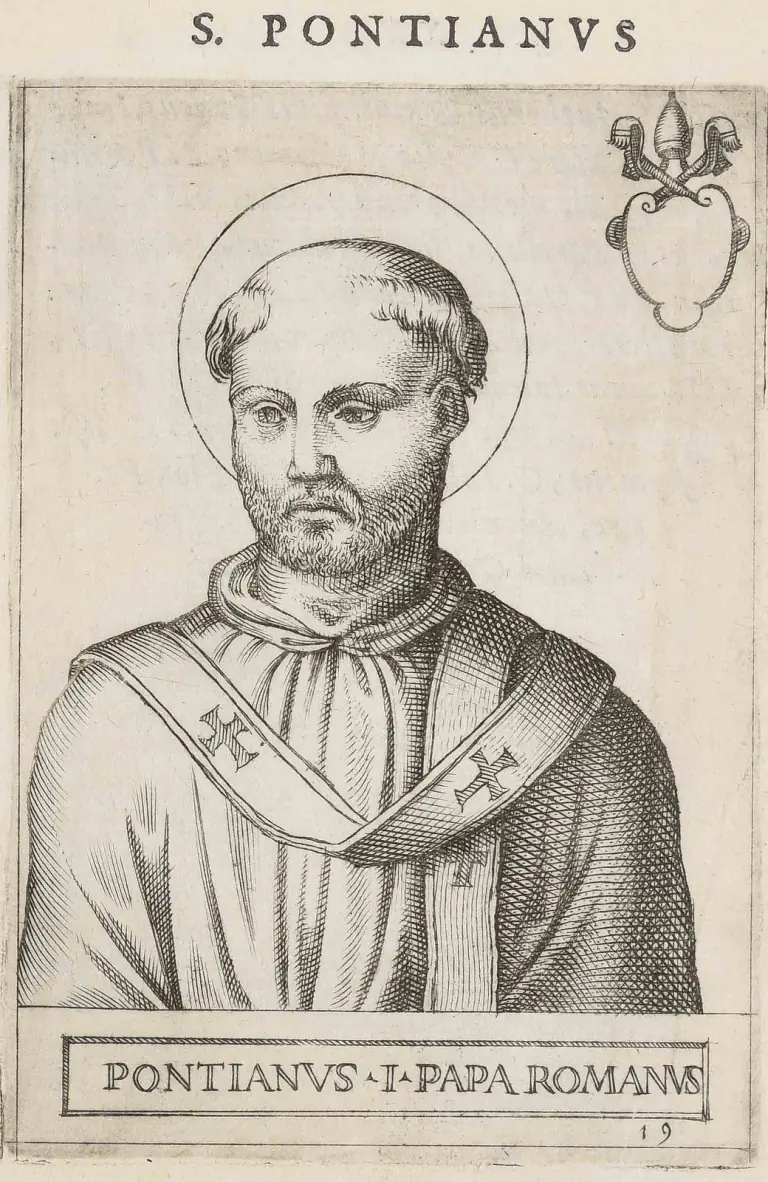
- Known for
- Being banished to the mines of Sardinia with Hippolytus, and resigning so that Rome could elect a successor 126
Saint Pontian was bishop of Rome from 230 to 235 and the first pope known to have given up his office: condemned to the mines of Sardinia, he resigned so that the Roman Church could elect a successor. 156 He was deported together with Hippolytus, the Roman priest who had led a rival church against three popes, and the two men are kept together on August 13. 127
A Roman, son of Calpurnius
The Liber Pontificalis, the early book of papal lives, says that Pontianus was "by nationality a Roman, son of Calpurnius." 3 J.P. Kirsch, in the Catholic Encyclopedia, adds that the dates of his birth and death are unknown, and that with him begins a short chronicle of the third-century Roman bishops which "gives more exact data for the lives of the popes." 1 Louise Ropes Loomis, introducing her translation of the Liber Pontificalis, explains that the Liberian Catalogue gave the length of each term in years, months and days, with the consuls of the year, and that under Pontianus it noted the troubles of persecution. 3
From that chronicle Kirsch dates the beginning of the pontificate to July 21, 230, and has it last until 235. 1 Eusebius records the succession in one line: Urbanus, "who had been for eight years bishop of the Roman church, was succeeded by Pontianus." 4 Later he says that Pontianus, "who had been bishop of the church at Rome for six years, was succeeded by Anteros," and puts it after Gordian had become emperor. 4 The Liber Pontificalis gives five years, two months and twenty-two days, and says he was bishop "in the time of Alexander," from the consulship that Loomis dates to 231. 3
Five years of peace
For most of those years the Church of Rome was left alone. The Norwegian bishops' saints database (katolsk.no) credits the tolerant policy of the emperor Alexander Severus, who reigned from 222 to 235. 5 The excerpt from J.V. Bartlett on Catholic Culture says that Pontian "had enjoyed a peaceful reign over the Roman Church during Severus' time." 6
The trouble was inside. Hippolytus, a Roman presbyter and theologian, had broken with Pope Callistus and had himself chosen as a rival bishop, and he stayed in opposition through the reigns of Urban and Pontian. 2 Kirsch thinks he probably wrote his Refutation of All Heresies while Pontian was pope. 2 "The schism of Hippolytus continued during his episcopate," Kirsch writes in his article on Pontian. 1 The quarrel itself is told on the page for Saint Hippolytus of Rome.
One act of Pontian's own can be named. After Origen was condemned at Alexandria in 231 or 232, a synod at Rome agreed with the sentence; Jerome and Rufinus report it, and Kirsch says that "without doubt this synod was held by Pontian." 1 katolsk.no gives the same account and spells out the sentence of Bishop Demetrius of Alexandria that the synod endorsed: Origen had been expelled from Egypt, removed from his post as a teacher and deposed from the priesthood. 5
Beyond that the record is thin. The Liber Pontificalis credits him with two ordinations in December, of six priests, five deacons and six bishops. 3 katolsk.no reports, as something that is said of him, that he ordered the psalms to be sung, the Confiteor to be said before death, and the greeting Dominus vobiscum to be used. 5 Kirsch mentions none of it. 1
Maximinus and the mines
In March 235 Alexander Severus was murdered and Maximinus Thrax became emperor. 5 katolsk.no describes him as a former wrestler with no interest in religion, who hated his predecessor and so overturned his tolerance of Christians and went after their leaders. 5 Eusebius gives the same reason: "On account of his hatred toward the household of Alexander, which contained many believers, he began a persecution, commanding that only the rulers of the churches should be put to death." 4 Kirsch writes that the persecution was "directed chiefly against the heads of the Church. One of its first victims was Pontian, who with Hippolytus was banished to the unhealthy island of Sardinia." 1
Not every source names that emperor. The Liber Pontificalis says that Pontianus and "Ypolitus, the priest" were "transported into exile by Alexander to the island of Bucina in Sardinia during the consulship of Severus and Quintianus," which Loomis dates to 235. 3 Loomis notes that no island of that name is known and that the word is probably garbled. 3 In his article on Hippolytus, Kirsch calls it the unhealthful island, insula nociva. 2 The 1897 Roman Martyrology also has them deported by the emperor Alexander, and Catholic Culture's own summary speaks of the persecution of Alexander Severus, though the Bartlett excerpt on the same page names Maximinus. 68 Bartlett calls Sardinia the "Island of Death," and katolsk.no uses the same name. 56
The first pope to resign
Kirsch gives the decision in two sentences: "To make the election of a new pope possible, Pontian resigned 28 Sept., 235, the Liberian Catalogue says 'discinctus est'. Consequently Anteros was elected in his stead." 1 katolsk.no calls September 28, 235, the first exact date handed down in the history of the papacy. 5 Bartlett explains the reasoning: "Since deportation was a life sentence which few survived, Pontian felt obligated to abdicate so that a successor might quickly preside over the Holy See. He is the first pope known to have abdicated." 6
The Liber Pontificalis knows nothing of a resignation. In its account Pontianus "was maltreated and beaten with clubs and he died, October 30. In his place Antheros was ordained, November 21." 3 Eusebius gives Anteros a month before Fabian followed. 4
Somewhere in these months Hippolytus came back. Kirsch says that "shortly before this or soon afterwards Hippolytus, who had been banished with Pontian, became reconciled to the Roman Church, and with this the schism he had caused came to an end." 1 katolsk.no says it is generally assumed that the two were reconciled, either in prison at Rome or after they reached Sardinia. 5 Bartlett places it in captivity, where Hippolytus "reconciled his differences with Pontian and even ordered his followers to bring themselves back to the Church." 6
Death in Sardinia
How Pontian died is told several ways. Kirsch is the most cautious: "How much longer Pontian endured the sufferings of exile and harsh treatment in the Sardinian mines is unknown." 1 He adds that old Acts of martyrs, now lost, which the author of the Liber Pontificalis used, said he died of the privations and inhuman treatment he suffered. 1 The Liber Pontificalis itself has him beaten with clubs. 3 katolsk.no says he was brutally beaten to death in November 235, and Bartlett that, "in the mines only two months," he "was brutally beaten to death by his jailers." 56 The 1897 Martyrology says he was "scourged to death with rods." 8 Vatican News, in its Spanish entry for the day, says that he and Hippolytus died of hunger and thirst in 235. 9
Brought home to the catacomb of Callistus
Pope Fabian, the second pope after him, later had the bodies of Pontian and Hippolytus brought back to Rome. 15 Pontian was buried on August 13 in the papal crypt of the catacomb of Callistus, Hippolytus the same day on the Via Tiburtina. 12 Kirsch dates the reburial to 236 or one of the following years, and katolsk.no to 236 or 237, adding that the papal crypt had only just been finished. 25 Bartlett says about a year later. 6 The Liber Pontificalis says that Fabian "brought him back in a boat and buried him in the cemetery of Calistus on the Via Appia." 3
His gravestone has been found. Kirsch reports that in 1909 the original epitaph turned up in the crypt of Saint Cecilia, beside the papal crypt, reading "PONTIANOS, EPISK. MARTUR (Pontianus, Bishop, Martyr)," and that the word for martyr was added later, in ligature. 1 Loomis's note, following Duchesne's edition, says instead that the epitaph had disappeared, and records a rough graffito on the doorway of the papal crypt: "Mayest thou live, Pontianus, ... in God with all." It may, the note says, have been written by someone who saw him buried. 3
The Roman calendar in the Chronography of 354 already records under August 13 the feast of Hippolytus on the Via Tiburtina and of Pontianus in the catacomb of Callistus. 2 Kirsch notes that Pontian stands on that day in its list of the burials of martyrs. 1
What is Saint Pontian the patron saint of?
Saint Pontian's feast day
Saint Pontian's feast day is August 13, which he shares with Saint Hippolytus. 67 The current Roman Martyrology, in the text published by the Italian bishops, enters on that day the holy martyrs Pontian, pope, and Hippolytus, priest, who were deported together to Sardinia, served a common sentence there, and were crowned, it seems, with a single crown; their bodies were buried at Rome, Pontian in the cemetery of Callistus and Hippolytus on the Via Tiburtina. 7 Catholic Culture lists the day as an optional memorial, and Vatican News gives the two names on the same date. 69
He was long kept on another day. Kirsch, writing in 1911, says that "the Roman Martyrology gives his feast on 19 Nov." 1 The 1897 English Martyrology enters there "the birthday of St. Pontian, pope and martyr, who, with the priest Hippolytus, was transported to Sardinia." 8 katolsk.no says the two were at first celebrated together, that Pontian's feast was moved to November 19 in the eighth century, and that since the reform of the calendar in 1969 they have again been kept together on August 13. 5
Praying with Saint Pontian
What is remembered of Pontian is a decision: sentenced to a place few left alive, he stepped aside so that the Church at home would not be without a bishop. 16 Kirsch's explanation is the plain one, "to make the election of a new pope possible." 1
He went into exile with the man who for years had refused to recognize him or the two popes before him. 12 None of the sources says what passed between them in Sardinia. They record only that the schism ended there, and that Hippolytus told his followers to return. 16
Fabian brought both bodies home, and Rome buried them on the same day. 12 The Martyrology still names them in one entry, deported together and crowned, as it seems, with a single crown. 7
Saint Pontian, pray for us.
Sources
- 1.J.P. Kirsch, "Pope St. Pontian," The Catholic Encyclopedia, Vol. 12 (New York: Robert Appleton Company, 1911).
- 2.J.P. Kirsch, "St. Hippolytus of Rome," The Catholic Encyclopedia, Vol. 7 (New York: Robert Appleton Company, 1910).
- 3.The Book of the Popes (Liber Pontificalis), Vol. 1, Introduction and "XIX. Pontianus," translated by Louise Ropes Loomis (New York: Columbia University Press, 1916).
- 4.Eusebius, Church History, Book VI, chapters 23, 28 and 29, translated by Arthur Cushman McGiffert, Nicene and Post-Nicene Fathers, Second Series, Vol. 1 (Buffalo: Christian Literature Publishing Co., 1890), as hosted by New Advent.
- 5."Den hellige pave Pontian ( -235)," Den katolske kirke (katolsk.no), Catholic Diocese of Oslo (in Norwegian).
- 6."Optional Memorial of Saints Pontian and St. Hippolytus," Liturgical Year, August 13, 2025, Catholic Culture (Trinity Communications); with an excerpt from J.V. Bartlett, The Popes: A Papal History.
- 7.Roman Martyrology, entry for August 13, "Santi martiri Ponziano, papa, e Ippolito, sacerdote," as printed in "Santo del giorno," Conferenza Episcopale Italiana (in Italian).
- 8.The Roman Martyrology, November 19 (Baltimore: John Murphy Company, 1897).
- 9."Ponciano, papa e Hipólito, sacerdote, mártires," Santos del día, 13 de agosto, Vatican News (Dicastery for Communication) (in Spanish).
Saints to turn to next
Others in this collection who are turned to for some of the same things.