Saint Pionius
Martyred at Smyrna, March 12, 250
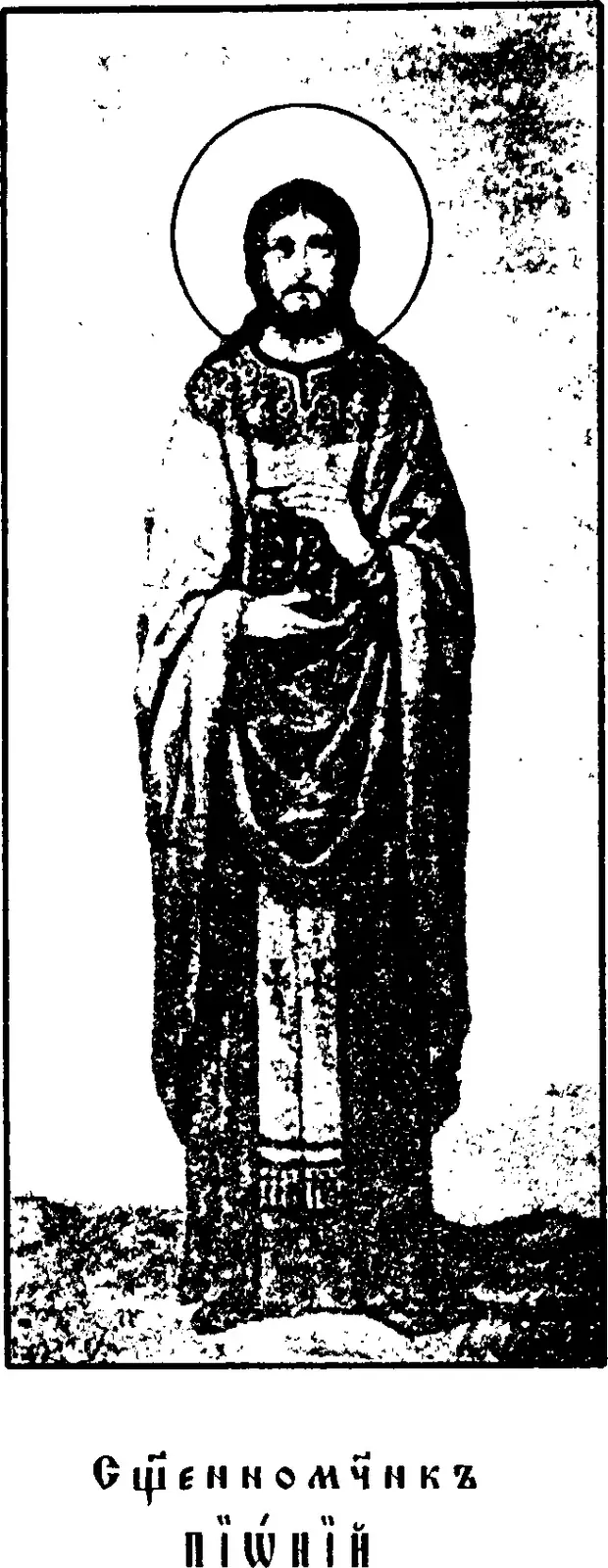
Saint Pionius was a priest of Smyrna who was arrested on the anniversary of Saint Polycarp's martyrdom in the year 250, during the persecution of Decius, with a fugitive slave woman named Sabina and a man named Asclepiades. 123 He had put a chain around his own neck and theirs before the soldiers came, so that no one could say they had gone willingly to sacrifice. 13 After weeks of argument, prison and attempts to force him into a temple, he was nailed to a stake and burned on March 12. 123 His feast is March 11. 4
A priest of Smyrna
Butler calls Pionius "a true heir of the spirit of St. Polycarp, an apostolic man, who converted multitudes to the faith," eloquent and learned, and adds that "the paleness of his countenance bespoke the austerity of his life." 2 The Norwegian bishops' biography describes him as well read in both secular literature and the Scriptures, widely traveled, a teacher and a natural leader. 3 It says that he had taken into his own house Sabina, a slave woman who had fled a pagan household where she was mistreated for her faith. 3
The Catholic Encyclopedia also credits him with a Life of Polycarp, and katolsk.no says that the letter describing Polycarp's martyrdom survives because Pionius made a copy of it. 13
The persecution of Decius demanded that every subject sacrifice to the gods. 3 At Smyrna many Christians complied, and the bishop was among them, Bacchus writes in the Catholic Encyclopedia. 1 Butler names him Eudaemon. 2 katolsk.no calls him Euctemon, a leader of the Christians, perhaps the bishop. 3
Chains around their necks
On the eve of February 23, 250, the anniversary of Polycarp's death, Pionius, Sabina and Asclepiades kept the night in prayer and fasting. 123 Butler and katolsk.no both say he had been warned of his arrest in a vision. 23 Knowing what was coming, he fastened chains around his own neck and those of his companions. 13 Bacchus explains why: Christians led off unbound might be taken for more of the many who were ready to sacrifice. 1
In the morning they took the holy bread and water. 12 What this was is disputed. Butler calls it "probably the eucharist." 2 Bacchus thinks it more likely a private Communion than a celebration, since the bread is called holy and the water is not, and since only three were present. 1 katolsk.no says simply that they celebrated Mass. 3
Then Polemon, the temple warden, came for them with officers who had orders to bring Christians to sacrifice. 23 The three were taken to the forum. 13 It was crowded with Greeks and Jews, Bacchus says, because it was "a great Sabbath and therefore a general holiday in the city." 1 katolsk.no says people climbed onto the roofs to see. 3
In the forum
Polemon urged Pionius to obey the edict like everyone else. Instead he addressed the crowd. 13 To the Greeks he quoted Homer, that it is not holy to gloat over those who are about to die; to the Jews he quoted the Scriptures to the same effect. 13 Bacchus reads it as a plea not to mock the Christians who had apostatized. 1 He ended by refusing to sacrifice. 1
Some advocates in the crowd begged him to save himself, saying they wanted him to live. katolsk.no gives his reply, that life is good, but the life they longed for was better. 3 When the officials threatened them with burning, Sabina smiled. 23 Told that women who refused to sacrifice were sent to the brothel, she answered, in Butler's version, "God will be my protector on that occasion." 23
Asked whom he worshiped, Asclepiades answered, "Jesus Christ." "Is that another God?" asked Polemon. "No; he is the same they have just now confessed." 2 Asked what church they belonged to, all three said the Catholic Church. 23
Prison and the temple
They were put in prison to await the proconsul. 12 There they found other confessors, katolsk.no says, a Catholic priest named Lennus among them and a Montanist woman named Macedonia; Bacchus mentions a Montanist too. 13 Butler says they chose the inner dungeon so that they could pray alone. 2 Pagans came to see them, and Christians who had sacrificed came to weep over their fall, and Pionius urged them to repent. 13
Before the proconsul arrived there was one more attempt. 1 Polemon came back with a cavalry officer and soldiers, and when Pionius objected that only the proconsul could order them out of prison, he was overpowered. 3 They were dragged to the forum and threw themselves on the ground rather than walk into the temple. 3 katolsk.no says it took six men to carry him in, head down. 3 Butler says he tore off the garlands they put on his head. 2 He would not sacrifice. 123
The fire
On March 12 he was brought before the proconsul, whom Butler names Quintilian. 12 The proconsul tried persuasion, then torture. 1 Butler says Pionius was hung on the rack and torn with iron hooks; katolsk.no says his fingernails were torn out, and gives the rack and hooks to Asclepiades. 23 He was condemned to be burned alive. 123
katolsk.no tells the end from the Acts. He went quickly to the stadium, undressed, and stretched himself out on the stake for the executioner to drive in the nails. 3 Offered his life one last time if he would change his mind, he said that the sooner he died, the sooner he would rise. 3 As the fire was built he closed his eyes and prayed, and died commending his spirit to the Lord. 3 A Marcionite priest, Metrodorus, was burned with him. 123 katolsk.no adds that fifteen other Christians died with them, and that nothing is known of what became of Sabina. 3
Bacchus says the account "bears all the marks of genuineness." 1 Its author says he saw it. 3 Eusebius placed the martyrdom a century earlier, under Antoninus in Bacchus's account and Marcus Aurelius in katolsk.no's; Bacchus suggests he found the Acts bound in a volume of older martyrdoms. 13
What is Saint Pionius the patron saint of?
Saint Pionius's feast day
Saint Pionius's feast day is March 11. The current Roman Martyrology enters him on that day, at Smyrna, as a priest and martyr who defended the faith in public, encouraged many of his brothers in prison to face martyrdom, and after cruel torture died in the fire. 4
The older dates are recorded with him. The Catholic Encyclopedia says the Latins kept his feast on February 1 and the Greeks on March 11, and that the true day of his martyrdom, according to the Acts, was March 12. 1 Butler enters him on February 1. 2 katolsk.no gives March 12 as his memorial, says February 1 was the earlier date in the Roman Martyrology, and puts the Eastern feast on February 1. 3
Praying with Saint Pionius
Pionius chose the day of his arrest to be Polycarp's day, and the chain he put on his own neck was a message to the city: these three had not gone to sacrifice. 13 Around them, many had, the bishop with them. 12
He did not mock them. His speech in the forum asked the crowd not to gloat over the fallen, and in prison he spent his time with Christians who had sacrificed and came to him in tears. 13
The Acts give Sabina a smile and a single sentence, and then lose her. 23 Nobody knows what happened to her. 3 Her name stays in the story beside his. 123
Saint Pionius, pray for us.
Sources
- 1.F. J. Bacchus, "St. Pionius," The Catholic Encyclopedia, Vol. 12 (New York: Robert Appleton Company, 1911).
- 2.Alban Butler, "St. Pionius, M.," February 1, in The Lives of the Fathers, Martyrs, and Other Principal Saints, Vol. I (New York, 1895), Project Gutenberg eBook #20450.
- 3.Per Einar Odden, "Den hellige Pionius av Smyrna og femten ledsagere," Den katolske kirke (katolsk.no), Catholic Church in Norway (in Norwegian).
- 4.Roman Martyrology, entries for March 11, Santo del giorno, Conferenza Episcopale Italiana (in Italian).
Saints to turn to next
Others in this collection who are turned to for some of the same things.