Saint Philip the Deacon
First century
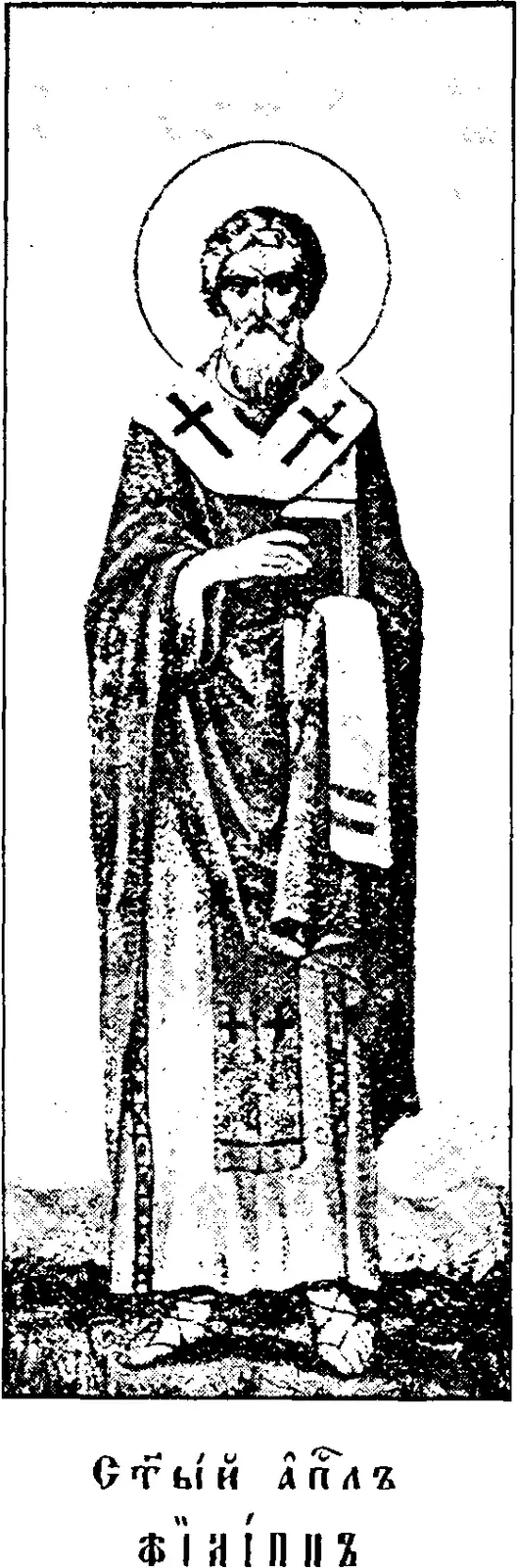
- Office
- One of the seven chosen at Jerusalem to serve the daily distribution, ordained by the laying on of the Apostles' hands 14
- Known for
- Preaching in Samaria, and baptizing the treasurer of the queen of Ethiopia on the road to Gaza 2910
Saint Philip the Deacon was one of the seven men the first Christians of Jerusalem chose to see that their widows were fed, and he became the first preacher of the Gospel in Samaria and the man who baptized the Ethiopian treasurer on the desert road to Gaza. 12 Luke calls him "Philip the evangelist," and years later Paul stayed in his house at Caesarea, where he lived with four daughters who prophesied. 3 He is commemorated in the Roman Martyrology on October 11. 10
One of the seven
The occasion was a complaint. As the number of disciples grew, those who spoke Greek complained against those who spoke Hebrew that "their widows, they said, were neglected in the daily administration of relief." 1 The Twelve called the community together and said it was too much that they should "forgo preaching God's word, and bestow our care upon tables," and asked for seven men "well spoken of, full of the Holy Spirit and of wisdom." 1
The assembly chose Stephen, then Philip, then Prochorus, Nicanor, Timon, Parmenas and Nicolas, a proselyte from Antioch. "These they presented to the apostles, who laid their hands on them with prayer." 1 Johann Peter Kirsch, writing in the Catholic Encyclopedia, calls this "the first separation of an ecclesiastical, hierarchical office from the Apostolate," and says of Nicanor, Timon and Parmenas that nothing more is known. 4
Of the rest, two step out of the list almost at once. Stephen preached and was stoned; Philip preached and traveled. 12 Butler, who places Philip second in the catalogue, adds on the authority of Isidore of Pelusium that he was a native of Caesarea, and says he "excelled so much in preaching the gospel, that he acquired the name of Evangelist." 8
Samaria
After Stephen's death the church in Jerusalem was scattered, all but the Apostles, and "those who had been driven away spread the gospel as they went from place to place." 2 Philip went down to a city of Samaria and preached Christ there. The crowds listened, unclean spirits came out of many with a loud cry, the paralyzed and the lame were healed, "and there was great rejoicing in that city." 2
Pope Francis, in his catechesis on the Acts in 2019, read the scattering as the engine of the story: "persecution, rather than extinguishing the fire of evangelization, fuels it even more." 9
One of those baptized was Simon, a sorcerer who had held the city in thrall and was hailed as "the great angel of God." He stayed close to Philip, "astonished by the great miracles and signs he saw happening." 2 When the Apostles in Jerusalem heard that Samaria had received the word, they sent Peter and John, who laid hands on the baptized so that they received the Holy Spirit. Simon offered them money for the same power and was rebuked by Peter: "Take thy wealth with thee to perdition, thou who hast told thyself that God's free gift can be bought with money." 2 Butler notes that the sin of buying spiritual things is called simony after him. 8
The road to Gaza
Then an angel of the Lord told Philip to go south "to meet the road which leads from Jerusalem to Gaza, out in the desert." 2 On it he found an Ethiopian, a eunuch, a court official of Candace, queen of Ethiopia, in charge of all her treasure, on his way home from worshiping at Jerusalem and reading the prophet Isaiah in his chariot. 2 The Spirit told Philip to go up to the chariot. He ran, heard the man reading, and asked, "Canst thou understand what thou art reading?" 2
"How could I, said he, without someone to guide me?" 2 The passage was the one about the lamb led to the slaughter and silent before its shearer, and the Ethiopian asked whom the prophet meant, himself or someone else. Philip began from that passage and preached Jesus to him. 2 When they came to water, the Ethiopian asked what kept him from being baptized; he had the chariot stopped, and the two went down into the water, and Philip baptized him. 2
Francis drew attention to the man before the miracle: a powerful official who "had all the power of money but he knew that without the explanation, he could not understand; he was humble." 9 And he insisted on who had arranged the meeting. "Who stirred Philip to go to the desert to encounter this man? ... It is the Holy Spirit. The Holy Spirit is the protagonist of evangelization." 9
When they came up from the water, the Spirit of the Lord carried Philip off, and the eunuch saw him no more; "he went on his way rejoicing." 2 Philip "was next heard of at Azotus," and preached in all the towns along the way until he came to Caesarea. 2 Butler adds that Saint Jerome counts the eunuch as the apostle of his own country, and that the Abyssinians still regarded him so in Butler's day. 8
The house at Caesarea
Philip appears once more in the Acts, many years later and in passing. Paul, on his last journey to Jerusalem, came to Caesarea, "where we went to the house of Philip the evangelist, one of the seven, and lodged with him. He had four daughters, unwedded maids, who possessed the gift of prophecy." 3 Butler dates the visit to the year 58. 8
It was in that house that the prophet Agabus came down from Judaea, took Paul's girdle, and bound his own hands and feet with it as a sign of what awaited Paul in Jerusalem. Philip's household was among those who begged Paul not to go. 3
Three centuries later the house was still being shown. Saint Jerome, describing the pilgrimage of his friend Paula through the Holy Land, says that at Caesarea "she saw the house of Cornelius now turned into a Christian church; and the humble abode of Philip; and the chambers of his daughters the four virgins which did prophesy." 7
Two Philips at Hierapolis
Where Philip died is not recorded in the Acts, and the early tradition is tangled. Eusebius quotes a letter of Polycrates, bishop of Ephesus, naming among the "great lights" of Asia "Philip, one of the twelve apostles, who sleeps in Hierapolis, and his two aged virgin daughters, and another daughter who lived in the Holy Spirit and now rests at Ephesus." 6 He then quotes Proclus: "there were four prophetesses, the daughters of Philip, at Hierapolis in Asia. Their tomb is there and the tomb of their father." Eusebius sets beside them the passage from the Acts about Philip the evangelist and his four daughters at Caesarea. 6
Kirsch finds it "extraordinary" that the Apostle Philip should have virgin daughters buried at Hierapolis and the deacon Philip four prophesying daughters said to be buried there too, and suggests that the two Philips were confused. 5 Butler is plainer: "St. Philip probably died at Caesarea. It was the apostle St. Philip who died at Hierapolis, whose death and daughters some have confounded with the deacon's." 8 The Roman Martyrology says he evangelized every town he passed through as far as Caesarea, "where he is thought to have ended his days." 10 Nothing in the sources consulted says how he died.
What is Saint Philip the Deacon the patron saint of?
Saint Philip the Deacon's feast day
Saint Philip the Deacon's feast day is October 11. The current Roman Martyrology, in the text published by the Italian bishops, commemorates him on that day as one of the seven deacons chosen by the Apostles, who converted Samaria and baptized the eunuch of Candace, queen of Ethiopia. 10
October 11 is also the date Kirsch gives for his feast in the Greek Church. In the West he was formerly kept on June 6: Kirsch gives that date, and Butler places his life there. 48
Praying with Saint Philip
Philip was chosen to wait on tables so that others could preach, and then he preached. 12 The Acts never shows him doing the work he was appointed for; it shows him doing the work he was sent to. 23
The meeting on the Gaza road begins with a question and an honest answer. A man of rank admits he cannot understand what he is reading without someone to guide him, and Philip sits beside him and starts from the very page he is stuck on. 2 Francis saw humility on both sides of that chariot. 9
Then Philip is gone. He does not stay to see what becomes of his convert; the Ethiopian goes on alone, rejoicing, and Philip turns up somewhere else and keeps preaching. 2 When the Acts last sees him, he has a house at Caesarea, a family that prophesies, and a door open to Paul on his way to prison. 3
Saint Philip the Deacon, pray for us.
Sources
- 1.The Acts of the Apostles, chapter 6, Knox translation, New Advent.
- 2.The Acts of the Apostles, chapter 8, Knox translation, New Advent.
- 3.The Acts of the Apostles, chapter 21, Knox translation, New Advent.
- 4.Johann Peter Kirsch, "Seven Deacons," The Catholic Encyclopedia, Vol. 13 (New York: Robert Appleton Company, 1912).
- 5.Johann Peter Kirsch, "St. Philip the Apostle," The Catholic Encyclopedia, Vol. 11 (New York: Robert Appleton Company, 1911).
- 6.Eusebius, Church History, Book III, chapter 31, trans. Arthur Cushman McGiffert, Nicene and Post-Nicene Fathers, Second Series, Vol. 1 (1890), New Advent.
- 7.Jerome, Letter 108, to Eustochium, trans. W. H. Fremantle, Nicene and Post-Nicene Fathers, Second Series, Vol. 6 (1893), New Advent.
- 8.Alban Butler, "St. Philip the Deacon," June 6, in The Lives of the Fathers, Martyrs, and Other Principal Saints, Vol. VI (Derby: Richardson and Son, 1842), Internet Archive.
- 9.Pope Francis, General Audience, October 2, 2019 (catechesis on the Acts of the Apostles: Philip and the Ethiopian), Holy See.
- 10.Roman Martyrology, entries for October 11, Santo del giorno, Conferenza Episcopale Italiana (in Italian).
Saints to turn to next
Others in this collection who are turned to for some of the same things.