Saint Philip the Apostle
First century
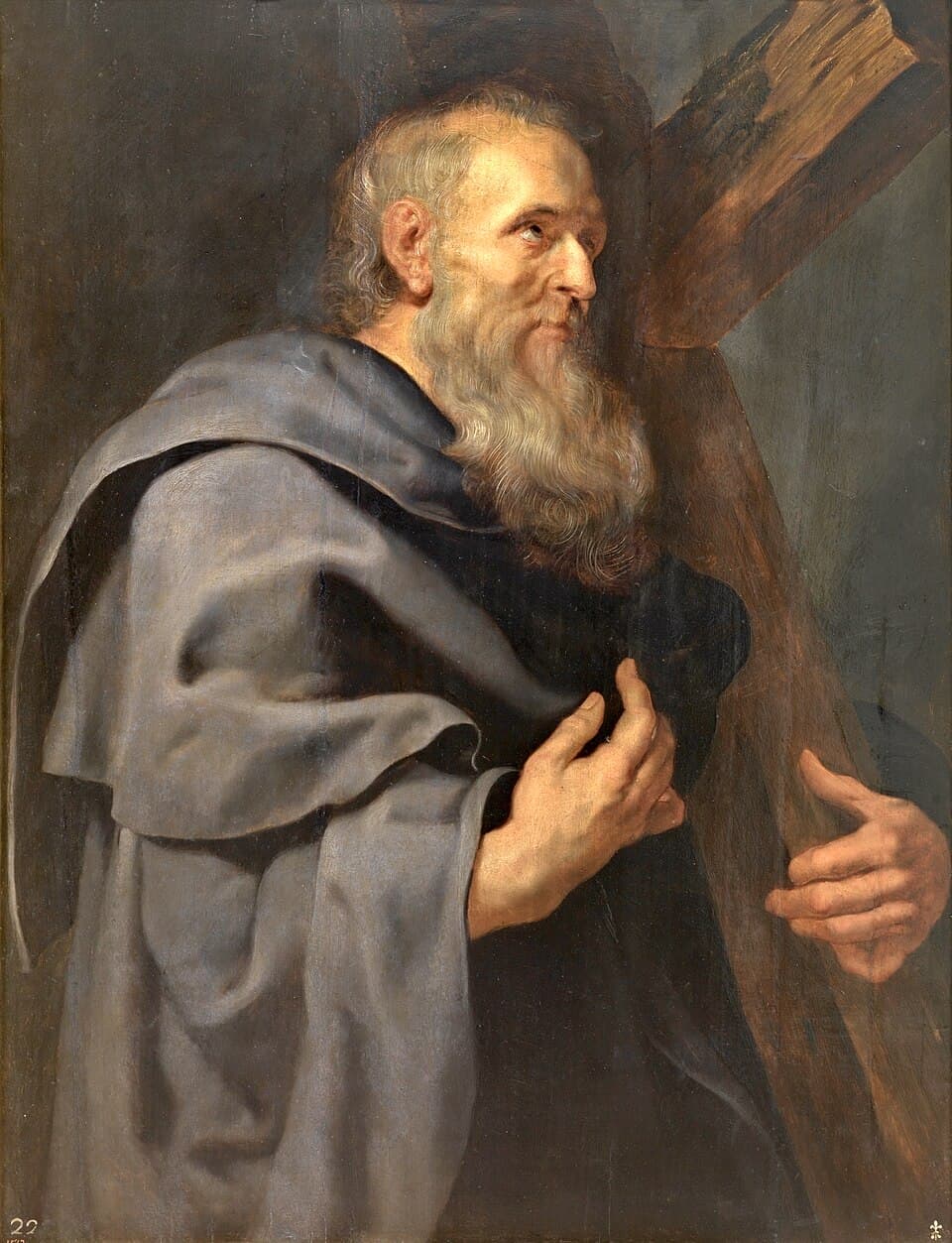
- Feast day
- May 3, kept with James 3. Kirsch in 1911 gives 1 May in the Roman Church and 14 November in the Greek 1
- Name
- Greek, though he was of Jewish origin - a sign of cultural openness, Benedict XVI says 2
- Said to have died
- At Hierapolis, by a torture later accounts describe variously as crucifixion or stoning 2
- The difficulty
- Kirsch: "it is difficult to decide which of the two, the Apostle or the deacon, was buried in Hieropolis" 1
Saint Philip is the Apostle who said "Come and see" rather than argue, and who at the Last Supper asked Jesus to show them the Father - drawing the answer that whoever has seen him has seen the Father. 12 Kirsch reads his three scenes as a consistent portrait: "a naive, somewhat shy, sober-minded man." 1 What became of him afterward is genuinely unclear, because the record keeps confusing him with a different Philip. 1
Bethsaida, and a Greek name
Philip came from Bethsaida on Lake Genesareth, the town of Peter and Andrew. 12 He was among those around John the Baptist when the Baptist first pointed out Jesus as the Lamb of God, and the day after Peter's call, as Jesus was setting out for Galilee, he was called with two words: "Follow me." 1
Benedict XVI makes something of the name. Philip was of Jewish origin and his name is Greek, like Andrew's, and this is "a small sign of cultural openness that must not be underestimated." 2 It matters later, when Greeks in Jerusalem pick him out of the Twelve to approach.
He is fifth in every list, after the two pairs of brothers - Peter and Andrew, James and John. 12 Benedict notes what that placement means: "hence, he is definitely among the first." 2
Come and see
The first thing he does after being called is fetch somebody else. He finds Nathanael and tells him they have found the one Moses and the prophets wrote about, Jesus of Nazareth, and gets the famous cold answer: can anything good come out of Nazareth? 12
Benedict admires the reply. Philip "does not give way" and does not argue the point; he says "Come and see!" 2 In that "dry but clear response," Benedict says, "Philip displays the characteristics of a true witness: he is not satisfied with presenting the proclamation theoretically, but directly challenges the person addressing him by suggesting he have a personal experience of what he has been told." 2
The same two words are what Jesus says to the two disciples of the Baptist who ask where he is staying. 2 Benedict builds the point out: Mark says Jesus chose the Twelve primarily "to be with him," and Paul tells the Ephesians the thing that matters is to "learn Christ" - not so much to hear his teaching as to know him in person. 2 "How will we be able to get to know him properly by being distant?" 2
Three scenes, and a character
John gives Philip three moments in the public ministry, and Kirsch thinks they add up to a portrait.
Before the feeding of the multitude, Jesus turns to him and asks where bread can be bought for all these people. Philip answers by doing the arithmetic: two hundred pennyworth would not be enough for each to have a little. 12 Benedict calls this "the practicality and realism of the Apostle who can judge the effective implications of a situation," and notices something else - that Jesus put the problem to Philip at all, "an obvious sign that he belonged to the close group." 2
When Greeks in Jerusalem for the Passover want to see Jesus, they come to Philip, who tells Andrew, and the two of them tell Jesus. 12 Benedict suggests the practical reason he was approached: "he probably spoke Greek and could serve as an interpreter." 2 And he draws out the role rather than the man: the requests people bring us "are not ultimately addressed to us, but to the Lord," so "each one of us must be an open road towards him." 2
The third is at the Last Supper. After Jesus says that to know him is to know the Father, Philip asks - Benedict says "quite ingenuously" - "Lord, show us the Father, and we shall be satisfied." 2 The answer is a gentle rebuke and one of the highest things in the Gospel: "Have I been with you so long, and yet you do not know me, Philip? He who has seen me has seen the Father." 12
Kirsch's summary of the three is plain and rather affectionate: "These three episodes furnish a consistent character-sketch of Philip as a naive, somewhat shy, sober-minded man." 1
Which Philip is buried at Hierapolis?
Kirsch is blunt about how little follows the Gospels. "No additional characteristics are given in the Gospels or the Acts," and "the second-century tradition concerning him is uncertain, inasmuch as a similar tradition is recorded concerning Philip the Deacon and Evangelist - a phenomenon which must be the result of confusion caused by the existence of the two Philips." 1
The evidence he then sets out is a genuine historical tangle. Polycrates of Ephesus, writing to Pope Victor about 189-98, names among the "great lights" whom the Lord will seek on the last day "Philip, one of the Twelve Apostles, who is buried in Hieropolis with his two daughters, who grew old as virgins," and a third daughter who "led a life in the Holy Ghost and rests in Ephesus." 1 Against that, the Dialogue of Caius has the Montanist Proclus declaring that "there were four prophetesses, the daughters of Philip, at Hieropolis in Asia where their and their father's grave is still situated." 1
The trouble is that Acts records four prophetess daughters belonging to the deacon Philip, living at Caesarea. 1 Kirsch weighs it: Polycrates "carries in itself more authority, but it is extraordinary that three virgin daughters of the Apostle Philip (two buried in Hieropolis) should be mentioned, and that the deacon Philip should also have four daughters, said to have been buried in Hieropolis." 1 His conclusion is the honest one: "it is difficult to decide which of the two, the Apostle or the deacon, was buried in Hieropolis." 1
Benedict reports the later accounts - the Acts of Philip and others - that he evangelized Greece and died at Hierapolis "by a torture described variously as crucifixion or stoning." 2 Kirsch adds that the remains of the Philip buried there were afterward moved, "as those of the Apostle," to Constantinople and then to the church of the Dodici Apostoli in Rome. 1 That parenthesis is doing a great deal of work, and it is his, not ours.
What is Saint Philip the Apostle the patron saint of?
Saint Philip the Apostle's feast day
The feast of Saint Philip the Apostle is May 3, kept together with Saint James. 13 The encyclopedia records an older arrangement and New Advent's editors have marked the change: Kirsch, writing in 1911, gives 1 May in the Roman Church "together with that of James the Younger," and 14 November in the Greek Church, and the article now carries an editorial note that the feast is celebrated on 3 May. 1 Franciscan Media keeps the two Apostles together on that day. 3 The pairing with James is older than the date, and survived the move.
Praying with Saint Philip
Two words are the whole of what he is remembered for, and they are worth copying exactly. Faced with a sneer he could not answer - the objection about Nazareth was a fair one on the premises of the day - he did not produce a better argument. He said come and see. 2 Anyone who has tried to defend the faith in an argument they were losing has reason to envy the move.
The question at the Supper is the other half. "Lord, show us the Father, and we shall be satisfied." 2 It is not a clever question and Benedict calls it ingenuous, which is a kind word for naive. It is also the question most people actually have, asked out loud by somebody who had been with Jesus for three years and still wanted something more definite. The answer he got is the reason anyone remembers him.
Kirsch's phrase for him - naive, somewhat shy, sober-minded - reads almost like a reference for a middling employee. 1 He counts the money and reports that there is not enough. He takes a message from strangers and passes it to someone senior. He asks the obvious thing at the worst moment. None of that is impressive and all of it is recognizable.
Benedict ends on what Philip is for: "to encounter Jesus as Philip encountered him, seeking to perceive in him God himself." 2 Whether the bones at Hierapolis were ever his is not settled and probably never will be. 1 What survives with certainty is two words he said to a skeptic, which still work.
Saint Philip the Apostle, pray for us.
Sources
Saints to turn to next
Others in this collection who are turned to for some of the same things.