Saint Philip Neri
1515 - May 1595
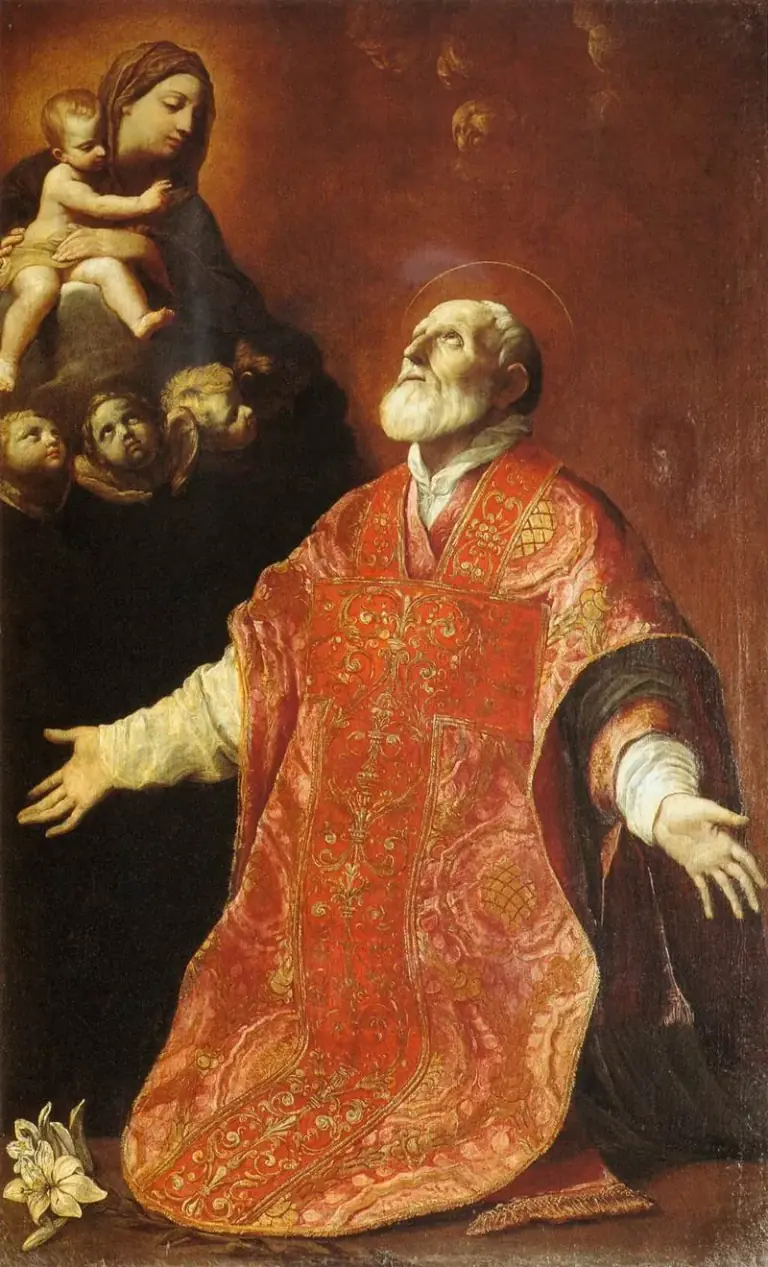
- Feast day
- May 26 2
- Known as
- The Apostle of Rome, and the amabile santo - the lovable saint 1
- Ordained
- 1551, at his confessor's insistence 1
- Founded
- The Congregation of the Oratory, recognized by Gregory XIII in 1575 1
- Canonized
- 1622, by Pope Gregory XV 1
Saint Philip Neri converted sixteenth-century Rome by being extremely good company. He heard confessions for decades, gave spiritual direction to half the city, and did it while telling jokes - his stated aim being that people should become not less human but more. He is the patron saint of nothing in particular, and one of the most useful saints alive for anyone who suspects holiness requires becoming duller.
Arriving in Rome with nothing
Philip was born at Florence in July 1515 and came to Rome in 1533 without money, devoting himself, in the encyclopedia's phrase, "entirely to the sanctification of his own soul and the good of his neighbour." 1
He began where Catholic reformers usually begin and where few stay: visiting hospitals. Then he took it into the street, going into the shops, warehouses and banks of Rome and simply talking to people. 1 Franciscan Media notes he gave himself to the poor and the marginalized of the city. 2
The young men
His method was disarmingly informal. He spent his afternoons inviting young men to meetings that were half prayer and half company - church visits, spiritual exercises, conversation - and a striking number of them ended up in religious life. 1
In 1548 he founded the Confraternity of the Most Holy Trinity for pilgrims and convalescents. 1 He was ordained in 1551, and only because his confessor insisted; he had not been angling for it. 1
The Oratory
The afternoon meetings became a settled thing in 1558, and the Congregation of the Oratory was recognized by Gregory XIII in 1575. 1 Franciscan Media describes what a session actually looked like: four informal talks, vernacular hymns and prayers - with music by Palestrina, who was one of his penitents. 2
Everything about that is deliberate. Talks rather than sermons, the vernacular rather than Latin, laypeople rather than clergy, and good music. Philip built the Counter-Reformation's most attractive institution by assuming people would come if it was worth coming to.
The confessor
Philip spent an enormous part of his life in the confessional. Franciscan Media credits him with "the knack of piercing the pretenses and illusions of others" 2 - the specific gift of a good spiritual director, which is not severity but accuracy.
He counseled, it says, "always in a charitable manner and often with a joke," and names his characteristic virtues as "humility and gaiety." 2 The encyclopedia calls him the amabile santo, the lovable saint, and describes teaching that was "quaintly humorous." 1 Rome called him the Apostle of Rome. 1
What is Saint Philip Neri the patron saint of?
Nothing that the sources cited here will state. He has no individual patronage in the Catholic Encyclopedia article, in Franciscan Media's entry, or in their list of popular patron saints - which is unusual for a saint this widely loved, and is left as it is rather than filled in.
What he is for is a different question, and easier: prayer, spiritual direction, and the conversion of people who were not looking for it.
Saint Philip Neri's feast day
The feast of Saint Philip Neri is celebrated on May 26. 2
Praying with Saint Philip Neri
Philip wanted people to come out of their religion more human than they went in, not less. 2 If faith has been quietly shrinking you, he is the correction, and he is a cheerful one.
Franciscan Media credits him with piercing the pretenses and illusions of others 2, which sounds severe and was not. He used it charitably and usually with a joke. That is what good spiritual direction feels like from the inside: being caught, kindly.
He converted a good deal of Rome by walking into shops and warehouses and banks and talking to people. 1 Anyone who has tried lecturing a relative back to the faith might take the hint.
The encyclopedia names humility and gaiety as his two characteristic virtues, in the same breath. 1 Rome called him the amabile santo. He is the patron saint of nothing the sources will name, and he formed half a city.
Saint Philip Neri, pray for us.
Sources
Saints to turn to next
Others in this collection who are turned to for some of the same things.