Saint Peter Faber
April 13, 1506 - August 1, 1546
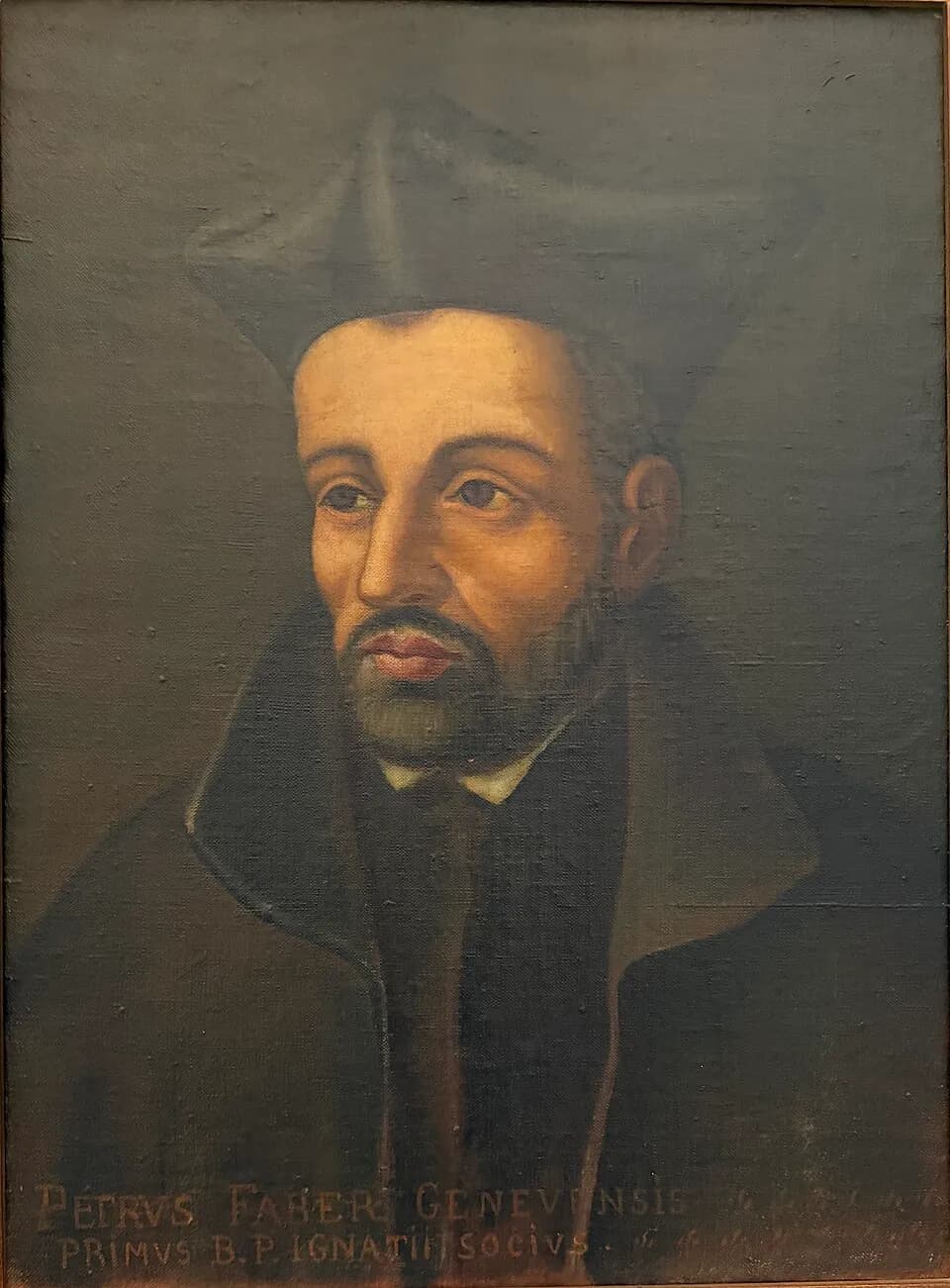
- Also called
- Pierre Lefèvre or Favre, in French 2
- Patron saint of
- No patronage is named in the sources consulted
- Beatified
- September 5, 1872 1
- Canonized
- 2013, by Pope Francis 2
Saint Peter Faber was a shepherd boy from Savoy who shared a room in Paris with Francis Xavier and Ignatius of Loyola, was ordained ahead of both, and spent the rest of his short life walking across Europe giving the Spiritual Exercises. 12 Benedict XVI called him "a modest, sensitive man with a profound inner life," endowed with "the gift of making friends with people from every walk of life." 4 Pope Francis canonized him in 2013, and his feast is kept on August 1. 2
A shepherd in Savoy
He was born on April 13, 1506, at Villaret in Savoy, in the mountains of what is now Haute-Savoie in France. 124 As a boy he looked after his father's sheep during the week, and on Sundays he taught the catechism to other children. 1 Vatican News says the people around him noticed that the little shepherd had an agile mind and an extraordinary memory, and so he was taught to read. 2
The 1913 Catholic Encyclopedia says he was first put in the care of a priest at Thônes and then sent to a school nearby. 1 He had no settled plan for his future, but he wanted to study, and his parents let him go. 1 In 1525, at nineteen, he set out for Paris. 12
The room at Sainte-Barbe
He was admitted without fees to the college of Sainte-Barbe and shared lodgings in a tower with a student from Navarre, Francis Xavier. 1 The two became close friends and took their master of arts degrees on the same day in 1530. 1 Then a third student joined them: Ignatius of Loyola, a Spaniard a little older than most of the others, who was finding some of the university courses hard. 12
Vatican News tells what happened next as an exchange. Peter tutored Ignatius in philosophy, and Ignatius, who by then had gone a long way in the spiritual life, became Peter's master in the life in Christ. 2 The encyclopedia puts it more briefly: Faber came to Paris for learning and "found quite unexpectedly his real vocation." 1
He was ordained in 1534, the first of the three roommates to become a priest, and so on August 15 of that year it was Faber who received his companions' vows in a small chapel on Montmartre. 12 When the friends left Paris, Ignatius charged Faber with leading them to Venice; they set out on November 15, 1536, and rejoined Ignatius there in January 1537. 1 Their plan to work in the Holy Land proved impossible, and the little company, which had begun to call itself the Society of Jesus, put itself at the disposal of the pope. 2
Germany and the Diets
Pope Paul III sent him first to cities in Italy, among them Parma and Piacenza, and then to Germany. 12 He attended the Diet of Worms in 1540 and that of Ratisbon in 1541, and Benedict XVI notes that he also took part, at the pope's order, in conversations with the leaders of the Reformation. 14
What he found shocked him. 12 Vatican News says the Church there was in disarray, from the Reformers and also from what they had been reacting against: clergy with no spiritual life, abuses of many kinds, a thin and listless Christianity. 2 The encyclopedia says he concluded that the remedy "did not lie in discussions with the heretics, but in the reform of the faithful," above all of the clergy. 1
So alongside the formal work he set about an interior reform, one person at a time. 2 He befriended hundreds of people and led them through the Spiritual Exercises; according to the encyclopedia, "princes, prelates, and priests revealed their consciences to him." 12 Demand grew so fast that he wrote to Ignatius that there was work enough in Germany for ten more Jesuits. 2
Always on foot
For the next five years he hardly stopped moving. 2 The encyclopedia says Ignatius recalled him to Spain, and that he had been there barely six months before the pope sent him back to Germany, where he worked for nineteen months at Speyer, Mainz and Cologne. 1 He spent some months in Louvain in 1543, and in August 1544 obedience took him out of Germany again, to Portugal and then Spain. 1 Vatican News says he walked to all of these places. 2
It was quiet work and it lasted. The encyclopedia credits him with deciding the vocation of Peter Canisius, which it says is enough on its own to justify calling Faber the Apostle of Germany, and with doing more than anyone to strengthen the vocation of Francis Borgia in Spain. 1 Benedict XVI says his gift for friendship "attracted many young men to the Society." 4
Simon Rodrigues, another of the first Jesuits, remembered him as "endowed with charming grace in dealing with people," and said that "his very way of living and gracious conversation powerfully drew to the love of God all those with whom he dealt." 2 Benedict XVI also held him up for another reason: his journeys were the vow of obedience to the pope "regarding the missions" carried out in practice, which made him "a model to follow for all future Jesuits." 4
His death in Rome
By forty he was worn out by the work and the walking. 1 The pope wanted him at the Council of Trent as a theologian of the Holy See, and the encyclopedia adds that King John III of Portugal wanted him made Patriarch of Ethiopia. 12 He set out in obedience, and stopped in Rome to see Ignatius, whom he had not seen for seven years. 2
He arrived on July 17, 1546, weakened by fever, and never reached Trent. 12 He died on August 1, in the arms of Ignatius, as the encyclopedia tells it; Vatican News adds "it is said." 12 People who had known him were already invoking him as a saint, and the encyclopedia notes that Francis de Sales "never spoke of him except as a saint." 1 He was beatified on September 5, 1872, and Pope Francis canonized him in 2013. 12
What is Saint Peter Faber the patron saint of?
None of the sources consulted for this page names a patronage for Saint Peter Faber, and none is claimed here. 12 The 1913 Catholic Encyclopedia records that Savoy "has never ceased to venerate him as a saint," which is a devotion and not a formal patronage. 1 Vatican News remembers him as a guide of souls and "a master at giving the Spiritual Exercises." 2
Saint Peter Faber's feast day
Praying with Saint Peter Faber
Most of what he did was conversation. He went to Worms and Ratisbon on official business, but what he left behind in Germany was a long list of people he had sat with, one at a time, through the Spiritual Exercises. 12 Benedict XVI singles out the same gift: he made friends "with people from every walk of life." 4
Pope Francis, in a homily at the Gesù in Rome in January 2014, picked out a restlessness in him, "a restless, unsettled, spirit that was never satisfied," which Ignatius taught him to join to "the ability to make decisions." 3 Faber, the pope said, "could discern God's voice in his desires," and he quoted the Jesuit's private notebook, the Memoriale, on leaving "the first place" in the heart "to the perfect intention of finding our Lord God." 3
The same homily took up the way Faber dealt with the people he disagreed with. Francis spoke of the temptation to link the Gospel with "inquisitorial blows," and answered it with Faber: "No, the Gospel is proclaimed with gentleness, with fraternity, with love." 3 The 1913 encyclopedia, a century earlier, had already named "his gentle sanctity" as the reason his companions esteemed him next after Ignatius. 1
He never stayed anywhere long. Francis quotes what was said of him, "it seems he was born not to stay put anywhere," and he died at forty on the way to yet another assignment, having stopped in Rome to see an old friend. 123 Francis ended the homily with a line from Faber's notebook: "let us never seek in this life to be tied to any name but that of Jesus." 3
Saint Peter Faber, pray for us.
Sources
- 1.P. Suau, "Bl. Peter Faber," The Catholic Encyclopedia, Vol. 11 (New York: Robert Appleton Company, 1911).
- 2."St Peter Faber, Jesuit," Saint of the Day, August 1, Vatican News.
- 3.Pope Francis, Homily at Holy Mass at the Church of the Gesù, Rome, January 3, 2014.
- 4.Pope Benedict XVI, Address to the Fathers and Brothers of the Society of Jesus, April 22, 2006.
Saints to turn to next
Others in this collection who are turned to for some of the same things.