Saint Amatus of Remiremont
c. 567 - c. 630
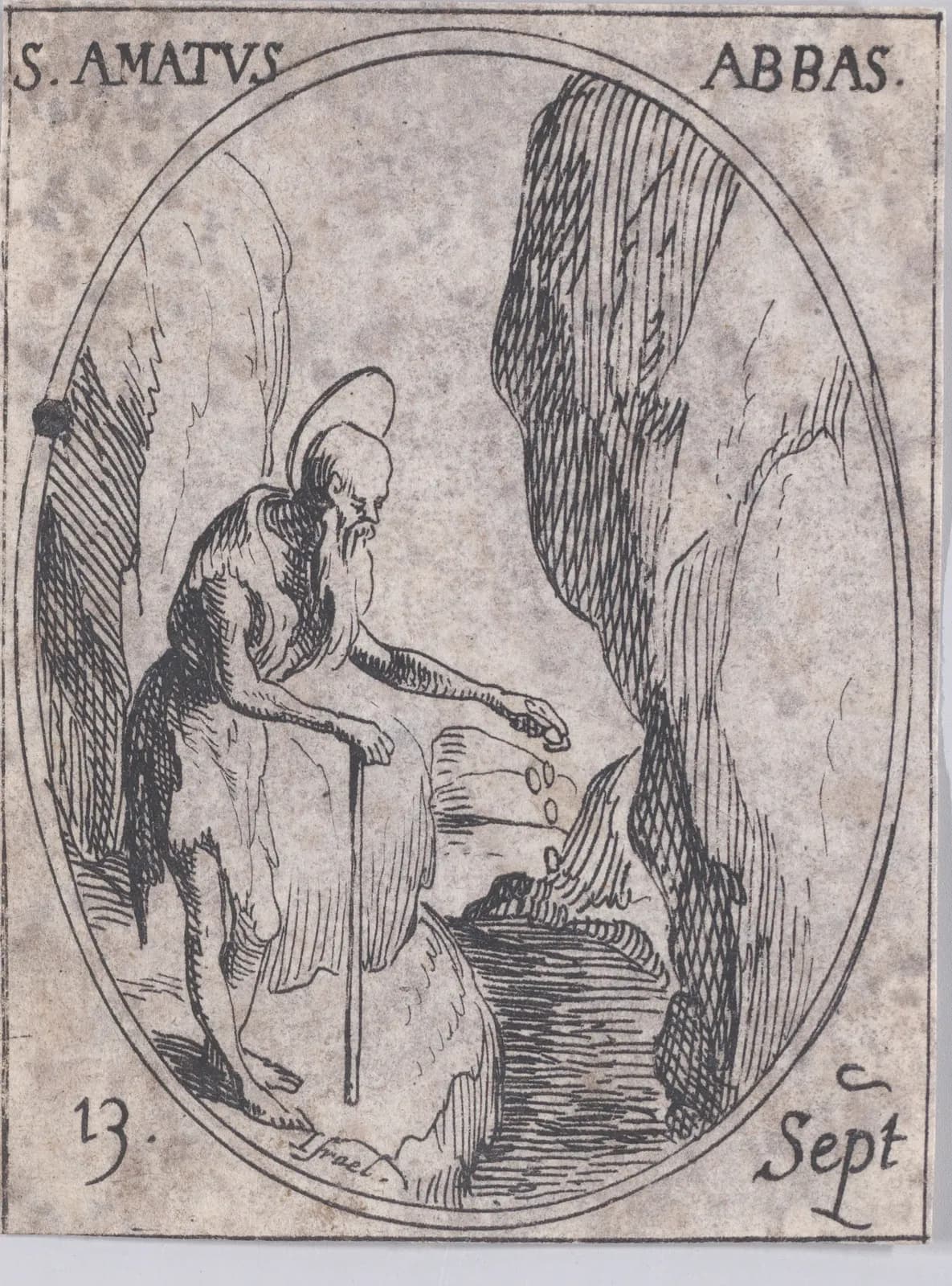
- Known for
- Austerity, fasting and love of solitude 2
Saint Amatus was a monk who wanted above all to be alone, and who spent his life being drawn back into community. He lived for some thirty years at the abbey of Saint-Maurice at Agaune, preached in Austrasia, converted the courtier Romaricus, and with him founded the double monastery in the Vosges that became Remiremont. 134 The Roman Martyrology remembers him for his austerity, his fasting and his desire for solitude. 2
Agaune
Almost everything known about Amatus comes from a Latin Life that the sources treat with caution. The Norwegian bishops' saints database (katolsk.no) says it was once taken for the work of a near-contemporary monk of Remiremont, but that many scholars now date it fifty or even two hundred years after his death and consider it wholly unreliable. 1 The Archdiocese of Madrid's daily santoral calls it a tangle of fables from which a biographer can only pick out the outline of a life. 3
That outline begins near Grenoble, where he was born into a Gallo-Roman family about 567, by katolsk.no's reckoning, or about 565, by Madrid's. 13 katolsk.no names his father as a noble called Heliodorus. 1 As a boy of about sixteen he entered the abbey of Saint-Maurice at Agaune, in the Valais, and he stayed there more than thirty years, first as a pupil and then as a monk, and was ordained a priest. 13
Toward the end of those years he left the common life for a hermit's cell above the monastery. 13 The two accounts of how he lived there differ in the details. katolsk.no says a brother named Berinus brought him barley bread, water and a few nuts every third day, and that he grew his own food in a small garden. 1 Madrid says the monks brought him vegetables and water once a week. 3 Madrid also tells, with some amusement, the story that the devil smashed his water jug and threw his food down the cliff, so that Amatus took to growing barley to spare the brothers the climb, and that he struck water from the rock with his staff. 3
Luxeuil, and Romaricus
In 614 Eustace, abbot of Luxeuil, stopped at Agaune. katolsk.no says he was on his way back from Bobbio, where he had failed to persuade the aging Columban to return; Madrid says he was on his way to Rome. 13 Both agree that Eustace met the hermit and admired him. 13 katolsk.no says Amatus went back with him to Luxeuil and its Columbanian rule; Madrid says Eustace encouraged him to go out and preach in Austrasia. 13
He did not stay in his cell there either. katolsk.no says Eustace sent him out to preach because he had a gift for it, and that on one of these missions, about 615, he came to the court of Austrasia at Metz. 1 There he met Romaricus, a rich nobleman of the court, and both sources say it was Amatus's preaching that turned him to the monastic life. 13 katolsk.no says Romaricus entered Luxeuil and gave his fortune away, keeping only an estate at a ruined fort called Habendum in the Vosges. 1
On that estate, in 620, the two men founded a monastery, first for women and soon for men as well. 14 Joseph Dedieu-Barthe, in the 1911 Catholic Encyclopedia, gives the same year and says the house stood on the hills above the present town, which took its name, Remiremont, from Romaricus. 4 katolsk.no says Amatus brought from Agaune the custom of perpetual praise, in which groups of nuns took turns singing the office day and night, and that some eighty-four nuns lived there. 1 One of those who came to live nearby was Romaricus's old friend Arnulf, the former bishop of Metz. 1
Abbot and hermit
Amatus was the first abbot, and the sources disagree on how long he governed. 13 Madrid says he ruled the house for fifteen years, in the last stage of his life. 3 katolsk.no says that from the beginning he lived as a hermit at some distance, in a cave in the rock, coming down on Sundays to celebrate the office and preach to the nuns, and that he left the running of the monastery more and more to Romaricus. 1
The community's early years were not untroubled. katolsk.no tells, from Jonas of Bobbio's life of Eustace, how a monk named Agrestius, expelled from Luxeuil for siding with a schism, came to Habendum and won Romaricus and Amatus over, so that they grew cold toward Eustace when he rebuked them. 1 A series of misfortunes followed, which the two founders took for a warning. After Agrestius died, about 628, they asked Eustace's forgiveness and restored order, and katolsk.no says the fault weighed on Amatus's conscience for a long time. 1
He spent his last years in his cell, tending a garden and the nuns' bees, and coming to the choir only on Sundays and feasts. 1 Near death, says katolsk.no, he lay on a bed of ashes, and asked to have read to him Pope Leo the Great's letter to Flavian on the Trinity and the Incarnation, as a profession of the Catholic faith and a sign that he renounced his earlier error. 1 He died on September 13, about 630; katolsk.no notes that some historians say 627 or 629. 13
His relics and his cult
He asked to be buried at the church door, but the monks later had to move his body inside because of the visitors who came to his grave. 1 Romaricus succeeded him as abbot of both communities. 1 Madrid says his reputation spread so far that he was entered in the Roman Martyrology in the ninth century. 3
The relics of the two founders stayed on the mountain until the nuns moved down into the valley, in 870 according to katolsk.no, in 910 according to the encyclopedia, which says they were fleeing the Huns. 14 They took the relics with them to the new convent, around which the town of Remiremont grew. 14 Pope Leo IX, says katolsk.no, enshrined the relics of Amatus, Romaricus and Adelphius in 1049, which amounted to a canonization, and the reliquaries are still in the abbey church today. 1 The encyclopedia records that the nuns later became noble canonesses and that the house was suppressed at the Revolution. 4
What is Saint Amatus the patron saint of?
None of the sources consulted names a patronage for Saint Amatus. katolsk.no says he is venerated chiefly at Grenoble and Saint-Dié, and that a pilgrimage is still made every September 13 to his cave on the Saint-Mont, where the village of Saint-Amé bears his name. 1 He is shown as a hermit, with a jug, a stone and a devil. 1
Saint Amatus's feast day
Saint Amatus's feast day is September 13. 123 The current Roman Martyrology enters him that day in the Vosges as a priest and abbot who governed the monastery of Habendum, which he had founded with Saint Romaricus. 12 On the same day it remembers another Saint Amatus, bishop of Sion, who began his monastic life at Agaune too, and katolsk.no warns that the two have often been confused. 12
Praying with Saint Amatus
Amatus wanted solitude, and the sources agree that he kept finding it and kept being called out of it: from his cell at Agaune to Luxeuil, from Luxeuil to preach at court, and from the cave above Habendum down to the choir every Sunday. 13 Romaricus's whole religious life began with a sermon Amatus preached while he would rather have been alone. 13
His story also includes a real mistake. katolsk.no does not soften the Agrestius affair: a founder and abbot led his community toward a schism and a quarrel with his own superior, and it took years and a series of disasters to bring him back. 1 He asked forgiveness, and at the end he had the Church's faith read aloud over him as he died. 1
Even his Life is untrustworthy, and both the Norwegian and the Spanish accounts say so plainly. 13 What is left is a monk, an abbot and a friend, remembered for more than thirteen hundred years at the mountain where he lived. 12
Saint Amatus of Remiremont, pray for us.
Sources
- 1."Den hellige Amatus av Remiremont (~567-~630)," Den katolske kirke (katolsk.no), Catholic Diocese of Oslo (in Norwegian).
- 2.Roman Martyrology, entry for September 13, "Sant'Amato, sacerdote e abate," as printed in "Santo del giorno," Conferenza Episcopale Italiana (in Italian).
- 3."Amado, abad (565-630)," Oración y Liturgia, Archdiocese of Madrid, September 13, 2025 (in Spanish).
- 4.Joseph Dedieu-Barthe, "Remiremont," The Catholic Encyclopedia, Vol. 12 (New York: Robert Appleton Company, 1911).
Saints to turn to next
Others in this collection who are turned to for some of the same things.