Saint Philip of Jesus
1572 - February 5, 1597
- Feast day
- February 5 in Mexico 3; February 6 in the general calendar, with Saint Paul Miki and companions 26
Saint Philip of Jesus was a young Franciscan from Mexico City who left the order once, came back to it in Manila, and was on his way home to be ordained when a storm drove his ship onto the coast of Japan. 12 He was crucified at Nagasaki on February 5, 1597, with twenty-five other Christians, and he was the first of them to die. 25 He is honored as Mexico's first saint and as the patron of its capital. 13
A restless boy in Mexico City
He was born Felipe de las Casas in Mexico City, the son of Spanish parents. The Franciscans and the magazine of the Archdiocese of Mexico, Desde la Fe, give the year as 1572; the 1911 Catholic Encyclopedia says the date is unknown. 123 The Franciscans name his parents as Alfonso de las Casas and Antonia Ruiz Martínez. 2
Nobody remembers him as a pious child. The encyclopedia calls him "unusually frivolous as a boy." 1 The Franciscans say he was restless and mischievous, and Desde la Fe adds that he was a poor student who wanted adventure. 23
A legend grew out of that reputation. A dried-up fig tree stood at the family house, and his nurse is supposed to have said that Felipe would be a saint when the fig tree put out green leaves. On the day he died, the story goes, it did. The Franciscans give this as tradition and Desde la Fe as legend, and it is why he is often painted with a fig tree. 23
Out of the order and back again
He tried the Franciscans young, and it did not last. According to the encyclopedia he joined the Discalced Franciscans of the Province of Saint Didacus, but "After some months in the Order, Philip grew tired of monastic life," left, "took up a mercantile career, and went to the Philippines, where he led a life of pleasure." 1 The Franciscans place that first novitiate at Puebla and say it was his father who sent him to Manila to learn trade. 2
The dates differ. The encyclopedia has him leave the order in 1589 and be readmitted at Manila in 1590. 1 Desde la Fe says he sailed for the Philippines in 1593, at twenty-one, and the Franciscans, citing a biographer, say he made his religious profession at Manila in 1594. 24
On why he came back the sources agree in substance. The Franciscans say that he was dazzled by worldly life in Manila until his money ran out and his friends left him. 2 Desde la Fe describes loneliness, spiritual emptiness and a crisis that sent him to the Franciscan community newly established in the city, and says that contact with the poor and the sick showed him his vocation. 34 In the order he stopped being Felipe de las Casas and became Felipe de Jesús. 4
The ship that did not reach Mexico
After some years he was ready for ordination, and there was no bishop to ordain him. The encyclopedia says the see of Manila was vacant at the time, so he was to be ordained in Mexico. 1 He sailed on July 12, 1596. 14
A storm drove the ship onto the coast of Japan. The governor of the province confiscated it and imprisoned the crew and passengers, among them another Franciscan, two Augustinians and a Dominican. 1 Soldiers, cannon and ammunition were found on board, which, the encyclopedia says, "led to the suspicion that it was intended for the conquest of Japan, and that the missionaries were merely to prepare the way for the soldiers." One of the crew said as much, "falsely and unwarrantably." 1 Matthew Bunson, writing for Catholic Answers, identifies the ship as the San Felipe and the man as its pilot, and calls his threats "complete fabrications." 5
The ruler of Japan, Hideyoshi, was enraged. On December 8, 1596, he ordered the arrest of the Franciscans in their house at Miako, the modern Kyoto, where Philip had gone after the wreck. 1
He could have gone free
Philip was a shipwrecked passenger. He was not a priest, he had never preached in Japan, and Desde la Fe points out that he did not even speak the language. 3 The Franciscans say that he could have avoided imprisonment and torture and freely chose the same fate as the missionaries. 2 Desde la Fe says that Spain's representative in Japan tried to save his life and at first won him exemption from some of the torments, and that Philip preferred to share the lot of the others. 3 The encyclopedia does not mention an offer of release. 1
The friars were held in their own house until December 30 and then moved to the city prison. 1 On January 3, 1597, the prisoners' ears were cropped and they were paraded through the streets of Kyoto. On January 21 they were taken to Osaka and from there toward Nagasaki. 1
February 5, 1597
They reached Nagasaki on February 5 and were taken to a hill near the city. 1 There were twenty-six: by the encyclopedia's count six Franciscans, seventeen Japanese tertiaries, and the Japanese Jesuit Paul Miki "with his two native servants," whom the Franciscans and Bunson count as two more Jesuits. 125 They were not nailed. Iron rings held each man to his cross at the neck, hands and feet. 5
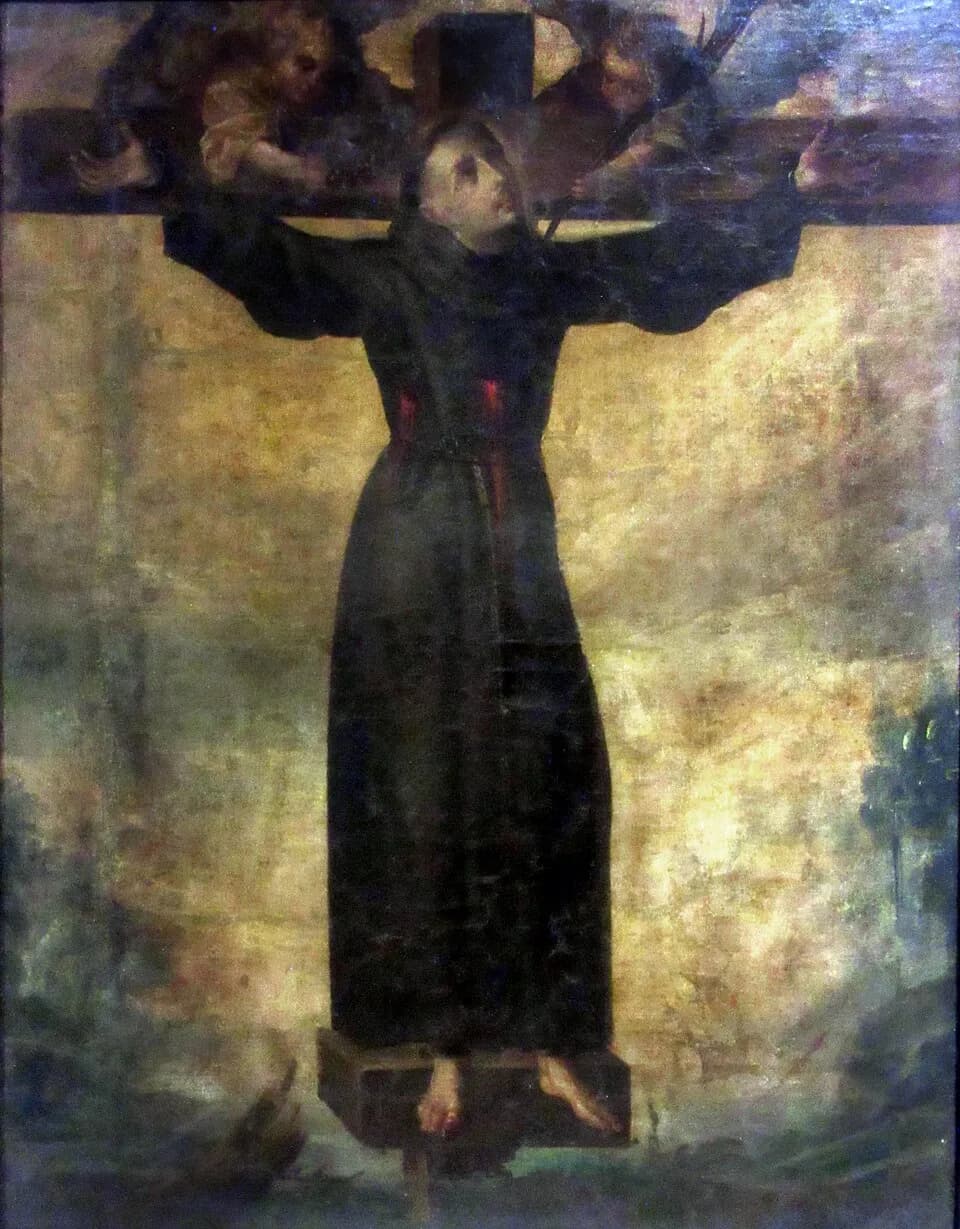
Philip died first. Bunson writes that his cross had been measured incorrectly, "so his entire weight was placed on the ring around his neck," and that he was slowly choking when the order was given for two soldiers to run him through with their spears. 5 The Franciscans' account adds that he was calling out "Jesús, Jesús, Jesús," and that one of the two lances pierced his heart. 2 The painting on this page, made in the century after his death, shows exactly that: a friar in his habit on the cross, two wounds in his chest.
The others were killed in the same way, by spears thrust from either side. 15 The people of Nagasaki came to call the place Martyrs' Hill, and the encyclopedia knows it as the "Mount of the Martyrs." 15
The first Mexican saint
Pope Urban VIII beatified the Nagasaki martyrs on September 14, 1627, thirty years after they died, and Pius IX canonized them on June 8, 1862. 123 Philip thus became, in the Franciscans' words, "the first saint of Mexican origin." 2 Desde la Fe calls him Mexico's first saint and first martyr. 3
Mexico City kept hold of him. The font at which he was baptized is shown in the metropolitan cathedral, and a fig tree grown from the one at his family's house has been planted there. 3 Desde la Fe also records that Japanese residents of Mexico once held a tea ceremony in the cathedral as an act of reconciliation. 3
What is Saint Philip of Jesus the patron saint of?
Saint Philip of Jesus is the patron saint of Mexico City. The 1911 Catholic Encyclopedia says so in its last sentence: "He is the patron saint of the city of Mexico." 1 Desde la Fe, the magazine of that city's archdiocese, calls him patron of Mexico City and of its archdiocese, and adds two more patronages that the encyclopedia does not mention: young people and silversmiths. 3
Saint Philip of Jesus's feast day
In Mexico the feast of Saint Philip of Jesus is February 5, the day he died, as the magazine of the Archdiocese of Mexico gives it. 3 The general calendar keeps him the next day. It has a single memorial for all twenty-six on February 6, under the name of Saint Paul Miki and companions, and the Roman Martyrology's entry for that day lists him among the religious of the Order of Friars Minor as Philip of Jesus de las Casas. 26
Praying with Saint Philip of Jesus
He is a saint with a false start in his record. He entered religious life, tired of it within months, and left for a merchant's career and what the encyclopedia flatly calls "a life of pleasure." 1 The order took him back, and he stayed. 12
He did almost nothing that a missionary does. Desde la Fe is blunt about it: he was never a priest, never consecrated the bread, and never preached in the country where he died. 3 He had been a professed friar for a few years and was a passenger on a ship. 12
What he did was decline a way out. The Franciscans and the archdiocesan magazine both say that he could have been spared and chose to stay with his brothers. 23 The priest who wrote about him for Desde la Fe, himself a missionary in Asia for twenty years, calls that choice the moment his vocation was settled. 4
The nurse's joke about the fig tree was a way of saying that this boy would never be a saint. 23 Mexico tells the story because of how it turned out.
Saint Philip of Jesus, pray for us.
Sources
- 1.Michael Bihl, "St. Philip of Jesus," The Catholic Encyclopedia, Vol. 12 (New York: Robert Appleton Company, 1911).
- 2."St Felipe de Jesús," Order of Friars Minor (ofm.org).
- 3."Santo de hoy 5 de febrero: San Felipe de Jesús," Desde la Fe, Archdiocese of Mexico, February 3, 2021 (in Spanish).
- 4.Rigoberto Colunga Hernández, MG, "San Felipe de Jesús, una vida consagrada a la misión," Desde la Fe, Archdiocese of Mexico, February 2022 (in Spanish).
- 5.Matthew E. Bunson, "Twenty-Six Crosses on a Hill," Catholic Answers Magazine, October 1, 2007.
- 6.Roman Martyrology, entry for February 6, as printed in "Santo del giorno," Conferenza Episcopale Italiana (in Italian).
Saints to turn to next
Others in this collection who are turned to for some of the same things.