Saint Nicodemus
First century
- Feast day
- August 31, with Saint Joseph of Arimathea 245; the 1911 Catholic Encyclopedia gives a commemoration of his relics on August 3 1
- In Scripture
- John 3, John 7 and John 19 only 1
- Death
- "The time of his death is unknown" 1
Saint Nicodemus was a Pharisee and a member of the Jewish ruling council who came to Jesus at night with a question and went away with an answer he did not understand. 18 He appears three times, all in the Gospel of John: in that night conversation about being "born from above," in a council debate where he spoke up for Jesus, and at the burial, carrying a hundred pounds of myrrh and aloes. 8910 The Church keeps his memory with Saint Joseph of Arimathea on August 31. 24
A ruler of the Jews
John introduces him as "a Pharisee named Nicodemus, a ruler of the Jews." 8 The notes to the New American Bible say that a ruler here most likely means a member of the Sanhedrin, the Jewish council, and J. F. Driscoll, writing in the Catholic Encyclopedia, reads John 7 the same way. 18 The name is Greek, Driscoll explains, but Jews of the period sometimes took Greek names, and a Hebrew form of it, Naqdimon, occurs in the Talmud. 1
He seems to have been a man of some standing. Jesus calls him "the teacher of Israel," and the quantity of spices he brought to the burial suggests to Driscoll that he had money and probably some influence in the council. 18 Some writers have guessed from his question about being born again "once grown old" that he was himself an old man; Driscoll thinks the words "too general to warrant such a conclusion." 18
At night
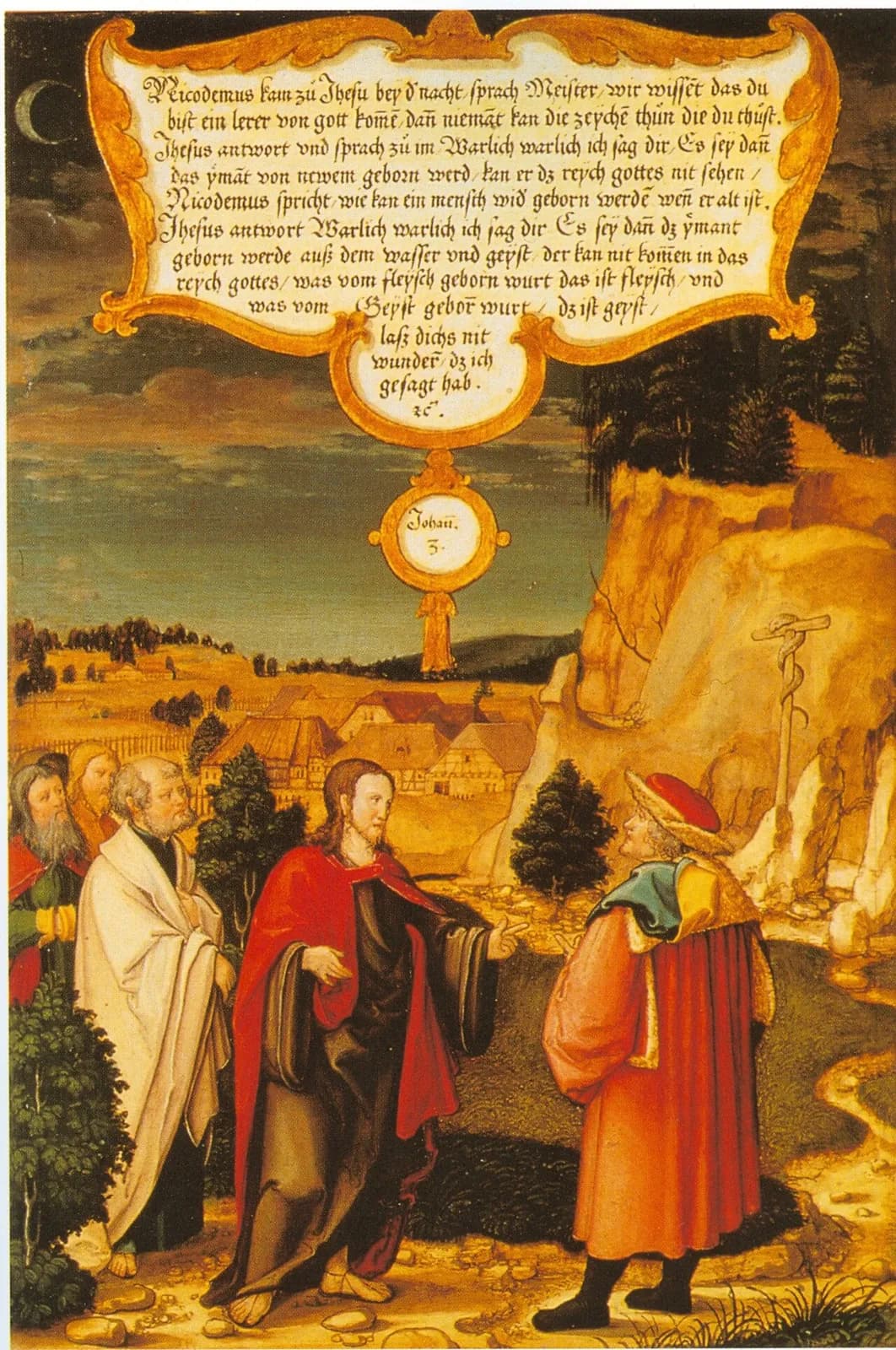
He came to Jesus at night and began respectfully: "Rabbi, we know that you are a teacher who has come from God, for no one can do these signs that you are doing unless God is with him." 8 Jesus answered that no one can see the kingdom of God "without being born from above." 8 The Greek word, the Bible notes explain, means both "from above" and "again." Jesus means the first; Nicodemus hears the second and asks how a grown man can enter his mother's womb again. 8 Jesus tells him he must be born "of water and Spirit," that the wind blows where it wills, and that "just as Moses lifted up the serpent in the desert, so must the Son of Man be lifted up." 8
Pope Francis, in a catechesis on this meeting in 2025, took the hour as a clue. In John's Gospel, he said, times of day often carry a symbolic meaning, and the night probably points to what was in Nicodemus's heart: "the darkness of doubt." 6 He found in him a man with a public role and a well-defined personality who sensed that something in his life no longer worked, and who did not yet know where to begin. 6 Vatican News draws the same picture of a learned man discovering that some knowledge "does not come from studying" and can only be received like a child. 3
Driscoll's verdict on the interview is that Nicodemus appears in it "as a learned and intelligent believer, but timid and not easily initiated into the mysteries of the new faith." 1 The conversation runs on into the most quoted verse of the Gospel, "For God so loved the world that he gave his only Son." 8 Catholic Culture says it was to Nicodemus that Jesus spoke those words. 5 The New American Bible notes read the passage differently: the scene moves from dialogue to monologue and then, from verse 16, to the evangelist's own reflection. 8
Before the council
He appears again in John 7, during the feast of Tabernacles. The temple guards had been sent to arrest Jesus and came back without him, saying, "Never before has anyone spoken like this one." 9 The Pharisees scorned them: had any of the authorities believed in him? Then "Nicodemus, one of their members who had come to him earlier," asked, "Does our law condemn a person before it first hears him and finds out what he is doing?" 9 They answered him with a jibe: "You are not from Galilee also, are you?" 9
The Roman Martyrology remembers him for exactly this, that before the chief priests and Pharisees who wanted to arrest the Lord he defended his cause. 4 Vatican News calls it one of the "small acts of courage" by which his secrecy gave way, and notes that it earned him "the derision of all." 3 Driscoll infers from the passage that he "embraced the truth as soon as it was fully made known to him." 1
At the tomb
His last appearance is on the evening of the crucifixion. Joseph of Arimathea, "secretly a disciple of Jesus for fear of the Jews," asked Pilate for the body. Then "Nicodemus, the one who had first come to him at night, also came bringing a mixture of myrrh and aloes weighing about one hundred pounds." 10 The two men bound the body in burial cloths with the spices, according to Jewish custom, and laid it in a new tomb in a garden near the place of crucifixion. 10 The Bible notes point out that only John has an anointing on the Friday; in Matthew and Luke the women come on Sunday morning to do it. 10
Pope Francis saw the whole of the man's story in that scene. Nicodemus, he said, "has finally come to the light, he is reborn, and he no longer needs to stay in the night." 6 In his telling Nicodemus is among those who go to Pilate for the body; in John's account it is Joseph who asks, and Nicodemus who comes with the spices. 610 Vatican News writes of the two of them: "Their hands gently wrap in clean linen the greatest visitation of God their people had ever known." 3
After the Gospel
Nothing certain is known of him afterward. "The time of his death is unknown," Driscoll writes. 1 Catholic Culture says he "has always been venerated as a martyr, although nothing is mentioned about his conversion or martyrdom in the New Testament." 5 This page does not call him a martyr.
His name was later attached to a book. The Acta Pilati, or Acts of Pilate, claims to be drawn from the official records of Pilate's court, and its supposed Hebrew original is attributed to Nicodemus; the title "Gospel of Nicodemus" is medieval. 7 Reid, in the Catholic Encyclopedia, says scholars date it to the middle of the fourth century, that it is orthodox and free of Gnostic influence, and that it was written to satisfy curiosity about the Passion and to strengthen faith in the Resurrection. 7
What is Saint Nicodemus the patron saint of?
Saint Nicodemus's feast day
Saint Nicodemus's feast day is August 31, which he shares with Saint Joseph of Arimathea. Vatican News lists the two together as disciples of the Lord and says, "They are celebrated on August 31." 2 The Roman Martyrology commemorates both at Jerusalem on that day, and Catholic Culture lists them there. 45
An older date was kept for him as well. Driscoll, writing in 1911, says the Roman Martyrology then commemorated the finding of his relics, together with those of Saints Stephen, Gamaliel and Abibo, on August 3. 1
Praying with Saint Nicodemus
Nicodemus came at night, said what he knew, and was told it was not enough. 8 He asked the obvious question and got an answer that did not make the problem easier. 8 Pope Francis chose him to begin a series on the encounters in the Gospels because, he said, his history shows "that it is possible to emerge from darkness and find the courage to follow Christ." 6
None of it happened in one night. Between John 3 and John 19 there is one sentence in the council, a question about due process that cost him a sneer. 9 Vatican News describes the change as a crack that slowly widened, small acts of courage, and then one large one. 3
At the end he did something with his hands. He brought the spices and helped wrap the body, a heavy, practical job that had to be done before the sabbath. 10 Francis pointed to the serpent Moses lifted up in the desert, from that first conversation, and asked his listeners to look, as Nicodemus finally did, at the One who was lifted up on the cross. 68
Saint Nicodemus, pray for us.
Sources
- 1.James F. Driscoll, "Nicodemus," The Catholic Encyclopedia, Vol. 11 (New York: Robert Appleton Company, 1911).
- 2."31 August," Saint of the Day, Vatican News.
- 3."Sts. Joseph of Arimathea and Nicodemus, disciples of the Lord," Saint of the Day, Vatican News.
- 4.Roman Martyrology, entry for August 31, "Santi Giuseppe d'Arimatea e Nicodemo," as printed in "Santo del giorno," Conferenza Episcopale Italiana (in Italian).
- 5."Thursday of the Twenty-First Week in Ordinary Time," Liturgical Year, August 31, 2023, Catholic Culture (section "St. Nicodemus").
- 6.Francis, General Audience, catechesis "Jesus Christ our hope," on the encounter with Nicodemus, March 19, 2025.
- 7.George Reid, "Acta Pilati," The Catholic Encyclopedia, Vol. 1 (New York: Robert Appleton Company, 1907).
- 8.John 3. Bible, United States Conference of Catholic Bishops.
- 9.John 7. Bible, United States Conference of Catholic Bishops.
- 10.John 19. Bible, United States Conference of Catholic Bishops.
Saints to turn to next
Others in this collection who are turned to for some of the same things.