Saint Paulinus of York
Died October 10, 644
- Origin
- A Roman monk of St. Andrew's monastery 4
- Consecrated bishop
- July 21, 625, by Archbishop Justus 1
- Baptized King Edwin
- Easter Day, April 12, 627, at York 1
- Patronage
- Rochester, England, in Catholic Culture's list 6
Saint Paulinus of York was a Roman monk sent to England by Pope Gregory the Great in 601, who went north in 625 as chaplain to a Christian queen and two years later baptized her husband, King Edwin of Northumbria, at York. 145 He was the first bishop of that city. 6 When Edwin was killed in 633 he brought the queen and her children back to Kent by sea and served as bishop of Rochester until his death on October 10, 644, the day his feast is kept. 125
From Rome to Kent
The encyclopedia says he was a monk of St. Andrew's monastery in Rome. 4 In 601 Gregory heard from Augustine at Canterbury that the harvest was great and the laborers few, and sent a second party of monks with vessels, vestments, relics and books. Bede names four of them as the chief: Mellitus, Justus, Paulinus and Rufinianus. 3
For the next two decades and more he worked in Kent, and almost nothing is recorded of it. 45 The encyclopedia allows for a possible mission to East Anglia before 616. 4 Neither Bede nor the encyclopedia gives a year for his birth. 14
A queen's chaplain
His second career began with a marriage. Edwin, the pagan king of Northumbria, asked for Ethelberga, sister of King Eadbald of Kent. Her brother answered that a Christian could not be given to a pagan, and Edwin promised that she and everyone with her could practice their faith freely. He added that he might accept it himself if his wise men, on examination, found it "more holy and more worthy of God." 1
Paulinus was ordained bishop by Archbishop Justus on July 21, 625, and went north with her. 1 Bede says he was sent to keep the queen's household in the faith, "but his mind was wholly bent" on converting the people he had come among. 1 For a long time he made no headway at all. 1
The next Easter an assassin sent by the king of the West Saxons reached Edwin with a poisoned dagger. Lilla, whom Bede calls the king's beloved minister, put his own body in the way, and the blow went through him and wounded the king. 1 That same night the queen gave birth to a daughter, Eanfled. Edwin thanked his gods; Paulinus thanked Christ and told the king so. Edwin promised that if he recovered and defeated the man who had sent the assassin, he would serve Christ, and as a pledge he gave the child to Paulinus. 1 She was baptized at Pentecost with twelve others of the household, "the first baptized of the nation" of the Northumbrians. 1
The king makes up his mind
Edwin won his war and gave up his idols, but he would not be hurried. Bede describes him sitting alone for hours, "silent as to his tongue, but deliberating in his heart" which religion to follow. 1 He tells a story, with a careful "as we may suppose," of how Paulinus came to know of a vision Edwin had had years before as a hunted exile, when a stranger promised him safety and a throne and laid a hand on his head as a sign to remember. Paulinus came to the king, laid his right hand on his head, and asked whether he knew that sign. 1
Edwin then called his council. The pagan high priest, Coifi, said plainly that the old religion had done him no good. Another counselor compared human life to "the swift flight of a sparrow through the room wherein you sit at supper in winter," in at one door and out at the other, from the dark into the dark: "of what went before, or what is to follow, we are utterly ignorant." If the new teaching had anything more certain to say, it deserved to be followed. 1 Coifi asked to hear Paulinus, declared himself convinced, borrowed the king's stallion and a spear, and rode off to profane his own temple at the place Bede's translator spells Godmundinghan, not far from York. 1
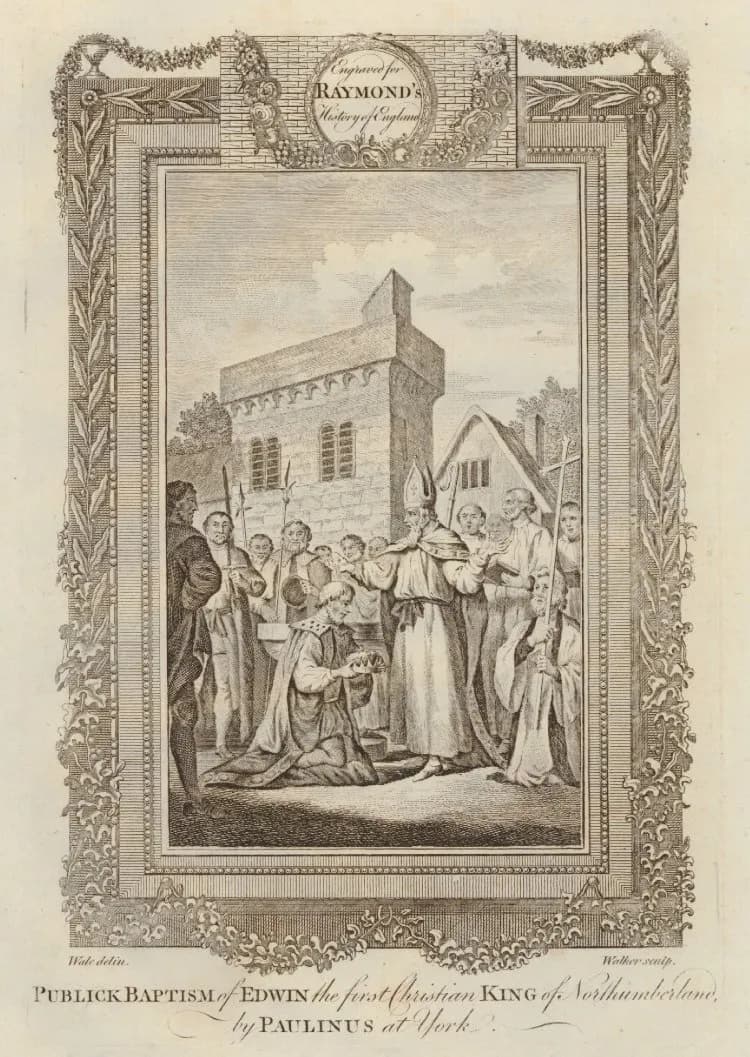
Edwin was baptized at York on Easter Day, April 12, 627, in a timber church of St. Peter that he had put up while he was under instruction. 1 He gave Paulinus his see in that city and began a larger church of stone around the wooden one. 1
Six years in the north
For six years Paulinus preached across the kingdom with the king's support. 1 At the royal residence of Adgefrin he stayed thirty-six days, catechizing from morning to night and baptizing in the river Glen. Farther south he baptized in the Swale near Catterick, because, Bede explains, there were as yet no oratories or fonts. 14 The encyclopedia lists other places where tradition remembers him, among them Dewsbury, Easingwold and Southwell. 4
South of the Humber he converted Blecca, the governor of Lincoln, with his household, and built a stone church there in which he consecrated Honorius as archbishop of Canterbury. 16 An old man who had been baptized by him in the Trent described him to an abbot, who told Bede: he was "tall of stature, a little stooping, his hair black, his visage meagre, his nose slender and aquiline, his aspect both venerable and majestic." 1
The Liturgy Office adds that he baptized Hilda, the future abbess of Whitby, as a child. 5 Pope Honorius sent him the pall. 1 The encyclopedia says it reached him only in 634, after his flight from the north. 4
Flight and Rochester
On October 12, 633, Edwin was killed in battle at Heathfield by the British king Cadwalla and the pagan Penda of Mercia, and his army was destroyed. 1 Northumbria was laid waste. Seeing, in Bede's words, no "prospect of safety except in flight," Paulinus took Queen Ethelberga, her daughter Eanfled, her son and a grandson of Edwin, and returned to Kent by sea under the protection of one of the king's soldiers. 1 He brought with him a large gold cross and a golden chalice that were still shown at Canterbury in Bede's day. 1 His deacon James stayed behind near Catterick, teaching and baptizing, and lived into Bede's own lifetime. 1
Whether he should have left has been argued over. The encyclopedia says Catholic writers, following Bede, have held that he had no choice and was the best judge of what the circumstances allowed. 4 The see of Rochester was vacant, its bishop having drowned at sea on an embassy to the pope, and at the request of the archbishop and King Eadbald Paulinus took charge of it. 1
He died there on October 10, 644, nineteen years, two months and twenty-one days after he was made a bishop, and was buried in the sacristy of the church of St. Andrew that King Ethelbert had built. 2 He left his pall to that church. 1 The encyclopedia says Archbishop Lanfranc later moved his relics to a silver shrine in the rebuilt cathedral, where they stayed until the Reformation. 4
What is Saint Paulinus of York the patron saint of?
Bede, the encyclopedia and the English bishops' calendar name no patronage for Saint Paulinus of York. 145 Catholic Culture's page for his feast lists one, "Rochester, England," the city where he spent his last eleven years and was buried, and gives no authority for it. 6 The same page says he is often portrayed as an archbishop baptizing King Edwin. 6
Saint Paulinus of York's feast day
Saint Paulinus of York's feast is October 10, the anniversary of his death. 4 The National Calendar for England lists him on that day, and so does the Vatican News calendar of saints, which titles him a disciple of Saint Gregory the Great. 57 The Roman Martyrology enters him on October 10 at Rochester, as the monk Gregory sent to the English, who converted King Edwin and baptized his people in a river. 8
Praying with Saint Paulinus of York
Most of his life was waiting. He spent more than twenty years in Kent that left no record, then went north and, as Bede admits, "laboured long" among people who did not want what he had brought. 14 The king he had come to convert took two years to decide. Paulinus did not force the pace. He taught, spoke when the king's council asked to hear him, and let Edwin think. 1
When the harvest came it was enormous, and it lasted six years. 1 Then the king was dead, a church Paulinus had built was burned, and the bishop was on a boat with a widow and three children. 1 Bede records nothing he said at that point. He records that Paulinus got the family to safety and then took up the next work he was asked to do. 1
He was bishop of Rochester for eleven years after losing a kingdom, and Bede says he held it "until he departed to heaven, with the glorious fruits of his labours." 1 The work in the north was not lost either. James the deacon kept baptizing near Catterick, and in 1911 the encyclopedia could still list the northern villages that remembered Paulinus. 14
The counselor's sparrow is the line people remember from his story, and it was a pagan who said it. The council where it was said was one Paulinus had waited two years for. 1
Saint Paulinus of York, pray for us.
Sources
- 1.Bede, The Ecclesiastical History of the English Nation (731), Book II, chapters 9, 12-14, 16, 17 and 20 (London: J. M. Dent, 1910; translator not named, probably L. C. Jane), in the Internet Medieval Sourcebook (Fordham University).
- 2.Bede, The Ecclesiastical History of the English Nation (731), Book III, chapter 14 (London: J. M. Dent, 1910; translator not named, probably L. C. Jane), in the Internet Medieval Sourcebook (Fordham University).
- 3.Bede, The Ecclesiastical History of the English Nation (731), Book I, chapter 29 (London: J. M. Dent, 1910; translator not named, probably L. C. Jane), in the Internet Medieval Sourcebook (Fordham University).
- 4.Edwin Burton, "St. Paulinus, Archbishop of York," The Catholic Encyclopedia, Vol. 11 (New York: Robert Appleton Company, 1911).
- 5."National Calendar for England," entries for 10 October and 17 November, Liturgy Office of the Catholic Bishops' Conference of England and Wales.
- 6."St. Paulinus of York," Liturgical Year, October 10, 2026, Catholic Culture, with an excerpt from the Congregation of the Divine Redeemer.
- 7."St. Paulinus, Bishop of York, Disciple of St. Gregory the Great," Saint of the Day, 10 October, Vatican News.
- 8.Roman Martyrology, entry for October 10, "San Paolino, vescovo," as printed in "Santo del giorno," Conferenza Episcopale Italiana (in Italian).
Saints to turn to next
Others in this collection who are turned to for some of the same things.