Saint Philip Benizi
August 15, 1233 - August 22 or 23, 1285
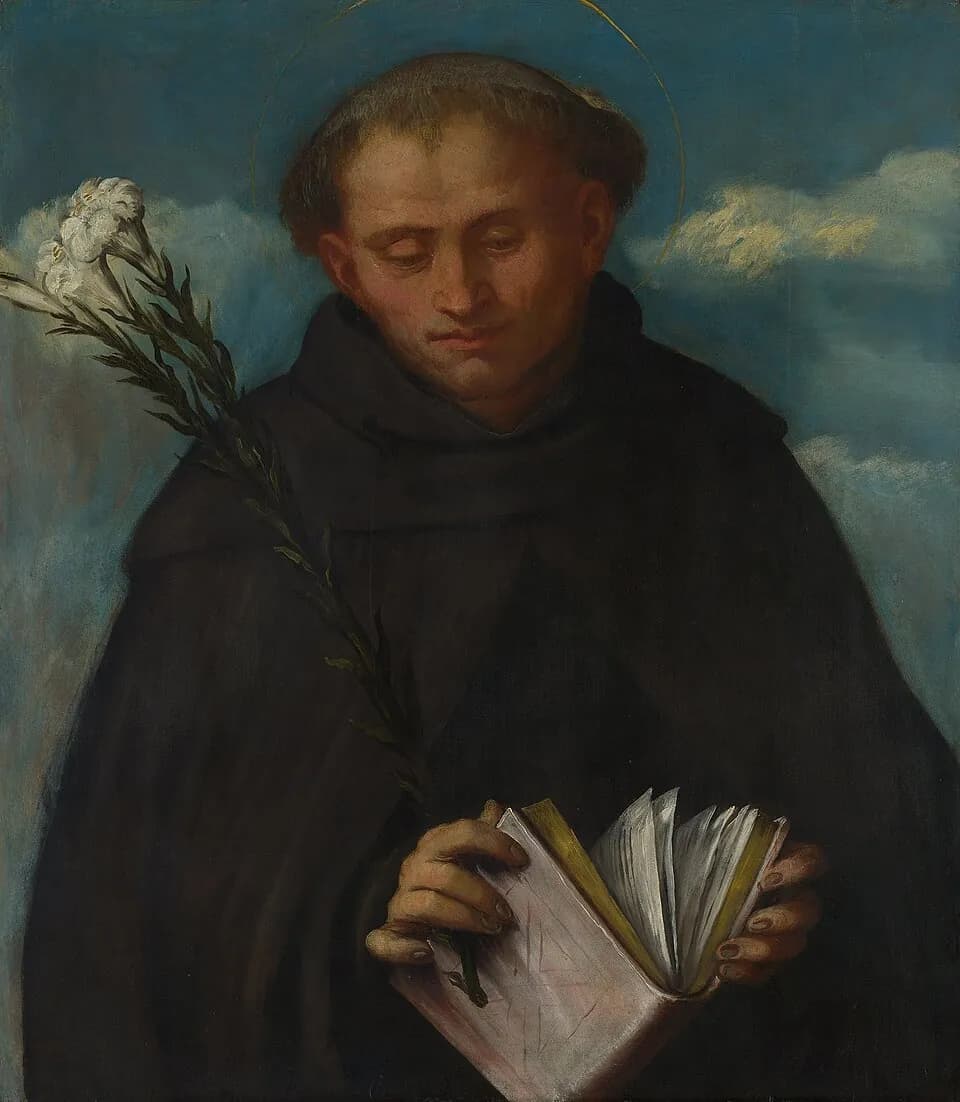
- Feast day
- August 22, as the Dicastery for the Causes of Saints lists it; the 1913 Catholic Encyclopedia gives August 23 23
- Beatified
- October 8, 1645, by Pope Innocent X 3
Saint Philip Benizi was a Florentine physician who joined the Servants of Mary as a lay brother, hid his education until it was found out by accident, and became the order's fifth prior general in 1267, just as the order came close to being abolished. 12 He is remembered as the man who held the Servites together through that crisis, gave the habit to Saint Juliana Falconieri, and spent his years as general traveling Italy as a peacemaker between Guelphs and Ghibellines. 124 He died at Todi in 1285, and his feast is kept on August 22. 13
A doctor in Florence
Philip was born in Florence on August 15, 1233, into a noble family. 13 The 1913 Catholic Encyclopedia names his parents' families as the Benizi and the Frescobaldi, and says they had been childless for many years and received him as an answer to prayer. 1 Its writer, Charles McGinnis, passes on a story from the Servite tradition: that at five months old, seeing two of the order's founders come to the door begging, the baby told his mother that Our Lady's Servants were coming and she should give them alms. 1
The date of his birth mattered to his order. The encyclopedia's article on the Servants of Mary notes that he was born on the feast of the Assumption, the day in 1233 when, by the order's account, the Virgin first appeared to the seven Florentines who founded it. 4
At thirteen he was sent to the University of Paris, and he finished his studies in medicine at Padua. 13 The Dicastery for the Causes of Saints says he took a doctorate in medicine and philosophy there at nineteen. 3 He practiced medicine in Florence for a year, mostly among the poor, and the Dicastery adds that he spent his spare time reading the Bible and the Fathers of the Church. 13
A lay brother with a secret
McGinnis says a vision of the Virgin directed him to the Servites, and that Saint Buonfiglio, the order's first superior, received him in 1254. 1 He asked to be enrolled as a lay brother rather than as a cleric, and was sent to Monte Senario, the order's hermitage in the hills north of Florence, where McGinnis says a fountain sprang up in his grotto and was still to be seen, enclosed in a small chapel, in 1911. 12 The Dicastery says he spent five years doing the humblest work of the house. 3
In 1258, on a journey to Siena, the learning he had kept to himself was discovered, and he was at once told to prepare for ordination. 1 He was ordained the next year by the Bishop of Florence. 1 McGinnis says he drew his holiness chiefly from the Passion of Jesus and the Sorrows of Mary, which the "Servants of Mary" article names as the order's distinctive spirit. 14 The Dicastery says he was made master of novices, and McGinnis that he rose quickly through the offices of the order until, on June 5, 1267, he was elected prior general unanimously. 13
General of an order in danger
Philip Griffin, writing on the Servites in the same encyclopedia, says that with Philip's election the order "entered into the crisis of its existence." 2 The Second Council of Lyons in 1274 suppressed every mendicant order not yet approved by the Holy See, and the Servites' enemies pressed the point; in 1276 Innocent V wrote to Philip declaring the order suppressed. 2 Philip set out for Rome, but Innocent died before he arrived, and his successor lived only five weeks. 2 It was John XXI who, on the advice of three consistorial advocates, decided that the Servites should go on as before. 2
McGinnis says Philip was at the Council of Lyons in 1274 and spoke there with the gift of tongues. 1 The Dicastery credits him with the writing of the order's constitutions, and the "Servants of Mary" article says he carried on the founders' work so fully that he earned the title of the order's Eighth Founder. 34
After Clement IV died in 1268, McGinnis says, the cardinals were about to elect Philip pope, and he fled and hid until they had chosen someone else. 1
Peacemaker
The quarrel between Guelphs and Ghibellines was at its fiercest in these years, and McGinnis says Philip worked as a peacemaker in city after city, especially in Florence, Pistoia, Arezzo, Forli and Bologna. 1 Griffin tells what happened at Forli, where Philip had gone at the request of Martin IV to preach peace. 2 A young man named Peregrine Laziosi, son of a Ghibelline leader, insulted him and struck him. 2 The mildness with which Philip took the blow moved Peregrine to ask his forgiveness, and in 1283 Peregrine entered the Servites himself; he too was later canonized. 2
Among those Philip received was Juliana Falconieri, the niece of one of the seven founders. 5 He gave her the habit of the order's Third Order and a rule to live by, about 1285 according to Johann Peter Kirsch and in 1284 according to the "Servants of Mary" article. 45 She became the foundress of the Servite sisters called the Mantellate. 15
Todi
Knowing his end was near, McGinnis says, Philip handed the government of the order to Blessed Lotharingus and went to Todi, in Umbria, where he chose the smallest and poorest house of the order to die in. 1 The Dicastery says he died there on his way back from Rome. 3 It dates his death August 22, 1285; McGinnis gives August 23. 13
McGinnis reports many miracles at his intercession afterward, "even the dead were raised to life." 1 Innocent X beatified him on October 8, 1645, according to the Dicastery. 3 It names Clement X as the pope who canonized him, on April 12, 1671; McGinnis names Clement IX. 13 His body is kept at Todi, in the sanctuary dedicated to him. 3
What is Saint Philip Benizi the patron saint of?
Saint Philip Benizi's feast day
Praying with Saint Philip Benizi
He came to the Servites with a medical degree from Padua and asked to be the brother who did the chores. 13 For five years, by the Dicastery's account, that is what he was, until his learning was discovered by accident on a journey to Siena. 13
Most of what he did afterward was administration under pressure: a general whose order was declared suppressed, who went to Rome to argue for it and found the pope dead. 2 The sources do not record any single dramatic victory. A council, three popes and three consistorial advocates decided the matter, and he kept the order going while they did. 2
The encounter at Forli is the one people remember. A young man struck him, Philip did not answer in kind, and the young man asked to be forgiven and later joined the order. 2 Griffin tells it in a few lines, and there is no more to it than that.
He ended his life by choosing the poorest house he had, at Todi, and giving up the office before he died. 1
Saint Philip Benizi, pray for us.
Sources
- 1.Charles F. McGinnis, "Philip Benizi, Saint," The Catholic Encyclopedia, Vol. 12 (New York: Robert Appleton Company, 1911), reprinted by Catholic Answers.
- 2.Philip Griffin, "Order of Servites," The Catholic Encyclopedia, Vol. 13 (New York: Robert Appleton Company, 1912).
- 3."Filippo Benizi (1233-1285)," Santi e Beati, Dicastery for the Causes of Saints (in Italian).
- 4."Servants of Mary (Order of Servites)," The Catholic Encyclopedia, Vol. 9 (New York: Robert Appleton Company, 1910).
- 5.Johann Peter Kirsch, "St. Juliana Falconieri," The Catholic Encyclopedia, Vol. 8 (New York: Robert Appleton Company, 1910).
Saints to turn to next
Others in this collection who are turned to for some of the same things.
- Saint Agnes of Montepulcianoc. 1268 - April 1317PrayerWork and vocationDiscernment
- Saint Andrew Avellino1521 - November 10, 1608DiscernmentWork and vocationPrayer
- Saint Anthony Mary ClaretDecember 23, 1807 - October 24, 1870Work and vocationCouragePrayer
- Saint Arnold JanssenNovember 5, 1837 - January 15, 1909Work and vocationCouragePrayer