Saint Petronius of Bologna
d. before 450
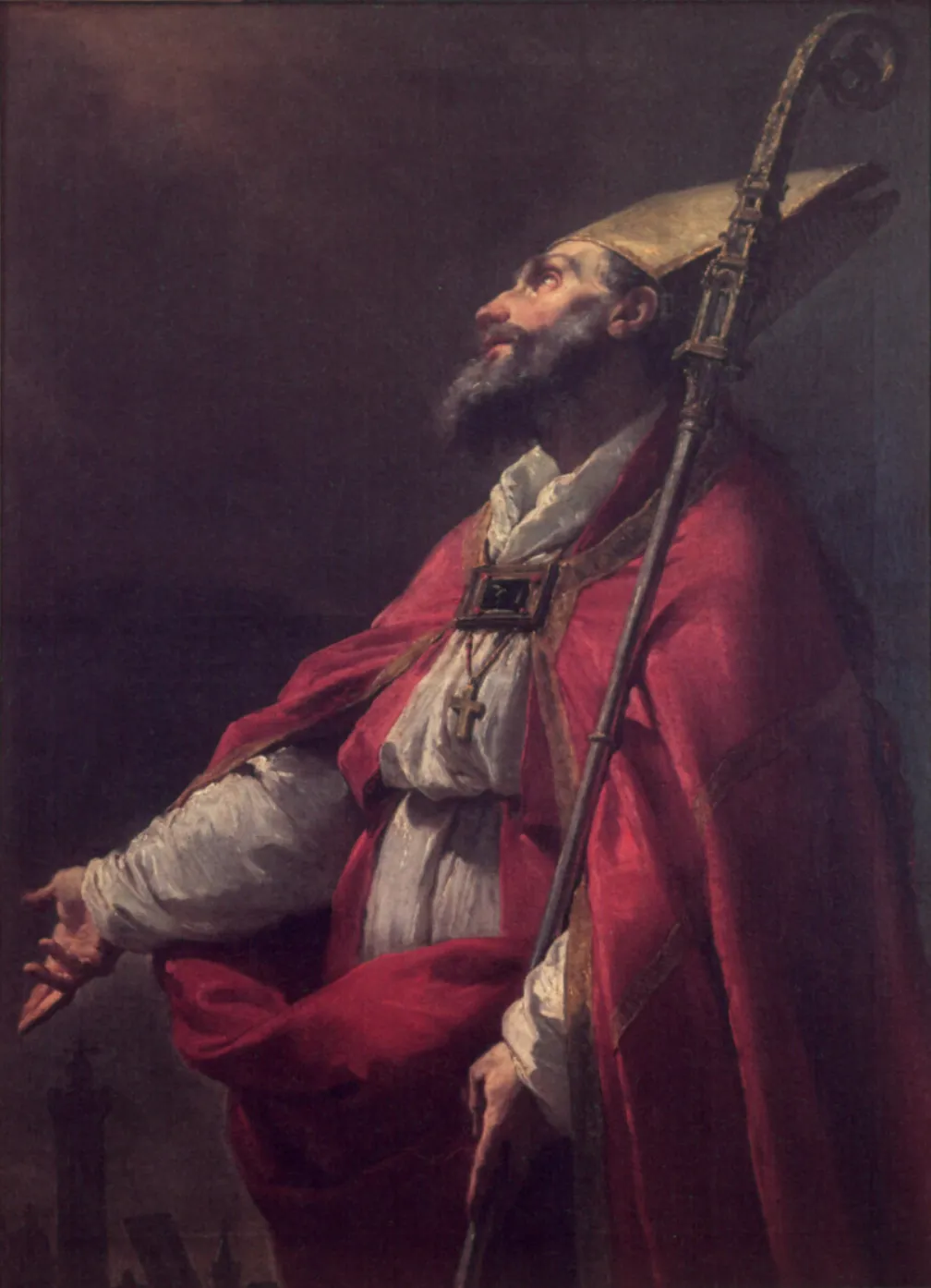
- Office
- Bishop of Bologna from about 432 1
- Before that
- A family that held high office at the imperial court; his father was probably a praetorian prefect 12
- Churches
- Santo Stefano, built to recall the shrines of Jerusalem, and probably San Giovanni in Monte 14
Saint Petronius was bishop of Bologna in the first half of the fifth century, a man from a family of imperial officials who gave up a public career for the Church. 12 He built a church in Bologna designed after the shrines of Jerusalem, and the city that grew up around his memory gave his name to one of the largest churches in Italy. 159 Almost everything else told about him was written seven hundred years after he died, and the 1911 Catholic Encyclopedia is careful to say which is which. 1
Two sentences from his own century
Johann Peter Kirsch, who wrote the encyclopedia's article, says that "the only certain historical information we possess" about Petronius comes from two writers. 1 One is Eucherius, bishop of Lyons, who mentions in a letter that the holy bishop Petronius was then renowned in Italy for his virtues. 1 The other is Gennadius, whose short notices of Christian writers continue Jerome's catalog of illustrious men. 2
Gennadius gives Petronius one chapter. He calls him "bishop of Bologna in Italy a man of holy life and from his youth practised in monastic studies," and says he "died in the reign of Theodosius and Valentinianus." 2 Kirsch reads that as a death before 450. 1 From the same notice, and from what is known of the family, Kirsch fills in a little more: the Petronii held high posts at the imperial court in Milan and in the provinces around the year 400, and the bishop's father, also named Petronius, was probably the praetorian prefect of that name who governed in Gaul between 402 and 408. 1 Eucherius seems to say that the son, too, held an important secular office before he was ordained. 1
The current Roman Martyrology condenses this into one line: Petronius left behind the authority of this world, rose to the priestly ministry, and taught the duties of a bishop by his writings and by his example. 3 Kirsch adds that even as a young man he practiced asceticism and seems to have visited the holy places in Jerusalem, perhaps as a pilgrim. 1 About 432 he was elected and consecrated bishop of Bologna. 1
What he wrote, and what he did not
Gennadius reports that Petronius "is reputed to have written the Lives of the Fathers, to wit of the Egyptian monks," a book the monks of Gennadius's day took as "the mirror and pattern of their profession." 2 Kirsch is plain that the author of that work is in fact Rufinus of Aquileia. 1
Gennadius had also read a treatise On the Ordination of Bishops under Petronius's name, and he doubted it. The work was "full of good reasoning and notable for its humility," he wrote, "but whose polished style shows it not to have been his," and he thought it more likely the work of the father, "a man of great eloquence and learned in secular literature," since its author describes himself as a praetorian prefect. 2 Kirsch agrees. 1 A short sermon for the anniversary of a bishop's ordination, published in 1897, has been claimed for Petronius of Bologna as well, but Kirsch calls the attribution "not certain." 1 The bishop whom the Martyrology remembers for teaching by his writings, then, has left no writing that can be safely called his. 13
A Jerusalem in Bologna
What he did leave is a building. As bishop, Kirsch writes, Petronius erected a church to Saint Stephen whose plan imitated the shrines on Golgotha and over the Holy Sepulchre in Jerusalem. 1 Kirsch dates it to the years when Leo I was raising basilicas in Rome and Galla Placidia in Ravenna. 1 The Archdiocese of Bologna credits him, probably, with the church of Monte Oliveto as well, the present San Giovanni in Monte, and says that he was buried in Santo Stefano. 4
Later tradition built on that. Catholic.net, drawing on it, says Petronius came to Bologna around 430 and took the see at the urging of Pope Celestine I; that he was born in Spain of a Roman father and had been praetorian prefect there himself; that before he built churches he rebuilt the people's houses and lengthened and strengthened the city walls; and that he laid out a whole quarter around the "seven churches" of Santo Stefano in the image of Jerusalem and its sanctuaries. 9 The same page passes on the story that he founded the University of Bologna, and calls its source unverified. 9
The homily preached on his feast in 2017, which the basilica publishes, put the idea in one sentence: Petronius thought of Bologna as Jerusalem, and he built and dreamed on a large scale. 6
Found again in 1141
Kirsch's next fact comes seven hundred years later. A legendary life of the saint appeared in the twelfth century, and in 1141 his relics were discovered; a church was built in his honor soon afterward. 1 A second church, planned on a large scale, followed: Kirsch says it was begun in 1390 and carried as far as the crossing; Catholic.net puts the decision to build it in 1388. 19 The basilica's own account gives the span of construction as 1390 to 1663, and records that the first Mass was celebrated there on October 4, 1392, the saint's day. 5 Work resumed in 1659, Kirsch writes, and the Italian Gothic church was finished as it stands. 1
His remains were divided. The archdiocese explains that his body lay in Santo Stefano until recent times, except for the head, which has been kept since 1743 in the basilica on the Piazza Maggiore. 4 The basilica says the head rests in a monumental reliquary of partly gilded silver and lapis lazuli given by Pope Benedict XIV, set inside a gilded bronze "glory" above the altar of the saint's chapel; both are the work of the Roman silversmith Francesco Giardoni. 5 On October 3, 2000, the body was brought to the basilica and reunited with the head in a solemn ceremony. 4 The chapel now keeps both. 5
What is Saint Petronius the patron saint of?
Saint Petronius is the patron saint of the city and the Archdiocese of Bologna. 48 Catholic.net adds the region of Emilia, says that he is invoked by architects and by the builders of churches, and notes that the people of Bologna have long called themselves "Petronians." 9 Cardinal Giacomo Lercaro, preaching on his feast in 1956, said much the same: Bologna still liked to call itself Petronian. 7
In art he is a bishop who holds the city of Bologna in his hands, or has it beside him. 9 Cardinal Matteo Zuppi drew on that image in his homily for the feast in 2026: Petronius lifts the city up in his hands, he said, as a reminder of who it is that keeps it. 8
Saint Petronius's feast day
Saint Petronius's feast day is October 4. Kirsch gives the date in 1911, and the current Roman Martyrology enters him on it. 13 In Bologna it is kept as a solemnity. 67 On October 4, 2026, Cardinal Zuppi celebrated the Mass in the Basilica of San Petronio, led a procession through the Piazza Maggiore with the saint's relics, and gave the city and the diocese a solemn blessing from the steps of the basilica through his intercession. 8 Seventy years earlier the procession carried the relic of the head, and Lercaro preached to the crowd in the square when it ended. 7
Praying with Saint Petronius
The secure facts are those of a career turned around. A son of the governing class left public life for the altar, and was remembered by a contemporary for his virtues and by another for a life given from youth to monastic study. 12 The Martyrology, choosing what to say about him, chose exactly this: he gave up the authority of the world and showed by his life what a bishop is for. 3
Bologna has read him as a builder ever since, and the homilies preached on his day keep finding the same thing in that. Lercaro called him the good shepherd who formed a community by loving and by teaching love, and in his account Petronius fought the Arian heresy of his time. 7 The 2017 homily spoke of guarding the city as a matter of prayer, passion, service and intelligence, so that the city keeps people at its center. 6
There is also the church of Santo Stefano. A bishop who seems to have seen the holy places himself had their shrines imitated at home, and the tradition remembers why: to draw his people into devotion to the saints and to the sacred mysteries. 19 A great deal about Petronius is uncertain. That he wanted the people of an Italian city to have Golgotha and the empty tomb in front of their eyes is not. 1
Saint Petronius of Bologna, pray for us.
Sources
- 1.Johann Peter Kirsch, "St. Petronius," The Catholic Encyclopedia, Vol. 11 (New York: Robert Appleton Company, 1911).
- 2.Gennadius of Marseilles, Lives of Illustrious Men, chapter 42, trans. Ernest Cushing Richardson, Nicene and Post-Nicene Fathers, Second Series, Vol. 3 (1892).
- 3.Roman Martyrology, entry for October 4, "San Petronio, vescovo," as printed in "Santo del giorno," Conferenza Episcopale Italiana (in Italian).
- 4."La storia dell'Arcidiocesi bolognese," Chiesa di Bologna (the Archdiocese of Bologna) (in Italian).
- 5."La Basilica," Basilica di San Petronio, Bologna (in Italian).
- 6."Solennità di S. Petronio, patrono della città e della diocesi," homily for the feast of Saint Petronius, 2017, published by the Basilica di San Petronio (in Italian).
- 7."Omelia del Card. G. Lercaro per la solennità di S. Petronio (1956)," report of October 5, 1956 from L'Avvenire d'Italia, published by the Basilica di San Petronio (in Italian).
- 8."La Festa di San Petronio," Chiesa di Bologna, on the Mass of October 4, 2026 celebrated by Cardinal Matteo Zuppi (in Italian).
- 9."Petronio de Bolonia, Santo," Catholic.net (in Spanish).
Saints to turn to next
Others in this collection who are turned to for some of the same things.
- Saint Agnes of Montepulcianoc. 1268 - April 1317Work and vocationDiscernment
- Saint Albert ChmielowskiAugust 20, 1845 - December 25, 1916DiscernmentWork and vocation
- Saint Andrew Avellino1521 - November 10, 1608DiscernmentWork and vocation
- Saint Angela MericiMarch 21, 1474 - January 27, 1540Work and vocationDiscernment