Saint Petronilla
Probably late first century
- Full name
- Aurelia Petronilla, from the inscription on her sarcophagus 1
- Lived
- Probably martyred at Rome at the end of the first century 1
- Earliest evidence
- A fresco painted shortly after 356 that labels her a martyr 1
Saint Petronilla was a Christian of Rome whose tomb in the Catacomb of Domitilla was honored from very early times, and whom a fresco painted there shortly after 356 names as a martyr. 12 For more than a thousand years she was also venerated as the daughter of the Apostle Peter. The sources no longer accept that, but on the strength of it she became the patroness of the Frankish kings and then of France. 123 Her feast is May 31. 12
What the tomb and the fresco establish
Almost all the lists of the tombs of the Roman martyrs drawn up in the sixth and seventh centuries mention her grave on the Via Ardeatina, near those of Saints Nereus and Achilleus. One of them places a church of Saint Petronilla there in which all three were buried. 1 The excavations in the Catacomb of Domitilla bore this out. The church, built into the catacomb, was found, and what was found in it, the 1913 Catholic Encyclopedia says, "removed all doubt that the tombs of the three saints were once venerated there." 1 It is a basilica of three naves from the later fourth century. 6
Behind the apse, in an underground crypt, the closing stone of a tomb carries a painting. A woman named Veneranda has died, and Petronilla is receiving her into heaven. Beside the saint is written "Petronilla Mart." An inscription in the same tomb proves the picture was painted shortly after 356. 1 From this Johann Peter Kirsch, who wrote the encyclopedia's article, draws his firmest conclusion: "It is thus clearly established that Petronilla was venerated at Rome as a martyr in the fourth century." 1
Her marble sarcophagus no longer exists. The Liber Pontificalis records what was carved on it, and gives the words as Aureae Petronillae Filiae Dulcissimae, "of the golden Petronilla, the sweetest daughter." 1 Notes on the sarcophagus that survive from the sixteenth century show that the first word was really the abbreviation Aur., for Aureliae. Her name was Aurelia Petronilla. 1
From the name Kirsch reasons toward a family. Petronilla derives from Petro or Petronius. The great-grandfather of the Christian consul Flavius Clemens was called Titus Flavius Petronius, so "it is very possible that Petronilla was a relative of the Christian Flavii," which would also explain her burial in the catacomb of Flavia Domitilla. 1 She may have suffered in the persecution of Domitian, he adds, "perhaps not till later." 1 Her name is missing from the fourth-century Roman calendar of martyrs' feasts, and Kirsch takes that as a sign that she died at the end of the first century or during the second, before martyrs were given feasts of their own. 1 Katolsk.no, the website of the Catholic Church in Norway, also reports a version that makes her a young martyr of the middle of the third century, and says frankly that reliable information about her is lacking. 2
How she became the daughter of Saint Peter
The apocryphal Acts of Peter, a Gnostic work of the second century, mention a daughter of the apostle without giving her a name. 13 Giovanni Maria Vian, writing in L'Osservatore Romano in 2015, retells the episode. The girl lies paralyzed on one side, and a crowd reproaches Peter for healing strangers and not his own child. He cures her for a moment to show that God can, then orders her back to her former state, and explains that the paralysis came in answer to his prayers after a rich man named Ptolemy had carried her off. 3
At Rome, Petronilla was identified with this unnamed daughter, "probably because of her name and the great antiquity of her tomb." 1 The identification was in place by the end of the sixth century, when it appears in a list of the martyrs' tombs prepared by an abbot named John. 1 The Norwegian page points out that anyone with Latin can see the flaw: Petronilla is the feminine of Petronius, not of Petrus. It offers a gentler reading, that she may have been the first Roman woman of rank whom Peter converted and baptized, and so his firstborn daughter in the faith. 2 The Roman Martyrology as CatholicCulture.org summarizes it now speaks of one "who was guided in the Faith by St. Peter, the first pope." 4 As late as the 1962 edition, the Norwegian page says, it still called her his daughter. 2
The story most people knew comes from the sixth-century Acts of Saints Nereus and Achilleus, which Kirsch judges "legendary even to a romantic degree," with "no historical value" for the lives of those two martyrs. 6 In these Acts she is a virgin and no longer a martyr. 1 Healed by her father, she is sought in marriage by a pagan noble named Flaccus. 34 In the version Dom Gueranger tells, she asks three days to consider and spends them in prayer; on the third day Flaccus arrives to find the household in mourning and her family preparing her funeral. 4 The Norwegian page has her ask three weeks and fast until she dies. 2 In the thirteenth century the Golden Legend carried the tale across Europe, with the paralysis reduced to a fever. 3
From the catacomb to Saint Peter's
In 757 her coffin was carried from the Via Ardeatina to an old circular building beside Saint Peter's, an imperial mausoleum from the end of the fourth century, which was altered and became the Chapel of Saint Petronilla. 1 The pope was Paul I, who was moving the bones of many martyrs out of catacombs the Lombards had devastated the year before; the chapel had been prepared by his predecessor for this purpose. 5 The Norwegian page says it followed on the choice of Petronilla as patron by Pepin, king of the Franks. Charlemagne and Carloman were regarded as adopted sons of Saint Peter, and his supposed daughter became their patron too. 2 Vian's essay puts the translation halfway through the ninth century, and says plainly that it served "to symbolically support the strategic alliance with the Frankish kings." 3
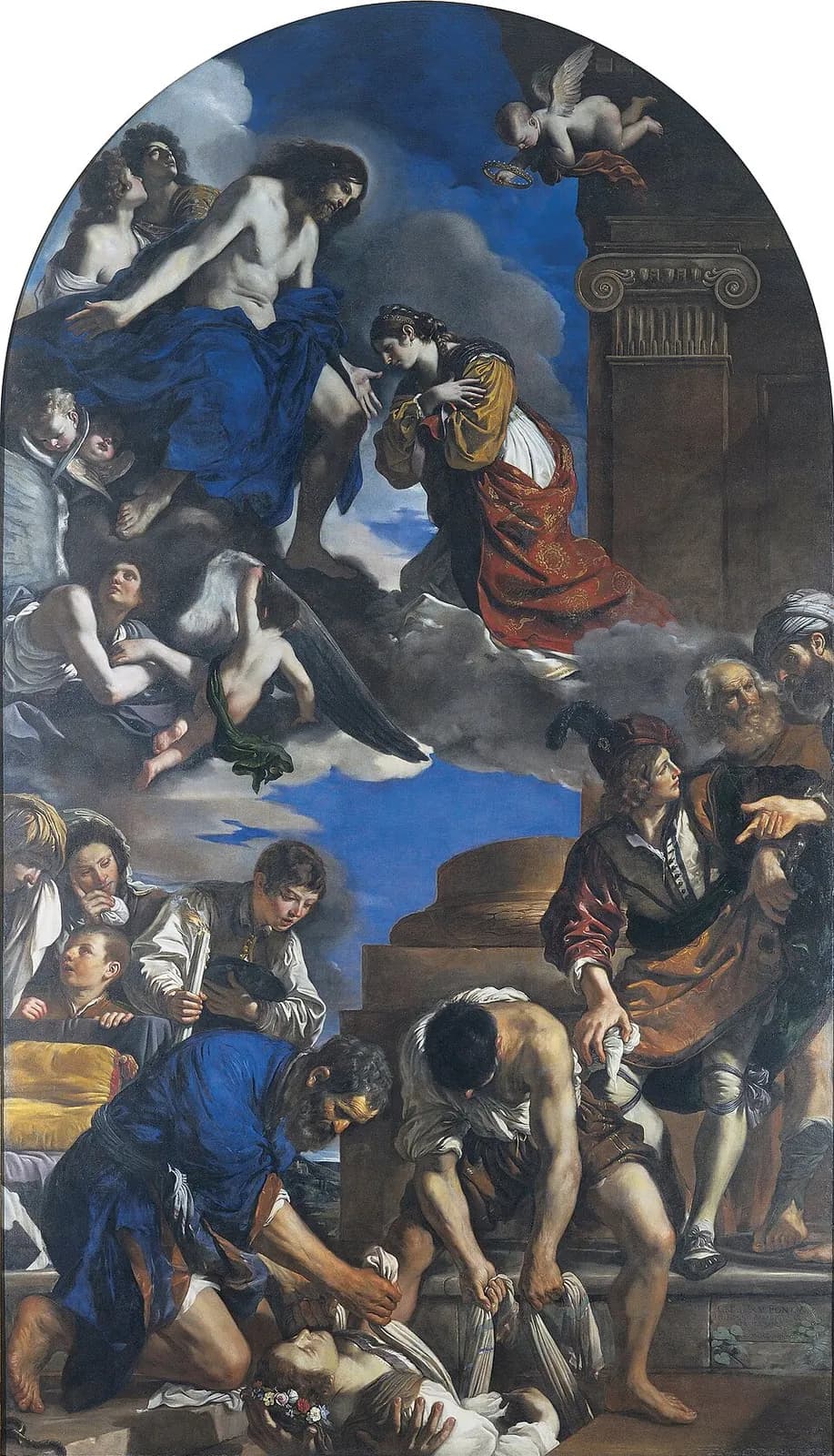
The mausoleum became the chapel of the Frankish kings. 2 It was for this chapel that a French cardinal commissioned a Pieta from the young Michelangelo. 23 The chapel was demolished when Saint Peter's was rebuilt in the sixteenth century, and her remains were moved to an altar in the new basilica, "still dedicated to her," at the upper end of the right aisle near the dome. 13 A great mosaic copy of the painting by Guercino, showing her burial and her glory, stands at it. 3
What is Saint Petronilla the patron saint of?
Saint Petronilla is the patron saint of France. 2 The patronage grew out of the legend. The encyclopedia calls her "the special patroness of the treaties concluded between the popes and the Frankish emperors" and "the special Roman patroness of the Frankish rulers." 15 The French like to call their country the eldest daughter of the Church, the Norwegian page remarks, and Vian writes that from the time of the translation the daughter of Saint Peter was affiliated to "the eldest daughter of the Church." 23
The same page lists her as a patron of the city of Rome and of pilgrims and travelers, and says she is invoked against fever. 2 CatholicCulture.org gives a similar list: "against fever; dauphins of France; mountain travelers; treaties between Popes and Frankish emperors." 4 The fever goes back to the legend of her healing by Peter, a scene Sano di Pietro painted in the fifteenth century in a panel now at Siena. 2 The dauphins and the mountain travelers go back to a dolphin. Gueranger says the lid of her sarcophagus had one carved at each corner, and the Norwegian page gives that carving as the reason the heirs to the French throne, the dauphins, claimed her. 24
Saint Petronilla's feast day
Saint Petronilla's feast day is May 31. 12 Her name was added to the Martyrology of Jerome under that date as a later insertion, and Bede and the martyrologies that followed him kept the same day. 1 In 1969 the feast was removed from the universal calendar of the Church and left to local and particular calendars; her name remains in the Roman Martyrology. 2
Every year on that day Mass is celebrated at her altar in Saint Peter's. 3 Vian credits the French ambassadors to the Holy See, down to the representatives of the Republic, with keeping the tie alive and with restoring the annual Mass in the second half of the nineteenth century. 3
Praying with Saint Petronilla
Vian opens his essay with an inventory: "What remains of Petronilla is a Mass, a painting and a mysterious fresco." 3 Nobody can say when she was born, who her parents were, or how she died. 12
The fresco is the place to start. In the middle of the fourth century someone in Rome buried a woman named Veneranda and had Petronilla painted on the stone that closed the grave, leading her into paradise. 13 They wrote "Mart." beside the saint's name. 1 That is the oldest thing known about devotion to her, and it is older than any story told about her.
The legend deserves a different kind of attention. In its earliest form a father prays his daughter into paralysis to keep her safe, and Vian does not excuse the text; he names its contempt for the body and for marriage. 3 In the later form she dies to avoid a marriage she has refused. 24 Neither version is history, and neither is comfortable. Each of them remembers a young woman whose life was being decided by other people, and whom the Church came to honor in her own right. 13
Then there is the altar. Kings adopted her for reasons of state, and the ambassadors of a republic have kept her Mass going. 23 Under all of it is a grave on the Via Ardeatina that Christians were visiting before there was any legend to explain why. 1
Saint Petronilla, pray for us.
Sources
- 1.Johann Peter Kirsch, "St. Petronilla," The Catholic Encyclopedia, Vol. 11 (New York: Robert Appleton Company, 1911).
- 2.Per Einar Odden, "Den hellige Petronilla (1.årh)," Den katolske kirke (the Catholic Church in Norway), last updated December 20, 2000 (in Norwegian).
- 3.Giovanni Maria Vian, "The Daughter of St Peter," L'Osservatore Romano, Weekly Edition in English, May 8, 2015, p. 14, as reprinted in the EWTN library.
- 4."St. Aurelia Petronilla," Liturgical Year entry for May 31, CatholicCulture.org, with the Roman Martyrology commemoration and an excerpt from Prosper Gueranger, The Liturgical Year.
- 5.Johann Peter Kirsch, "Pope Paul I," The Catholic Encyclopedia, Vol. 11 (New York: Robert Appleton Company, 1911).
- 6.Johann Peter Kirsch, "Sts. Nereus and Achilleus, Domitilla and Pancratius," The Catholic Encyclopedia, Vol. 10 (New York: Robert Appleton Company, 1911).
Saints to turn to next
Others in this collection who are turned to for some of the same things.
- Saint Claude de la Colombiere1641 - February 15, 1682Suffering and illnessCourage
- Saint Denis of ParisMartyred at Paris about 275, or in 258 by another accountCourageSuffering and illness
- Saint John Paul IIMay 18, 1920 - April 2, 2005CourageSuffering and illness
- Saint Louis de MontfortJanuary 31, 1673 - April 28, 1716CourageSuffering and illness