Saint Peter of Alexandria
died November 311
- Born
- Date unknown 2
Saint Peter of Alexandria became bishop of that city, the chief see of Egypt, in 300, less than three years before the emperor Diocletian's persecution began, and was beheaded without warning in November 311, in its ninth year. 13 In between he wrote the rules by which Christians who had given way under torture or fear could come back to the Church. 16 Tradition calls him the Seal of the Martyrs, the last to die in the great persecution, and his feast is November 25. 28
Bishop on the eve of the persecution
Nothing is recorded of his birth or of when he was ordained. 2 The Catholic Encyclopedia reports, on the word of Philip of Sidetes, that he once headed the famous catechetical school of Alexandria; Catholic News Agency says only that he may have. 12 He succeeded Saint Theonas as bishop in 300. 123
The best witness to him is Eusebius of Caesarea, who counts him among the churchmen of his own day. Eusebius writes that Peter "was very eminent among them for twelve entire years," and that "he governed the church less than three years before the persecution, and for the remainder of his life he subjected himself to a more rigid discipline and cared in no secret manner for the general interest of the churches." 3 Elsewhere he calls him "one of the most excellent teachers of the religion of Christ" and "a divine example of a bishop on account of the excellence of his life and his study of the sacred Scriptures." 45
The persecution that Diocletian opened destroyed church buildings, jailed and tortured believers, and in the end killed those who would not join the pagan rites. 2 Catholic News Agency says Peter is remembered for severe penances undertaken for his suffering people and for letters of encouragement to those in prison. 2 At some point he also left the city and went into hiding. 12
The canons on the lapsed
Persecution produced martyrs, and it also produced people who took part in the pagan rites under coercion and afterward repented and asked to come back. They were called the lapsed. 12 Peter's answer survives as fourteen canons, taken in all likelihood from one of his Easter letters. 1 The encyclopedia dates them to the third year of the persecution; the first canon itself begins, "since the fourth passover of the persecution has arrived." 16
They sort cases with care, and they are mild. Those who gave way only after prison and "torments not to be borne," and had been mourning their fall into a third year, were to do forty more days of penance, the length of Christ's fast, and then be received. 6 Those who had paid money to be left alone were not to be accused at all, since they had lost their goods to save their souls. 6 Those who had iron and chains forced into their mouths and their hands burned in a sacrifice put on them by violence had not consented, and were to be reckoned among the confessors. 6
Two canons bear on his own conduct. One refuses to blame those "who have left all, and have retired for the safety of their life," and cites the apostle Peter's escape from prison. 6 The other deals with the opposite temperament, the zealots who walked up to the authorities uninvited. He keeps them in communion because they acted in Christ's name, and reminds them that the Lord taught his disciples to pray not to be led into temptation, and that he "often retired from those who would lay snares for Him." 6
The canons were later ratified by the Council in Trullo and so passed into the law of the Eastern Church, which the encyclopedia thinks is why they were preserved. 1 Many manuscripts add a fifteenth, from a work of his on Easter, defending the Wednesday and Friday fasts and keeping Sunday "as a day of joy, because on it He rose again." 16
Meletius
While Peter was in hiding another Egyptian bishop, Meletius of Lycopolis, moved into the gap. The encyclopedia sets out three ancient accounts and weighs them. 1 By the first, a set of Latin documents translated from lost Greek ones, Meletius consecrated bishops for sees whose own bishops were in prison for the faith, ignored the protest of four of them, and came to Alexandria, where he replaced the men Peter had left in charge. Among those who egged him on was Arius, the future heresiarch. Peter excommunicated him. 1
By the second account, that of Saint Athanasius, Meletius had also offered sacrifice and had denounced Peter to the emperor. The encyclopedia finds nothing in this that contradicts the documents but advises caution about the charge of sacrificing, which was never raised at the Council of Nicaea. 1 Henri Leclercq and Catholic News Agency both say a council under Peter at Alexandria, about 306, deposed Meletius, with sacrifice to idols among the grounds. 27
The third account turns the story around. Saint Epiphanius, writing later, makes the quarrel one over the lapsed, with Meletius the stricter party and Peter the lenient one. The encyclopedia thinks Epiphanius had this from a Meletian source and calls his version "full of historical blunders," for instance that Peter died in prison as Meletius's cellmate. 1 The schism outlived Peter by many years. 2
A teacher against Origen's excesses
Of his other writings only pieces remain. The encyclopedia sees his importance for theology in the fact that he "marked, very probably initiated, the reaction at Alexandria against extreme Origenism." 1 Fragments survive of a treatise against the idea that souls existed and sinned before they had bodies, and of another on the Resurrection that insists the risen body is the same body that lived. 1 Three passages from his work On the Godhead were quoted by Saint Cyril at the Council of Ephesus in the fifth century. 12 The encyclopedia is equally careful to list what is not his: a number of Syriac, Armenian and Coptic fragments under his name are doubtful or forged. 1
Beheaded without a hearing
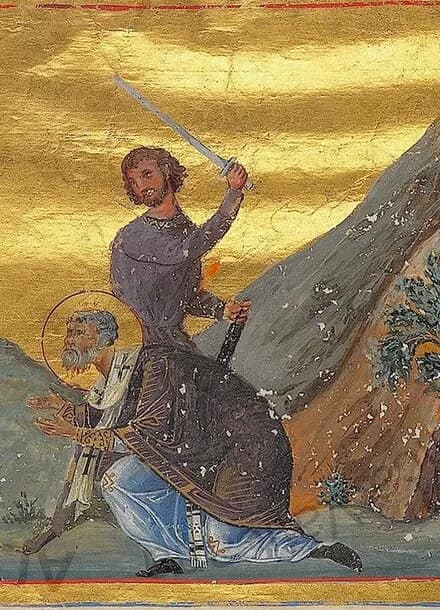
Eusebius places his death in a renewed wave of persecution, and tells it in a sentence: "being seized for no cause and quite unexpectedly," he "was, as if by command of Maximinus, immediately and without explanation, beheaded." 5 It was the ninth year of the persecution. 3 Eusebius names three priests who died with him, Faustus, Dius and Ammonius, and says many other Egyptian bishops suffered the same fate. 45
Catholic News Agency identifies the emperor as Maximinus Daia and places the order during his visit to Alexandria. 2 The Roman Martyrology attributes it to Galerius Maximian. 8 A Coptic history of the patriarchs compiled in the tenth century, which Catholic News Agency quotes, says the leading men of the city "wrapped his body in the leathern mat on which he used to sleep" and carried him to the church for burial. 2
There are also Acts of his martyrdom, and the encyclopedia sets them aside as "too late to have any historical value." They contain, it says, "the story of Christ appearing to St. Peter with His garment rent, foretelling the Arian schism." 1
What is Saint Peter of Alexandria the patron saint of?
None of the sources consulted for this page names Saint Peter of Alexandria as patron of any place, group or cause, and the page does not supply one. 128 What tradition gives him is a title. He is the "Seal of the Martyrs," in Catholic News Agency's words because he was held to be "the last believer to suffer death at the hands of Roman imperial authorities for his faith in Christ," and the Roman Martyrology uses the same title. 28 The same article says he is especially loved by Catholic and Orthodox Christians of the Coptic tradition. 2
Saint Peter of Alexandria's feast day
Saint Peter of Alexandria is commemorated on November 25. The current Roman Martyrology enters him on that day, and Vatican News lists "St Peter of Alexandria, Bishop and Martyr" on its calendar for 25 November. 89 Catholic News Agency says commemorations are kept "on Nov. 25 and 26," and that November 26 was his feast in the Western tradition until it was dropped from the universal calendar. 2 The Catholic Encyclopedia gives the month of his death, November 311, without a day. 1
Praying with Saint Peter of Alexandria
Peter was a bishop who hid and a bishop who died, and he seems to have seen no contradiction. His thirteenth canon defends the Christian who runs for his life, and his ninth gently corrects the one who goes looking for arrest. 6 When his own arrest came there was no time to choose anything. He was seized and beheaded at once, Eusebius says, with no explanation given. 5
The canons are the nearest thing to his voice that survives. They were written for people who had failed publicly and badly, and for the congregations that had to decide whether to take them back. He measures what each person actually suffered and actually chose, lets the tortured return after forty days, and will not let those who stood firm look down on those who fled or paid. 6
He was also capable of drawing a line. Meletius, who used the bishop's absence to take over his church, was excommunicated. 1
Eusebius put Peter first among the martyrs of Egypt and called his life an example of what a bishop is. 45
Saint Peter of Alexandria, pray for us.
Sources
- 1.Francis Joseph Bacchus, "St. Peter of Alexandria," The Catholic Encyclopedia, vol. 11 (New York: Robert Appleton Company, 1911).
- 2."Church remembers St. Peter of Alexandria, 'Seal of the Martyrs'," Catholic News Agency, November 25, 2012.
- 3.Eusebius of Caesarea, Church History, Book VII, chapter 32, trans. Arthur Cushman McGiffert (Nicene and Post-Nicene Fathers, Second Series, vol. 1), New Advent.
- 4.Eusebius of Caesarea, Church History, Book VIII, chapter 13, trans. Arthur Cushman McGiffert, New Advent.
- 5.Eusebius of Caesarea, Church History, Book IX, chapter 6, trans. Arthur Cushman McGiffert, New Advent.
- 6.Saint Peter of Alexandria, Canonical Epistle, trans. James B. H. Hawkins (Ante-Nicene Fathers, vol. 6), New Advent.
- 7.Henri Leclercq, "Meletius of Lycopolis," The Catholic Encyclopedia, vol. 10 (New York: Robert Appleton Company, 1911).
- 8."San Pietro, vescovo e martire," Santo del giorno, 25 novembre (Roman Martyrology entry, in Italian), Conferenza Episcopale Italiana.
- 9."St Peter of Alexandria, Bishop and Martyr," Saint of the Day, 25 November, Vatican News.
Saints to turn to next
Others in this collection who are turned to for some of the same things.
- Saint CyprianBirth unknown - September 14, 258CourageConversionSuffering and illness
- Saint EustaceMartyred at Rome, in 118 by tradition; other accounts give 140 or 188ConversionCourageSuffering and illness
- Saint Gregory the Illuminatorc. 257 - c. 337 (both dates uncertain)ConversionSuffering and illnessCourage
- Saint John Paul IIMay 18, 1920 - April 2, 2005CourageSuffering and illnessConversion