Saint Peter Fourier
November 30, 1565 - December 9, 1640
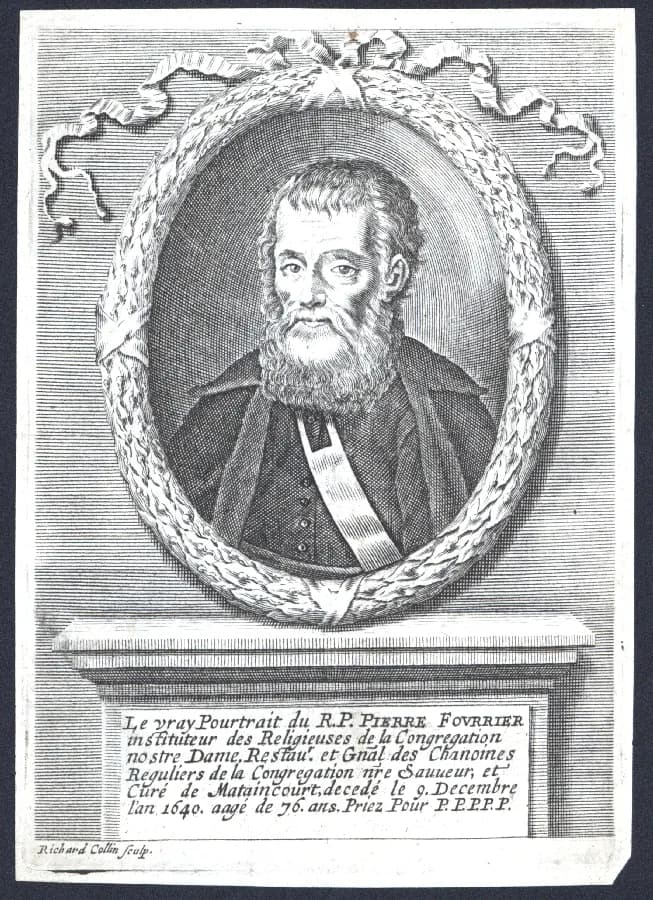
- Known as
- Le bon père de Mattaincourt, the good father of Mattaincourt 1
- Ordained
- 1589, as a canon regular of the Abbey of Chaumousey 1
- Parish priest of Mattaincourt
- From 1597 1
- Founded
- The Congregation of Notre-Dame, for the free schooling of poor girls (1598, or 1597 in another article by the same author) 14
- Patron saint of
- No patronage is named in the sources consulted
Saint Peter Fourier was a canon regular from Lorraine who, offered a choice of three parishes, took the poorest, turned it around, and founded a congregation of sisters to run free schools for girls. 12 The Congregation of Notre-Dame, which he founded in 1598, taught poor girls without charge and spread through France and Italy and, through Marguerite Bourgeoys, to Montreal. 14 He was known as the good father of Mattaincourt, and his feast is December 9. 13
Mirecourt and Pont-à-Mousson
He was born at Mirecourt, in Lorraine, on November 30, 1565. 12 Leo XIII's letter of canonization names his parents as Dominique Fourier and Anne Nacquart, and says they sent him to be taught by the Jesuits at Pont-à-Mousson, at the time the most famous school in Lorraine. 2 The 1913 Catholic Encyclopedia says he went to the university there at fifteen, and that his piety and learning led noble families to ask him to teach their sons. 1
He joined the canons regular at the Abbey of Chaumousey and was ordained in 1589. 1 His abbot sent him back to the university, where he became expert in the Fathers of the Church; the encyclopedia says he knew the Summa of Saint Thomas Aquinas by heart. 1 Leo XIII adds that among his fellow students were two future reformers of religious orders, and a kinsman, the Jesuit Jean Fourier, whom Francis de Sales thought highly of. 2
Back at the abbey, according to Leo XIII, he asked his superior to let him give most of his allowance to the poor, and lived on vegetables, boiled roots and wine heavily cut with water. 2
The poorest parish
In 1597 he was made parish priest of Mattaincourt, which the encyclopedia calls "a corrupt district threatened with the new heresy." 1 Leo XIII says three parishes were vacant and he was allowed to choose. He took the poorest, a place so hostile to the faith that it was commonly called little Geneva, on the grounds that there would be little income there and work enough. 2 He took possession of it on the feast of Corpus Christi, carrying the Blessed Sacrament through the village in procession. 2
By his prayer, his teaching and his example, the encyclopedia says, religion was soon restored. 1 He founded three sodalities: one of Saint Sebastian for the men, one of the Rosary for the women, and one of the Immaculate Conception for the girls. 12 He wrote short dialogues on the virtues opposed to the vices most common among his people, and had the children perform them in public every Sunday. 1
He also looked after the parish's money troubles. For people who had fallen into poverty through bad luck he set up what the encyclopedia calls "a kind of mutual help bank." 1 Leo XIII says some of his arrangements anticipated ideas that more recent economists took pride in, and that he preached almsgiving so persuasively that the well-off of Mattaincourt competed in it. 2 The Bishop of Toul held him up to other parish priests and sent him preaching through the whole diocese. 2
Free schools for girls
To make the work last, he founded an order of women, the Congregation of Notre-Dame, to teach poor girls for nothing. 1 Allaria's article on Fourier dates it to 1598; his article on the canons regular says 1597, at Mattaincourt. 14 Leo XIII says Pope Paul V approved it in 1614, and that Urban VIII named the sisters Canonesses Regular of Saint Augustine of the Congregation of Our Lady. 2
The congregation spread quickly through France and Italy. 4 With some changes its work reached Canada through Marguerite Bourgeoys, who in 1657 opened a school at Montreal where, following the rules Fourier had laid down, the poor were taught free of charge. 14 Leo XIII wrote in 1897 that the institute was still bearing fruit in America as well as in Europe. 24
Reformer of the canons
In 1621, by order of the Bishop of Toul, he took on the reform of the canons regular of Lorraine, and the reformed houses formed the Congregation of Our Saviour in 1629. 1 Leo XIII says Pope Gregory XV approved the work, and that permission for a permanent superior general was granted on January 25, 1629. 2 Fourier himself became superior general in 1632, and he wanted the canons to do for boys what his sisters were doing for girls. 1
In 1625 he was sent to the principality of Salm, near Nancy, which had gone over to Calvinism. 1 According to the encyclopedia, within six months the Protestants had returned to the Catholic faith. 1 Leo XIII describes him at Badonviller, the chief town, repairing the parish church and preaching to the Calvinists, whom he called strangers rather than heretics because it was a gentler name. 2 The encyclopedia gives his own phrase for them: "poor strangers." 1
He took no credit for any of it. Leo XIII says that when the Duke of Lorraine and the magistrates congratulated him, he put it down to God and to his companions, disowned as far as he could the miracles witnesses attributed to him, and was content with menial work among his brethren. 2
Exile and death at Gray
The sources tell his last years differently. The encyclopedia says he was driven into exile at Gray, in Franche-Comté, because of his attachment to the House of Lorraine. 1 Leo XIII says that in 1636 he was sent with some companions toward Gray on public business, was held up by the war, and was teaching boys and instructing their elders when he fell ill with a fever and foretold his death. 2
Leo XIII says he was afraid at the end, and wept over his sins and the judgment to come, while holding on to Mary. 2 On the feast of the Immaculate Conception he received Communion again, and on December 9, 1640, in his seventy-sixth year, he made the sign of the cross three times and died peacefully. 12
His heart was left to the people of Gray. 2 The canons set out to carry his body back to Lorraine, but when it reached Mattaincourt his parishioners would not allow their pastor to be buried anywhere else, and his tomb is there. 2
Beatification and canonization
Clement XI declared his virtues heroic on April 1, 1717, and Benedict XIII beatified him on January 10, 1730. 12 The cause was taken up again in 1845. 2 The two healings accepted for his canonization, as Leo XIII sets them out, were both of sisters of his own Congregation of Notre-Dame: one in Paris in 1868, of a knee that surgeons had despaired of, and one at Strasbourg in 1881, of a stomach ulcer that had kept her in bed for four years. 2 Leo XIII canonized him in St. Peter's Basilica on Ascension Day, May 27, 1897, together with Anthony Mary Zaccaria. 12
What is Saint Peter Fourier the patron saint of?
Saint Peter Fourier's feast day
Praying with Saint Peter Fourier
He chose Mattaincourt because it was the worst of the three parishes on offer, and he stayed attached to it for the rest of his life. 2 Even while he was away reforming the canons, Leo XIII says, he came back whenever his people were in trouble, and in the end they kept his body. 2
His holiness was practical. A bank for families who had fallen on hard times, sodalities, plays for the children on Sundays, a school that cost nothing. 1 Leo XIII says that above all he cared for the sound instruction of ordinary Christians, and that he founded the sisters' schools in opposition to the mixed schools then spreading. 2 Leo XIII wrote his letter of canonization around the commandment that whoever loves God must love his brother too, and set Fourier up against a kind of philanthropy that forgets God. 2
With the Calvinists of Salm he chose his words with care. Leo XIII says he called them strangers to draw them with a less bitter name, and the encyclopedia remembers the phrase as "poor strangers." 12
He did not die serenely. Leo XIII records his fear of judgment in his last illness and his tears over his sins, and that he held on to the Mother of God, whom he said could not abandon even so unworthy a client. 2 Then he received Communion, signed himself with the cross, and died in peace. 2
Saint Peter Fourier, pray for us.
Sources
- 1.Anthony Allaria, "St. Peter Fourier," The Catholic Encyclopedia, Vol. 11 (New York: Robert Appleton Company, 1911).
- 2.Pope Leo XIII, Hoc mandatum, apostolic letter for the canonization of Peter Fourier, June 27, 1897 (Latin).
- 3.Saint of the Day, Calendar of Saints, December 9, Vatican News.
- 4.Anthony Allaria, "Canons and Canonesses Regular," The Catholic Encyclopedia, Vol. 3 (New York: Robert Appleton Company, 1908).
Saints to turn to next
Others in this collection who are turned to for some of the same things.
- Saint Alexander Sauli1533 or 1534 - October 11, 1592Work and vocationPoverty and simplicityStudy and teaching
- Saint Antoninus of FlorenceMarch 1, 1389 - May 2, 1459Poverty and simplicityStudy and teachingWork and vocation
- Saint Brigid of Kildare451 or 452 - February 1, 525Work and vocationStudy and teachingPoverty and simplicity
- Saint Giuseppe MoscatiJuly 25, 1880 - April 12, 1927Work and vocationStudy and teachingPoverty and simplicity