Saint Paula of Rome
347 - 404
- Feast day
- January 26, the day she died 4
- Family
- Wife of Toxotius; mother of Blesilla, Paulina, Eustochium, Rufina and Toxotius 2
- Widowed
- 379, at the age of 32 1
Saint Paula of Rome was a senator's widow from one of the first families of the city who gave away a great fortune, sailed east in 385, and spent her last twenty years at Bethlehem, where she built monasteries and studied the Bible with Saint Jerome. 123 Nearly everything known about her comes from the long letter Jerome wrote to her daughter Eustochium after she died. 1 "Noble in family," he says in its first lines, "she was nobler still in holiness." 2 Her feast is January 26. 4
A great house in Rome
She was born in Rome in 347. 13 Jerome names her mother as Blæsilla, a descendant of the Scipios and the Gracchi, and her father as Rogatus, whose family claimed the blood of Agamemnon. 2 He lists the pedigree and then waves it away, saying he will praise only what belongs to her. 2
She married Toxotius and bore him five children: Blesilla, Paulina, Eustochium, Rufina and a son named Toxotius after his father. 2 Vatican News says her husband was a senator and that until she was thirty-two she lived in privilege, dressed in silk and carried through the city by eunuch slaves. 3 Jerome confirms the last detail. When she later set out from Antioch on a donkey, in midwinter, he remarks that this was a noble lady "who had always previously been carried by eunuchs." 2
Widowhood
Toxotius died in 379, when she was thirty-two. 1 Jerome writes that "her grief was so great that she nearly died herself," and that she then gave herself entirely to the service of God. 2 The Catholic Encyclopedia credits the influence of Saint Marcella and the circle of Roman widows around her. 1 Vatican News adds that Paula hosted the group in her own house on the Aventine. 3
She began giving her money away, and went looking through the city for the dying and the bedridden. When her relatives protested that she was robbing her children, Jerome says, "she declared that she was leaving to them a better inheritance in the mercy of Christ." 2
In 382 the emperors summoned bishops of East and West to Rome. Epiphanius of Salamis stayed in her house, and she looked after Paulinus of Antioch as though he were lodged there too. Their example set her thinking about the monks of the desert. 12 Jerome had come with them. After they left, at Marcella's request, he gave readings from Scripture to the patrician women among whom Paula was prominent. 1 Her eldest daughter Blesilla was widowed young and died in 384, the same year as Pope Damasus, and the encyclopedia says those two deaths changed the course of life for both Paula and Jerome. 1
Leaving
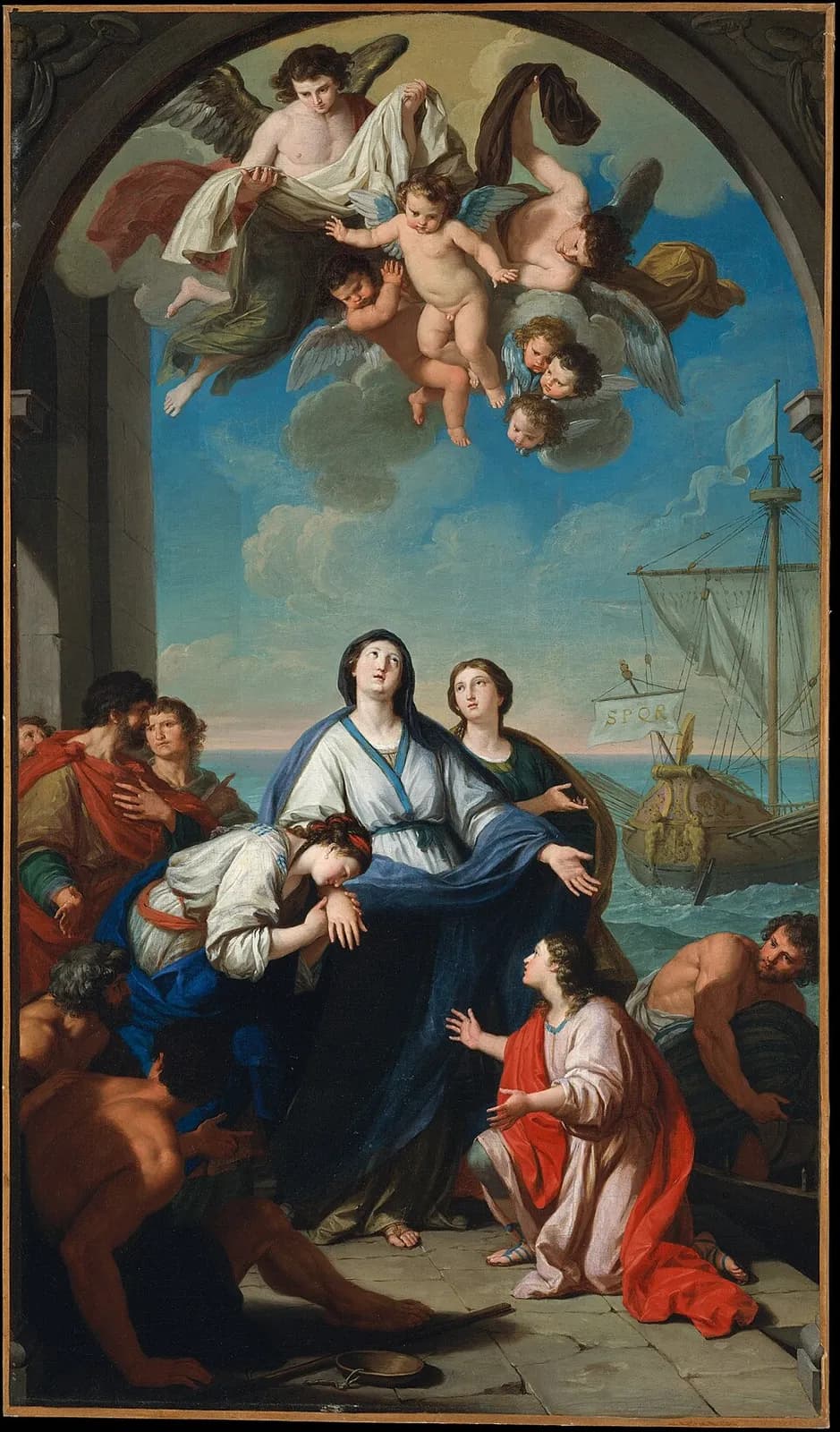
In September 385 she went down to the harbor at Portus and sailed with Eustochium. 12 Jerome had left a month before her. 1 He describes her brother, her kinsfolk and her children at the water, trying to change her mind. "On the shore the little Toxotius stretched forth his hands in entreaty," while Rufina, by then grown up, begged through silent sobs that her mother wait until she was married. 2
Jerome does not pretend it cost her nothing. "Yet her heart was rent within her," he writes, "and she wrestled with her grief, as though she were being forcibly separated from parts of herself." 2 He says she kept her eyes turned away from the shore so as not to see what she could not bear to see, and that before sailing she had given her children everything she owned. 2 Rufina died the following year. 1
She stopped ten days with Epiphanius in Cyprus, visiting the monasteries of the island, and met Jerome at Antioch. 12 From there the party went through the holy places of Palestine in detail. 1 At the cave of the Nativity in Bethlehem, Jerome records, "she protested in my hearing that she could behold with the eyes of faith the infant Lord wrapped in swaddling clothes and crying in the manger." 2 They went on to Egypt and the monks of Nitria, where she would have liked to stay, and then came back. 2
Bethlehem
She settled at Bethlehem for good. For three years she lived in what Jerome calls "a miserable hostelry" while the buildings went up: cells, monasteries, and a guest house for travelers, "where they might find the welcome which Mary and Joseph had missed." 2
The encyclopedia and Vatican News speak of two monasteries, one for men and one for women. 13 Jerome is more exact. The men's house she left to men to run. The women, drawn from many provinces and every class, she divided into three companies that worked and ate apart and came together to pray. 2 They recited the psalter at dawn, at the third, sixth and ninth hours, at evening and at midnight. "No sister was allowed to be ignorant of the psalms," and each had to learn a portion of Scripture every day. 2 All dressed alike and owned nothing beyond food and clothing. 2
She was hardest on herself. Jerome admits that her fasting went past what he thought wise, and tells how he once sent Epiphanius to her sickbed to talk her into taking a little wine. She saw through it at once. The old bishop came out saying that she had nearly persuaded him to give up wine himself. 2
Scripture and Hebrew
She asked Jerome to read the Old and New Testaments through with her and Eustochium. He refused at first, out of modesty he says, and gave in because she kept asking. 2 She was not an easy pupil. Whenever he admitted he was stuck, she pressed him with new questions until he said which of several answers he thought most probable. 2
Then she learned Hebrew, which Jerome himself had acquired only with years of labor. She succeeded so well, he writes, "that she could chant the psalms in Hebrew and could speak the language without a trace of the pronunciation peculiar to Latin." 2 The encyclopedia says mother and daughter mastered the language and took a growing share in his biblical work. 1 Vatican News goes further, and says that Paula herself suggested the need for a Latin translation of the Bible and, with Eustochium, copied it out so that it could be shared. 3
Debts, trials and death
Her giving outran her fortune. Jerome says she borrowed at interest, and took new loans to pay old ones, so as never to turn a beggar away. He scolded her for it. "I was wrong, I admit," he writes, and he gives her answer: "My prayer is that I may die a beggar not leaving a penny to my daughter and indebted to strangers for my winding sheet." 2 She got her wish. Eustochium inherited a mass of debt and a community to feed. 2
The last years were not peaceful. The encyclopedia mentions the controversy over Origen, which strained relations with John, the bishop of Jerusalem, and then her want of money. 1 Vatican News says she helped the irascible Jerome meet his opponents with humility and patience. 3 When Jerome urged her to move away from her enemies, she answered, "I cannot find another Bethlehem elsewhere." 2
She died at Bethlehem after a serious illness, with Eustochium nursing her. Asked by Jerome whether she was in pain, "she replied in Greek that she had no suffering and that all things were to her eyes calm and tranquil," and she went on whispering verses of the psalms until her breath failed. 2 Bishops carried her bier to the church at the cave of the Savior, and the poor held up the clothes she had given them. 2 Jerome's epitaph says she "fell asleep on the seventh day before the Kalends of February" and lived "fifty-six years eight months and twenty-one days." 2 The Catholic Encyclopedia gives the year as 404. 1 Vatican News says 406, at the age of fifty-nine. 3
What is Saint Paula of Rome the patron saint of?
Saint Paula of Rome's feast day
Praying with Saint Paula of Rome
Jerome knew his readers would suspect him of gilding a friend. "I am no flatterer," he insists. "I add nothing. I exaggerate nothing." 2 The encyclopedia grants that the letter is "somewhat rhetorical" and calls it "a wonderful production" all the same. 1
Her departure from Rome is the hard part of the story, and Jerome leaves it hard. A boy holds out his hands from the shore and his mother turns her eyes away. 2 Jerome praises her for it, and in the same passage says no mother ever loved her children so dearly. 2 He also records that the deaths of her husband and daughters each brought her close to death herself. 2
Her houses prayed the psalms six times a day, and she learned Hebrew well enough to chant them in it. 2 She also wanted to know what the text meant. Jerome says she knew the Scriptures by heart, loved the history in them, and still pressed past it for the spiritual meaning, and that she would not let him rest when he confessed himself at a loss. 2
She chose Bethlehem over Rome, in Jerome's phrase, and "left her palace glittering with gold to dwell in a mud cabin." 2 She built a guest house there because Mary and Joseph had found none. 2 When she was dying, the daughter who had sailed with her ran back and forth between the sickbed and the cave of the Nativity to pray. 2
Saint Paula of Rome, pray for us.
Sources
- 1.Louis Saltet, "St. Paula," The Catholic Encyclopedia, vol. 11 (New York: Robert Appleton Company, 1911).
- 2.Saint Jerome, Letter 108, to Eustochium (404), trans. W. H. Fremantle, G. Lewis and W. G. Martley, Nicene and Post-Nicene Fathers, Second Series, vol. 6 (1893). New Advent.
- 3."St. Paula," Saint of the Day, 26 January, Vatican News.
- 4."26 January," Saint of the Day, Vatican News.
Saints to turn to next
Others in this collection who are turned to for some of the same things.
- Saint Alexander Sauli1533 or 1534 - October 11, 1592Poverty and simplicityStudy and teaching
- Saint Alexius of RomeFifth century, by traditionPoverty and simplicityMarriage and family
- Saint Antoninus of FlorenceMarch 1, 1389 - May 2, 1459Poverty and simplicityStudy and teaching
- Saint Brigid of Kildare451 or 452 - February 1, 525Study and teachingPoverty and simplicity