Saint Paul of Constantinople
Died about 350
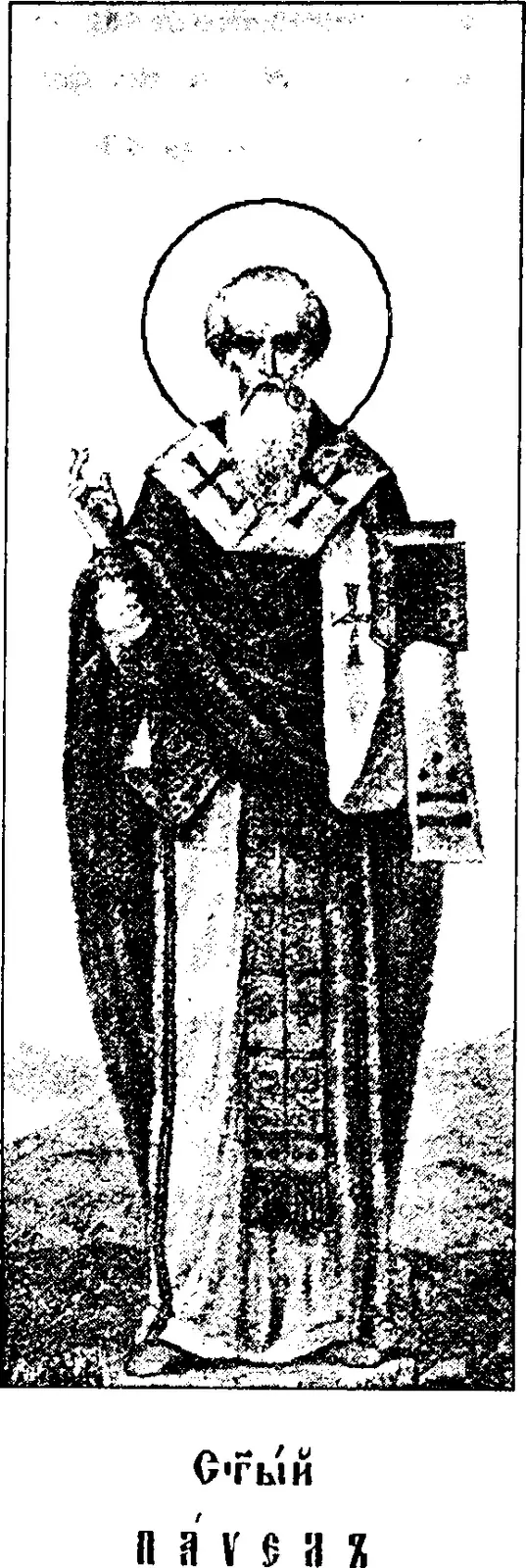
- Origin
- A native of Thessalonica, says Butler 5; his ancestors came from there, say Socrates and Sozomen 12
- Bishop of Constantinople
- Chosen after the death of Alexander; expelled and restored several times 125
Saint Paul of Constantinople was the bishop the Nicene party in the capital chose after the death of Alexander, and for about ten years the Emperor Constantius and the Arian bishops around him kept driving him out of the city while his people, the pope and the bishops of the West kept bringing him back. 125 He died in his last exile at Cucusus, in the mountains of Cappadocia, and Saint Athanasius, who knew him, wrote that his guards starved him for six days and then strangled him. 4 The Church remembers him on November 6. 6
Alexander's choice
Alexander, bishop of Constantinople and an old enemy of Arius, died at ninety-eight without having ordained a successor. 12 According to Socrates, he left the choice between two men. If the people wanted someone "competent to teach, and of eminent piety," they should elect Paul, a priest he had ordained himself, "young indeed in years, but of advanced intelligence and prudence"; if they wanted "a man of venerable aspect, and external show only of sanctity," they could have Macedonius, an aged deacon. 1 Sozomen tells it a little differently: Paul for a man good in divine matters and apt to teach, Macedonius for one at home in public affairs and the councils of rulers. 2
Butler makes Paul a deacon of the church, not a priest, and a native of Thessalonica; Socrates and Sozomen say only that his ancestors came from there. 125 The city divided along the lines of the quarrel over Arius. Those who held the faith of the Council of Nicaea wanted Paul, the Arian party wanted Macedonius, and Paul was ordained in the church called Irene, beside the great church of Sophia. 12
Even the ordination became an argument. Sozomen reports the claim of Paul's enemies that he took the see on his own authority, without the bishops of Nicomedia and Heraclea, and the reply of others that the bishops then in the city had ordained him. 2 The same enemies, he says, slandered his private life, while admitting that he was eloquent and "brilliant in teaching the Church." 2 Athanasius adds that Macedonius himself brought a charge against Paul, then dropped it and served as a priest under him. 4
Deposed and restored
The Emperor Constantius was away at the time of the election, and when he came back he was furious. 125 He called a synod of Arian bishops, had Paul deposed, and moved Eusebius of Nicomedia, the leader of the Arian party, to Constantinople in his place. 125 Butler dates this to 340, and says Paul went west, to the court of Constans, Constantius's brother, and on to Rome. 5
There he found Athanasius, who had fled from Alexandria, along with other deposed bishops of the East. 12 Pope Julius heard their cases, and Socrates says that he, "by virtue of the Church of Rome's peculiar privilege," sent them back with letters restoring each to his see and rebuking those who had deposed them. 1 Sozomen gives the same reason in other words: the care of all belonged to the dignity of his see. 2
Eusebius died soon afterward, and Paul's people brought him back into the church. 12 On the same day the Arian bishops ordained Macedonius in another church, and the two parties fought in the streets; Socrates says many lives were lost. 12 Constantius, then at Antioch, ordered his general Hermogenes, who was marching to Thrace, to pass through Constantinople and expel Paul. The people rose to defend their bishop, set fire to Hermogenes's house, and killed him. 125 The emperor rode to the capital himself and expelled Paul again, but he would not confirm Macedonius either, since so many had died over him. 1
The bath of Zeuxippus
When word reached Antioch that Paul had once more taken possession of his church, Constantius sent a written order to Philip, the praetorian prefect, to remove him and install Macedonius. 12 Philip, afraid of the crowd, kept the order secret. He invited Paul to meet him at the public baths of Zeuxippus, as if on public business, and there showed him the emperor's order. 12 Socrates says the bishop "patiently submitted condemnation without a hearing." 1 A crowd had gathered outside, so Philip had Paul taken out through a door into the imperial palace, put on board a ship, and sent off to Thessalonica, with leave to travel in Illyricum but never to return to the East. 12
Then the prefect drove to the church with Macedonius beside him in his chariot and soldiers with drawn swords around them. The church was packed, the soldiers took the press of the crowd for resistance, and they began to cut their way through. Socrates says that about 3,150 people died, cut down or crushed. 1 Macedonius was seated in the bishop's chair, Socrates wrote, "by the prefect, rather than by the ecclesiastical canon." 1
Socrates and Sozomen tell this story before the Council of Sardica. 12 Butler places it later, after the death of Constans in 350, as the beginning of Paul's last exile, and says that from Thessalonica he was sent on in chains to Singara, then to Emesa, and at last to Cucusus. 5
Sardica, and one more return
In Socrates's account, Paul was in the West again when the bishops met at Sardica, a council that Butler dates to 347. 15 The council restored him and Athanasius to their sees, while the Eastern bishops withdrew to Philippopolis and excommunicated them, and with them Pope Julius. 15 Constans then wrote his brother a letter that Socrates quotes: "Athanasius and Paul are here with me; and I am quite satisfied after investigation, that they are persecuted for the sake of piety." If Constantius would not restore them, Constans would come and restore them himself. 1
Constantius gave way rather than face a civil war. 1 Paul came back to Constantinople with two bishops as escort and letters from the Western emperor and the council, and Macedonius withdrew to a separate church. 1 Butler says Constantius allowed it only for fear of his brother's armies. 5
Exile and death at Cucusus
In 350 Constans died, and Constantius was left sole emperor. 15 The protection was gone. Paul was sent into exile for the last time, and Macedonius took the see. 13 Those who held the Nicene faith in Constantinople were driven from the churches and then forced into communion with Macedonius, Socrates and Sozomen say, by scourging, confiscation and branding. 13 Sozomen tells of two of Paul's household, Martyrius, a subdeacon, and Marcian, a reader and singer, who were handed over to the governor on a charge of having killed Hermogenes years before, and beheaded. 3
Athanasius, who was present when Macedonius first accused Paul, counts four banishments: to Pontus under Constantine, then under Constantius in iron chains to Singara in Mesopotamia, then to Emesa, and last to Cucusus in Cappadocia, "near the deserts of Mount Taurus." 4 There, he says, "as those who were with him have declared, he died by strangulation at their hands." 4 He had the details from Philagrius, the deputy governor, who told Bishop Serapion and others that Paul was shut up in a small, dark place and left to starve, and that when they found him still alive after six days, they strangled him. 4 Paul's enemies afterward said he had died of illness. 4
Socrates says plainly that the men conducting him strangled him at Cucusus. 1 Sozomen is the most cautious: he puts Cucusus in Armenia, says he had never been able to find out whether Paul died a natural death, and records that it was reported that the followers of Macedonius strangled him. 3 Butler dates the death to 350 or 351. 5
His relics
Butler says that Paul's body was taken first to Ancyra in Galatia and then, by order of Theodosius the Great, to Constantinople in 381, about thirty years after his death. It was laid in the great church that Macedonius had built, which from then on was known by Paul's name. 5 The 1897 Martyrology also records that his body was brought back to Constantinople with the greatest honors in the reign of Theodosius. 7 Butler adds that the relics were carried to Venice in 1226 and kept in the church of Saint Lawrence, belonging to a monastery of Benedictine nuns. 5
What is Saint Paul of Constantinople the patron saint of?
Saint Paul of Constantinople's feast day
Saint Paul of Constantinople's feast day is November 6. The current Roman Martyrology, as the Italian bishops print it, commemorates him on that day: repeatedly driven out by the Arians for his Nicene faith and repeatedly restored to his dignity, he was finally banished by the Emperor Constantius to Cucusus, the modern Göksun, a small town of Cappadocia, where the Arians are said to have strangled him in an ambush. 6
Older calendars kept him on June 7. The 1897 English Martyrology entered on that day "the birthday of St. Paul, bishop of that city," who was "often expelled from his see by the Arians, and restored to it by the Roman Pontiff, St. Julius," and was "barbarously strangled" at Cucusus. 7 Butler's Lives also tells his story under June 7. 5
Praying with Saint Paul of Constantinople
Very little of what Paul said survives. Sozomen, reporting what even his enemies admitted, says he was eloquent and a brilliant teacher, but not good at dealing with the powerful, and never able to outmaneuver the men who plotted against him. 2 Socrates gives a single phrase of his conduct, at the bath of Zeuxippus: he submitted patiently to a sentence passed without a hearing. 1
His people paid for their loyalty to him. Hermogenes died at their hands, and thousands died in the church when Macedonius was installed, and afterward those who held the Nicene faith were scourged, stripped of their property and branded. 13 The sources do not resolve this into anything tidy, and neither does this page.
He was sent away so often that the four exiles Athanasius counts do not line up with the ones Socrates describes, and the sources do not agree on their order. 145 What they all agree on is that he would not give up the faith of Nicaea, that the bishop of Rome and the bishops of the West stood by him, and that he died far from his city, in an exile his enemies had chosen for him. 1345
Saint Paul of Constantinople, pray for us.
Sources
- 1.Socrates Scholasticus, Ecclesiastical History, Book II, chapters 6, 7, 12, 13, 15, 16, 22, 23 and 26, trans. A. C. Zenos, Nicene and Post-Nicene Fathers, Second Series, vol. 2 (1890), at New Advent.
- 2.Sozomen, Ecclesiastical History, Book III, chapters 3, 4, 7, 8 and 9, trans. Chester D. Hartranft, Nicene and Post-Nicene Fathers, Second Series, vol. 2 (1890), at New Advent.
- 3.Sozomen, Ecclesiastical History, Book IV, chapters 2 and 3, trans. Chester D. Hartranft, Nicene and Post-Nicene Fathers, Second Series, vol. 2 (1890), at New Advent.
- 4.Athanasius, History of the Arians, Part I, chapter 7, "Martyrdom of Paul of Constantinople," trans. M. Atkinson and Archibald Robertson, Nicene and Post-Nicene Fathers, Second Series, vol. 4 (1892), at New Advent.
- 5.Alban Butler, "St. Paul, Bishop of Constantinople, M.," June 7, in The Lives of the Fathers, Martyrs, and Other Principal Saints, vol. VI (Derby: Richardson and Son), Internet Archive.
- 6.Roman Martyrology, entry for November 6, "San Paolo, vescovo di Costantinopoli," Santo del giorno, Conferenza Episcopale Italiana (in Italian).
- 7.The Roman Martyrology, June 7 (Baltimore: John Murphy Company, 1897), Internet Archive.
Saints to turn to next
Others in this collection who are turned to for some of the same things.