Saint Paul I
Birth unknown - June 28, 767
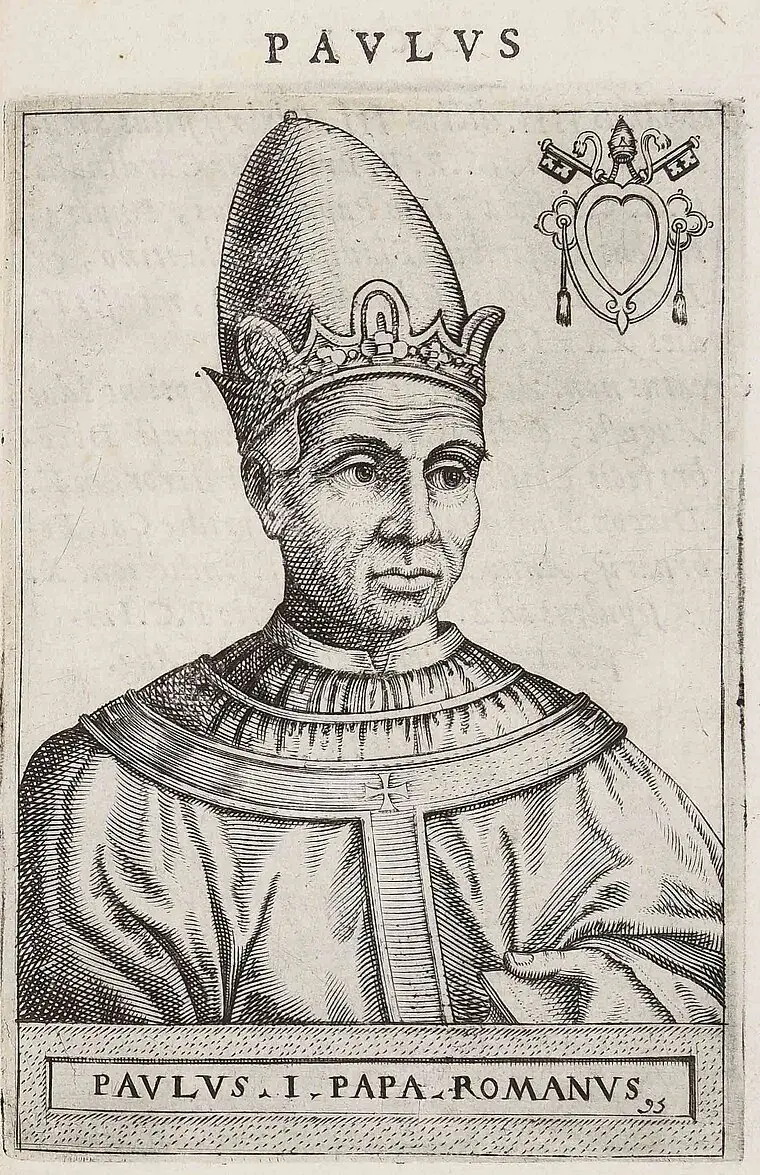
- Pope
- Elected April 757, consecrated May 29, 757; died June 28, 767; the 93rd pope in the Holy See's list 126
Saint Paul I was pope from 757 to 767, the younger brother of Stephen II, who nursed Stephen through his last illness and was elected to succeed him. 12 For ten years he kept the newly founded Papal States out of the hands of the Lombards and the Byzantines with a stream of letters to Pepin, king of the Franks, and he moved the bodies of martyrs out of the ruined catacombs into the churches of Rome. 124 His feast is June 28, the day he died. 14
Two brothers at the Lateran
Nobody recorded the year of his birth. The Holy See's list of popes gives his birthplace as Rome. 6 Johann Peter Kirsch, in the Catholic Encyclopedia, says Paul and his brother Stephen "had been educated for the priesthood at the Lateran palace." 1 The Norwegian bishops' saints database adds that the two were orphaned as children, that Pope Zachary ordained them both deacons, and that as deacons they signed the decrees of a Roman synod in 743. 3
When Stephen became pope, Paul stayed at his side. Stephen is Stephen II in Kirsch and in the Holy See's list; older books, Horace Mann's among them, sometimes number him Stephen III. 126 Paul supported his brother's turn toward the Frankish king Pepin and was given, Kirsch says, "many important ecclesiastical affairs," among them recovering for Rome the cities the Lombard kings had seized. 1
Election in 757
When Stephen fell ill, Mann writes, he was "tenderly" nursed by Paul. While he lay dying, a party gathered in the house of the archdeacon Theophylact to prepare the archdeacon's own election. 2 A larger number of officials and people declared for Paul, who, as the old papal biography in the Liber Pontificalis observes, did nothing to campaign and stayed at his brother's bedside. 2 Stephen died on April 26, and Paul was elected by a large majority immediately after the burial. 1
His consecration came on May 29, 757. 126 katolsk.no explains the month's delay by the minority that preferred Theophylact, and adds that the archdeacon was never set up as an antipope. 3 Paul wrote to Pepin before the consecration, still signing himself deacon and pope-elect, and promised to remain in "that fidelity, love and treaty which our brother offered to and made with you." 2
Night visits and harsh officials
His contemporary biographer, as Mann summarizes him, says Paul went out by night to the homes of the poor and the sick, visited the prisons, often freed men under sentence of death, and paid the debts of poor debtors to save them from slavery. 2 The current Roman Martyrology keeps the same picture: a gentle and merciful man who went silently at night among the cells of the sick poor, bringing them food. 4
The same biographer admits a weakness. "If for a short time any were oppressed by his wicked satellites," he writes, "it was not long before the Pope in his compassion administered the balm of comfort to the injured." 2 katolsk.no reports that Paul was criticized as a rigid administrator who used tyrannical subordinates, and that he hurried to set things right when he discovered an injustice. 3
One story from these years comes from Naples. John the Deacon tells of a Neapolitan deacon, also named Paul, who became the Roman deacon's friend. "God grant I may live to see you Pope," the Neapolitan said; "May I see you Bishop of Naples," came the reply. 2 Both wishes came true, and when the Neapolitans, who leaned toward the Greeks, held up his consecration, the bishop-elect went secretly to Rome and his old friend consecrated him himself. 2
Desiderius and the two letters
The new Lombard king, Desiderius, had promised to give up cities to the papacy and did not. Kirsch names Imola, Osimo, Ancona and Bologna. 1 In 758 Desiderius laid waste the Pentapolis on his way south, took the duchies of Spoleto and Benevento, and agreed with the Byzantine envoy George on a joint attack on Ravenna. 12 Coming home through Rome, he told the pope he would return Imola only if Pepin released the Lombard hostages the Franks were holding, and threatened war otherwise. 1
Paul answered with two letters, carried by Bishop George of Ostia and the priest Stephen. 1 The first, meant to be seen, asked Pepin to return the hostages and make peace. 12 The second, secret, told him what Desiderius had really done and begged for help. 1 The open letter, in Mann's words, "was simply written that the Pope's messengers might have something to show that would save them from being detained by the Lombards," and he calls the whole business "this simple diplomatic ruse." 2 katolsk.no says the pope's correspondence was being intercepted. 3
Pepin, at war in Aquitaine, would not send an army. 23 Early in 760 his brother Remedius, bishop of Rouen, and Duke Auchar came to Desiderius, who promised to restore the Roman patrimonies by April and then kept the promise only in part. 12 When Desiderius visited Rome in 765 the boundary disputes were finally settled. 1 In a late letter Paul tells Pepin that Desiderius had come "to pray" at the tombs of the apostles and brought with him Saxulus, a runaway slave of the Roman Church, and that the pope had agreed to go with him to Ravenna to plan its defense against the Greeks. 2
The images and the emperor
The emperor Constantine V had, by katolsk.no's account, held a council at Hieria in 754 that condemned holy images. 3 Paul, the Liber Pontificalis says, was "a stout defender of the orthodox faith," and he sent legate after legate to the emperor urging him to restore the images. 12 As the persecution grew, he received Greek monks into the monastery he had made of his family home. 23
The imperial envoy George went to Pepin's court himself, and there won over one of the pope's own envoys, the priest Marinus. 12 Paul told the king plainly what the quarrel was about: "it is for no other reason that we are annoyed by the Greeks than because we hold to the holy and orthodox faith and the tradition of the fathers, which they are eager to destroy." 2
Pepin held firm. He kept two papal envoys at his court, and in 767 a Frankish synod at Gentilly, near Paris, upheld the Church's teaching on the Trinity and on the veneration of images. 1
The martyrs brought into the city
Many of the catacombs outside Rome had fallen into ruin, and the Lombards had ravaged them in 756. 1 Paul took the bodies of numerous martyrs out of them and placed them in churches inside the walls. 12 The current Martyrology says he moved them into basilicas and monasteries of the city with hymns and canticles, and saw to their veneration. 4
The best known of these was Saint Petronilla, then held to be a daughter of Saint Peter and venerated as a special patroness of the Frankish kings. 1 Paul carried her body from the catacomb of Domitilla to a chapel at Saint Peter's that his brother had prepared for it; Mann dates the translation probably October 8, 757, and notes that one chronicler puts it in 758. 12
He turned his family home into a monastery and rebuilt the church beside it, San Silvestro in Capite, into which he brought the remains of Pope Saint Silvester. 12 He built an oratory of the Virgin in Saint Peter's, with a silver statue, and prepared his own tomb there, and he raised a church to the apostles on the Via Sacra. 12 He sent Pepin Greek books, among them works of Aristotle and of Dionysius the Areopagite, and took Frankish monks into the Roman school of chant. 2
Death at Saint Paul's
In the summer of 767 he went out to the basilica of Saint Paul outside the Walls to escape the heat, fell ill there, and died on June 28. 12 Mann writes that when others abandoned him he was nursed by the priest Stephen, who later succeeded him, as carefully as he had once nursed his own brother. 2
His body stayed at Saint Paul's for three months. Then the Romans and the foreign communities of the city carried it by water to Saint Peter's, singing the psalms for the dead, and laid it in the oratory he had prepared. 2 The epitaph read: "Hic requiescit Paulus Papa," here lies Pope Paul. 2
What is Saint Paul I the patron saint of?
Saint Paul I's feast day
Saint Paul I's feast day is June 28, the anniversary of his death. Kirsch writes that "his feast is celebrated on the twenty-eighth of June." 1 The Roman Martyrology, in the text published by the Italian bishops, has his entry that day: at Rome, Saint Paul I, pope, a gentle and merciful man who served the sick poor by night, wrote to the emperors in defense of holy images, and carried the bodies of the martyrs from the ruined cemeteries into the city. 4 The 1897 English edition of the Martyrology has, on the same day, "At Rome, of St. Paul, pope and confessor." 5
katolsk.no notes that there is no sign of a cult before the fifteenth century. 3
Praying with Saint Paul I
Much of what survives of Paul is letters to a king, and Mann admits they are monotonous. 2 They are the record of a man asking, again and again, for help that seldom came, and keeping his position for ten years by patience and correspondence. 23
The old biography sets beside them a different picture: a pope going out at night through Rome to the sick, the prisoners and the debtors, so that, in the biographer's phrase, his right hand might not know what his left was doing. 24 It is honest enough to add that some of his officials were cruel, and that his remedy came after the harm. 2
He sat with his brother through Stephen's last illness, and in Mann's account was nursed through his own by the priest who would follow him. 2 Between those two deathbeds he gathered the bones of martyrs out of ruined tombs and gave them churches. 14
Saint Paul I, pray for us.
Sources
- 1.Johann Peter Kirsch, "Pope Paul I," The Catholic Encyclopedia, vol. 11 (New York: Robert Appleton Company, 1911).
- 2.Horace K. Mann, The Lives of the Popes in the Early Middle Ages, vol. 1, part 2 (London: Kegan Paul, Trench, Trübner, 1902), "St. Paul I," pp. 331-360, as digitized on the Internet Archive.
- 3."Den hellige pave Paul I," Den katolske kirke, the saints database of the Catholic Church in Norway, katolsk.no (in Norwegian).
- 4.Roman Martyrology, entry for June 28, "San Paolo I, papa," Santo del giorno, Conferenza Episcopale Italiana (in Italian).
- 5.The Roman Martyrology, June 28 (Baltimore: John Murphy Company, 1897), Internet Archive.
- 6."Paul I," The Supreme Pontiffs, The Holy See.
Saints to turn to next
Others in this collection who are turned to for some of the same things.