Saint Pantaenus
Died c. 200, or under Caracalla (211-217)
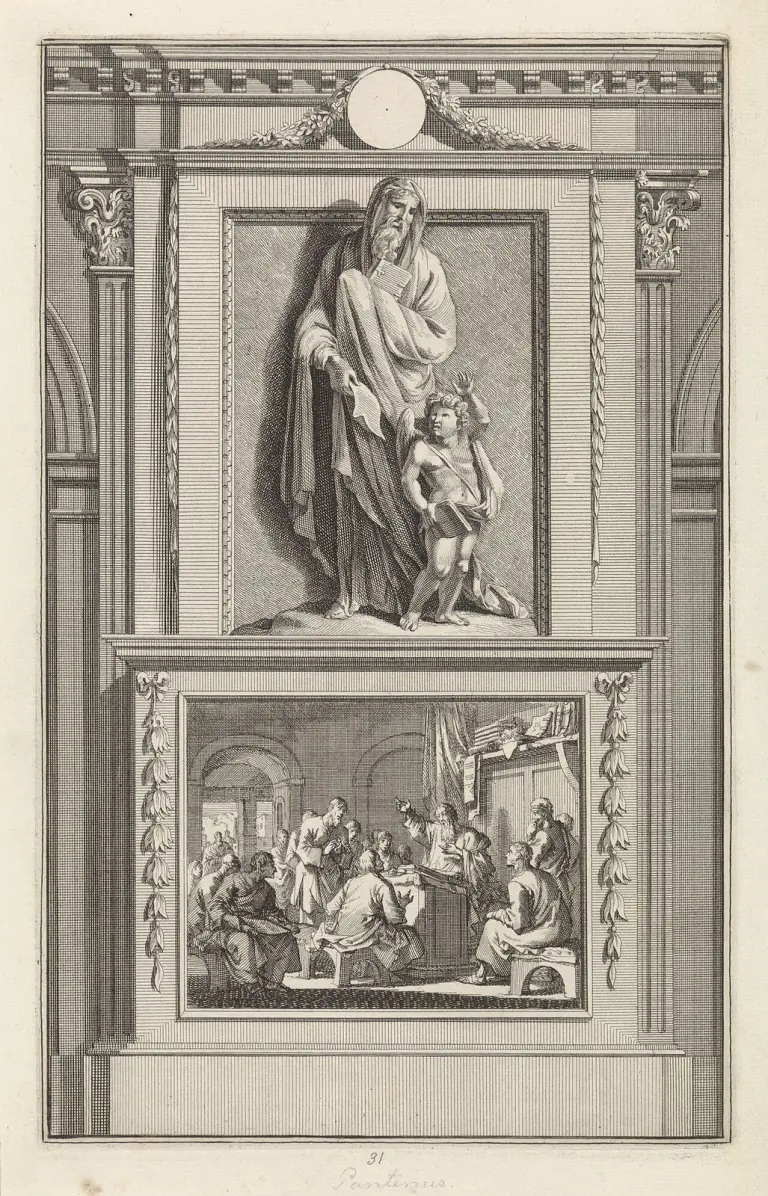
Saint Pantaenus was a Stoic philosopher who became a Christian and headed the school of sacred learning at Alexandria toward the end of the second century. 13 He is said to have preached the Gospel as far as India, and he was the teacher of Clement of Alexandria, who called him "the true, the Sicilian bee." 36 His feast is July 7. 7
A Stoic in Alexandria
Almost everything known about him comes from a few pages of Eusebius, Clement and Jerome. 1 Eusebius introduces him as "a man highly distinguished for his learning," educated in "the philosophical system of those called Stoics." 3 Jerome says he was of "so great prudence and erudition both in scripture and secular literature" that he stood out even in Alexandria. 5
Where he came from is uncertain. Butler calls him "by birth a Sicilian," taking Clement's phrase about the Sicilian bee at its word. 2 Eusebius thought Clement was speaking of Pantaenus when he described his last and greatest teacher as "a Hebrew in Palestine." 36 The Catholic Encyclopedia notes that a Hebrew of Palestine was unlikely to have been trained as a Stoic, though it allows that Eusebius may be right. 1
Butler says that what drew him to the faith was the "innocence and sanctity" of the Christians he came to know. 2
Head of the school
Alexandria had a school of sacred learning, Eusebius says, "established there in ancient times," and Pantaenus was "especially conspicuous" among the men who ran it. 3 Jerome traces the custom back to Mark the Evangelist, from whose time "the ecclesiastics were always doctors" in Alexandria. 5 The Catholic Encyclopedia puts him at the head of the school about 180, and Butler before 179. 12
He is remembered for one thing above all: using Greek philosophy in the service of theology before Clement and Origen did. 1 Origen, defending his own reading of the philosophers years later, wrote: "in this we have followed Pantænus, who benefited many before our time by his thorough preparation in such things." 4
Alexander, bishop of Jerusalem, who counted both Pantaenus and Clement among his friends, wrote to Origen of "those blessed fathers who have trodden the way before us," and named first "Pantænus, the truly blessed man and master." 4
The mission to India
Eusebius reports, as something "they say," that Pantaenus showed such zeal for the Word that he was sent as a herald of the Gospel "to the nations in the East," as far as India. 3 Jerome adds that he went at the request of envoys from that country, sent by Demetrius, bishop of Alexandria. 5 Butler says the Indians who traded at Alexandria asked him to come. 2
There, Eusebius continues, he found people who already knew of Christ, and among them the Gospel of Matthew in Hebrew, left by the apostle Bartholomew; Jerome says he brought it back to Alexandria. 35 The Catholic Encyclopedia points out that Eusebius gives all this as report, and suggests the "India" in question was probably South Arabia. 1
After his return, Eusebius says, he "finally became the head of the school at Alexandria, and expounded the treasures of divine doctrine both orally and in writing." 3
Clement's teacher
Clement of Alexandria named Pantaenus as his teacher in his Hypotyposes and gave "his opinions and traditions" there. 4 In the first book of the Stromata Clement looked back on the teachers he had sought out in Greece, Italy and the East, and came to the last: "having tracked him out concealed in Egypt, I found rest. He, the true, the Sicilian bee, gathering the spoil of the flowers of the prophetic and apostolic meadow, engendered in the souls of his hearers a deathless element of knowledge." 6
Clement says these teachers had preserved "the tradition of the blessed doctrine derived directly from the holy apostles, Peter, James, John, and Paul," and had come "by God's will to us also to deposit those ancestral and apostolic seeds." 6 The Catholic Encyclopedia adds that Photius later reported a claim that Pantaenus had heard men who had seen the Apostles, which it thinks Clement may well have said, and even that he had heard the Apostles themselves, which it treats as a misreading of this passage. 1
Little of his actual teaching can be recovered. The Catholic Encyclopedia notes that Anastasius of Sinai names him among the early Fathers who read the six days of creation and the garden of Eden as figures of Christ and the Church. 1
Clement does not name this teacher in the Stromata, and the identification is Eusebius's. 3 The Catholic Encyclopedia thinks a mind like Clement's may well have "found rest" in a teacher who pressed the Greek philosophers into the service of Christianity. 1
Clement succeeded him at the school. 4 Butler says Pantaenus went on teaching privately after that. 2 Jerome says many of his commentaries on Scripture were extant, "but his living voice was of still greater benefit to the churches." 5 The Catholic Encyclopedia finds none that can be securely attributed to him. 1
His death
The date is uncertain. The Catholic Encyclopedia reasons that he was alive in 193 and had been succeeded by Clement, who left Alexandria about 203, and so places his death about 200. 1 Jerome says he taught under the emperors Severus and Caracalla. 5 Butler, following Rufinus, says he died under Caracalla, "consequently before the year 216." 2 The current Roman Martyrology says that, back in Alexandria, he rested in peace in the time of the emperor Caracalla. 7
What is Saint Pantaenus the patron saint of?
Saint Pantaenus's feast day
Saint Pantaenus's feast day is July 7. The current Roman Martyrology commemorates him on that day as a man filled with apostolic zeal and rich in wisdom, who for love of the word of God set out to bring the Gospel to unknown peoples of the far East. 7 Butler, writing in the eighteenth century, already says that "his name is inserted in all Western Martyrologies on the 7th of July." 2
Praying with Saint Pantaenus
He was a philosopher before he was a Christian, and he did not stop being one. Origen and the Catholic Encyclopedia both remember him for putting what he knew of Greek thought to work for the faith. 41
He left a school to go and preach in a country he did not know, and came back to teach again. 35
Little of what he wrote survives, if anything. Jerome thought his "living voice" mattered more than his books, and Clement remembered finding "rest" with him. 56
His students wrote of him as a father. Alexander of Jerusalem called him "the truly blessed man and master." 4
Saint Pantaenus, pray for us.
Sources
- 1.Francis Joseph Bacchus, "Pantænus," The Catholic Encyclopedia, vol. 11 (New York: Robert Appleton Company, 1911).
- 2.Alban Butler, "St. Pantænus, Father of the Church," July 7, in The Lives of the Fathers, Martyrs, and Other Principal Saints, Vol. VII (New York: P. J. Kenedy, 1908), Project Gutenberg eBook #49604.
- 3.Eusebius, Church History, Book V, chapters 10-11, trans. Arthur Cushman McGiffert, Nicene and Post-Nicene Fathers, Second Series, vol. 1 (1890), New Advent.
- 4.Eusebius, Church History, Book VI, chapters 6, 13, 14 and 19, trans. Arthur Cushman McGiffert, Nicene and Post-Nicene Fathers, Second Series, vol. 1 (1890), New Advent.
- 5.Jerome, De viris illustribus (Lives of Illustrious Men), chapter 36, trans. Ernest Cushing Richardson, Nicene and Post-Nicene Fathers, Second Series, vol. 3 (1892), New Advent.
- 6.Clement of Alexandria, Stromata, Book I, chapter 1, trans. William Wilson, Ante-Nicene Fathers, vol. 2 (1885), New Advent.
- 7.Roman Martyrology, entry for July 7, "San Panteno di Alessandria," Santo del giorno, Conferenza Episcopale Italiana (in Italian).
Saints to turn to next
Others in this collection who are turned to for some of the same things.
- Saint Augustine of HippoNovember 13, 354 - August 28, 430ConversionStudy and teaching
- Saint Cyril of AlexandriaBirth unknown - 444Study and teachingConversion
- Saint Dionysius the AreopagiteFirst centuryConversionStudy and teaching
- Saint Edmund CampionJanuary 25, 1540 - December 1, 1581Study and teachingConversion