Saint Pachomius
Died about 346
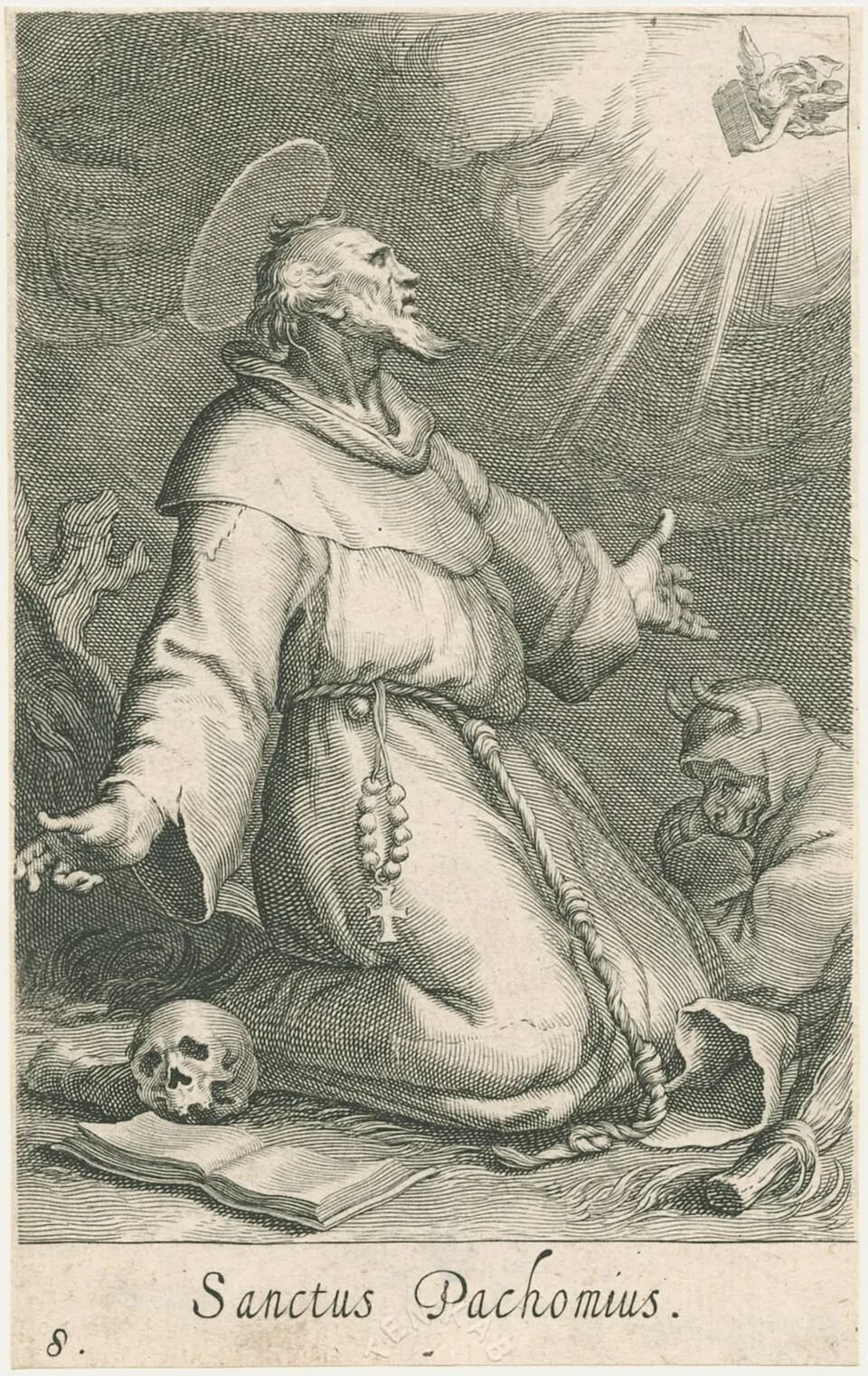
- Born
- Near Esneh, in Egypt 3
Saint Pachomius was an Egyptian conscript who became a Christian, then a hermit, and then the founder of the first monasteries in which monks lived a common life under a rule. 12 By the time he died, about 346, he governed nine houses of men and two of women along the upper Nile, organized as something no one in the East founded before or after him: a religious order. 12 The Roman Martyrology keeps his memory on May 9. 5
A recruit on a Nile boat
Catholic Culture says he was born near Esneh, in Egypt. 3 He was not raised a Christian. The Catholic Encyclopedia tells how, "still a heathen," he was forcibly enlisted along with a number of other young men and put on a ship to be carried down the Nile to Alexandria; it dates this to 313, when Constantine was at war with Maxentius. 2 At a town where the ship put in, the recruits were "overwhelmed with the kindness of the Christians." Pachomius resolved on the spot to become one, and did so as soon as he was released from the army. 2
The Roman Martyrology tells the same story in a line: still a pagan, he was moved by an act of Christian charity toward the soldiers held with him, and was converted. 5 It is the only episode of his early life that these sources record.
After his baptism he lived as an ascetic in a small village, in an abandoned temple of Serapis, growing a garden that fed him and gave him something to give away. 2 That temple later produced a theory that he had once been a pagan monk of Serapis. The encyclopedia has no patience with it. It calls the view "quite exploded," explains that the supposed monks of Serapis were people who slept in the temple hoping for oracular dreams, and adds wearily, "But theories of this kind die hard." 12
Palemon, and the vision at Tabennisi
Next he sought out an old hermit named Palemon and persuaded him to take him as a disciple and share his cell, which was a recognized arrangement among the hermits of Egypt. 2 The Martyrology says he received the monastic habit from Palemon. 5
After some time with him, Pachomius went to a deserted village called Tabennisi, near Denderah. 12 He may not have meant to stay; hermits often withdrew for a while to a more remote place and then came back. But he did not come back. A vision told him to remain and build a monastery: "very many eager to embrace the monastic life will come hither to thee." 1 Catholic Culture's account says the vision spoke of people who wanted the ascetic life of the desert without the hermit's solitude. 3 The Martyrology puts the founding seven years after he took the habit. 5
The encyclopedia is firm that this was no quarrel with the hermits. Palemon helped him build, and it adds: "There was never any rivalry between the hermits and the cenobites." 1 Its own reading is that Pachomius found the solitude of the hermit's life "a bar to vocations," and thought the common life the higher in itself. 1
Doing the chores himself
It did not work at once. His elder brother joined him first, then others, but they all wanted to go on living as hermits with a few changes, such as meals in common. 1 When men came who could enter into what he had in mind, he handled them carefully. He saw that people who knew only the hermit's life might quickly sour on a community if "the distracting cares of the cenobitical life" were thrust on them too suddenly. So he let them give all their time to prayer and took on himself "all the burdensome work which community life entails." 1 Catholic Culture says he spent most of his first years "doing all the menial work on his own." 3
Tabennisi was enlarged several times and still grew too small. A second house was founded at Pabau, a monastery at Chenoboskion joined, and before he died there were nine monasteries of men and two of women, by the encyclopedia's article on him and by Catholic Culture; its article on monasticism says "eight or nine" for men. 123
How a Pachomian monastery worked
The encyclopedia describes a walled group of buildings. The monks lived in houses of about forty, three or four houses made a tribe, and a monastery held thirty or forty houses, with an abbot over the whole and a provost over each house. 2 Men were grouped by their work, so that there was a house of carpenters and a house of farmers, and there was also "a house for the Greeks." On Saturdays and Sundays everyone gathered in the church for Mass; on other days the prayers were said in the houses. 2
Seen from outside, it was "an industrial community in which almost every kind of trade was practised." The monasteries had their own boats on the Nile to take produce and goods to market. 2 The produce of each house went to the head house of the order, where it was sold and the price shared out among the monasteries according to need. 2
The principle of the rule, in a sentence the encyclopedia quotes from Abbot Cuthbert Butler, "was to establish a moderate level of observance (moderate in comparison with the life led by the hermits) which might be obligatory on all," and then to encourage each monk to go beyond it as his strength and zeal allowed. 2 Food is the example. Tables were laid twice a day except on the Wednesday and Friday fasts, but some ate little, some took only bread, and for those who stayed away altogether bread, water and salt were left in their cells. 12
What made it an order was the government. Butler, again as quoted, says it "almost at once assumed the shape of a fully organized congregation or order, with a superior general and a system of visitation and general chapters," which was not seen again until the Cistercians and the friars. 2 Of founders of religious orders in the East, the encyclopedia says flatly, "No Eastern, except St. Pachomius, ever was." 2
The rule and the angel
Catholic Culture repeats the old tradition that the rule Pachomius drew up "was said to have been dictated to him by an angel," and says that Saint Benedict in the West and Saint Basil in the East both drew on it. 3 The Martyrology says simply that he wrote a rule for monks that became famous. 5
The encyclopedia is more cautious about the angel. All accounts of that rule, it says, go back to the writer Palladius, and "in some most important points it can be shown that it was never followed by either Pachomius or his monks." 1 Adrian Fortescue, in another article of the same encyclopedia, goes further: of the two written rules that carry Pachomius's name, the longer of which Saint Jerome translated into Latin, he writes: "Neither of these rules is authentic, but they may well contain maxims and principles that go back to his time, mixed with later ones." 6
Pachomius named a monk called Petronius to succeed him. Petronius died within months and was followed by Horsiesi, who later took Theodore, a favorite disciple of Pachomius, as his helper. 2 Catholic Culture adds that the order lasted until the eleventh century. 3
What is Saint Pachomius the patron saint of?
None of the sources consulted for this page names Saint Pachomius as the patron of anything, and the page does not supply a patronage. 13 What they give him is a title: Catholic Culture says he "can justifiably be called the founder of cenobitic monasticism," the life of monks in community. 3 It also notes how artists show him, "in hermit's garb, or crossing the Nile on the back of a crocodile." 3
Saint Pachomius's feast day
Saint Pachomius is commemorated on May 9. That is his day in the Roman Martyrology, where the entry places him in the Thebaid in Egypt, and Vatican News and Catholic Culture both list him on it. 345 Catholic Culture files him under the day's other commemorations, marked as taken from the Roman Martyrology. 3
Praying with Saint Pachomius
The Martyrology traces everything in his life to one kindness shown to a boatload of conscripts by strangers in a river town. 5 Nothing is recorded of what those Christians said. They looked after young men who had been enlisted by force, and one of them decided then to become a Christian. 2
His own way of leading had the same character. He did not lecture the first monks on the value of chores. He did the work himself and let them pray until they were ready to share it. 13 A man who wanted a community badly enough to wait for it, and to carry it while he waited, is a different figure from the lawgiver that the story of the angel suggests.
He also refused to set the two vocations against each other. He wanted his monks to match the hermits in austerity where they could, and the rule set a floor everyone could stand on and left the ceiling open. 12 The encyclopedia observes that Basil later preferred the common life partly because a solitary has no one whose feet he can wash. 2
It is worth knowing that Egypt exported the other model. The hermit colonies of the north were the ones pilgrims saw and copied. In the encyclopedia's words, "It was the eremitical, not the cenobitical, type of monasticism which went forth from Egypt." 2 The monasteries of Pachomius stayed in the south, in a relatively small area. 2
Saint Pachomius, pray for us.
Sources
- 1.Francis Joseph Bacchus, "St. Pachomius," The Catholic Encyclopedia, vol. 11 (New York: Robert Appleton Company, 1911).
- 2.Francis Joseph Bacchus, "Eastern Monasticism Before Chalcedon (A.D. 451)," The Catholic Encyclopedia, vol. 10 (New York: Robert Appleton Company, 1911).
- 3.Liturgical Year calendar, May 9 (Other Commemorations: St. Pachomius, Abbot), Catholic Culture, with a profile credited to Catholic News Agency.
- 4."St. Pachomius, Abbot," Saint of the Day, 09 May, Vatican News.
- 5."San Pacomio, abate," Santo del giorno, 9 maggio, from the Roman Martyrology, Conferenza Episcopale Italiana (in Italian).
- 6.Adrian Fortescue, "Eastern Monasticism," The Catholic Encyclopedia, vol. 10 (New York: Robert Appleton Company, 1911).
Saints to turn to next
Others in this collection who are turned to for some of the same things.
- Saint Agnes of Montepulcianoc. 1268 - April 1317PrayerWork and vocationDiscernment
- Saint Andrew Avellino1521 - November 10, 1608DiscernmentWork and vocationPrayer
- Saint Benedict of Anianec. 750 - February 11, 821DiscernmentPrayerWork and vocation
- Saint Benedict of Nursiac. 480 - March 21, 547PrayerWork and vocationDiscernment