Saint Otto of Bamberg
c. 1060 - June 30, 1139
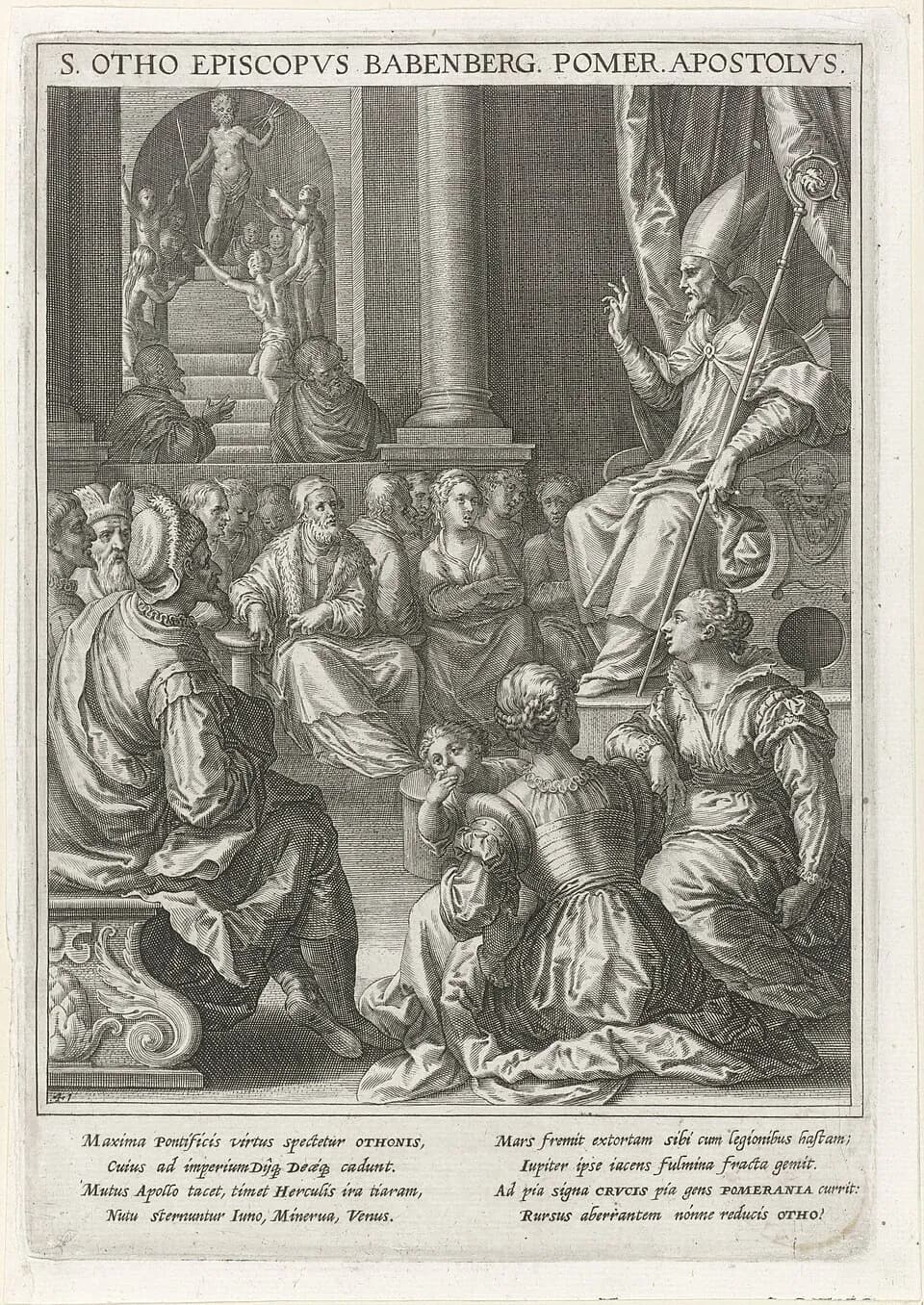
Saint Otto was bishop of Bamberg from 1102 to 1139, a former imperial chancellor who spent the great quarrel between emperor and pope trying to make peace between them. 12 In his sixties he twice traveled to Pomerania and preached Christianity there, which earned him the name Apostle of the Pomeranians. 14 His feast is June 30, and Bamberg keeps it on September 30. 2
Chaplain and chancellor
He was born about 1060. 14 The Catholic Encyclopedia says he belonged to "the noble, though not wealthy, family of Mistelbach in Swabia," and adds that nothing is known of where he was educated. 1 The Archdiocese of Bamberg says simply that he came of Swabian nobility. 2
As a young priest he went to Poland. The encyclopedia says he joined the household of Duke Wladislaw. 1 Bamberg explains how: around 1088 he was chaplain to Judith, the sister of Emperor Henry IV, who had married the duke. 2 A report published by the Archdiocese of Berlin says he learned the Slavic language there, which mattered later. 4
In 1090 he entered the emperor's own service. 1 According to Bamberg he was put in charge of the cathedral works at Speyer from 1097, and the cathedral was finished under him. 2 About 1101 he became chancellor. 12
A bishop between emperor and pope
Henry IV named him bishop of Bamberg in 1102, on Christmas Day by Bamberg's account. 12 On Candlemas 1103 he entered his cathedral city for the first time, and he did it barefoot. 2
This was the middle of the investiture controversy, the dispute over who had the right to install bishops and abbots. 2 Otto had been appointed and invested by the emperor. The encyclopedia says he "refused to be consecrated by a schismatic bishop" and sent ambassadors to declare his loyalty to the Holy See. 1 He waited more than three years. He was finally consecrated in 1106, on May 13 at Rome according to the encyclopedia, or at Pentecost at Anagni by Pope Paschal II according to Bamberg. 12
He never broke with the emperors either. The encyclopedia says he sided with Henry IV in political matters while avoiding open partisanship, went over to Henry V in 1105, and accompanied him to Rome in 1110 and 1111, where he "disapproved of the disgraceful treatment of Pope Paschal." 1 The pope gave him the pallium that April. 1 When war resumed he stayed with Henry, and for that the papal party suspended him at a synod at Fritzlar in 1118. 1
What he wanted was a settlement. At the congress of princes at Würzburg in 1121 he "strove hard for peace," and Bamberg credits his initiative there with the terms that ended the quarrel: appointment to a spiritual office belongs to the Church, and the grant of lands and rights to the king. 12 The agreement was sealed at Worms in 1122. 12
Father of the Monks
At home, the encyclopedia says, he "led a model, simple, and even a poor life." 1 He finished the cathedral, improved its school, recovered lost property, and built castles and churches. 1 Bamberg adds that he rebuilt the abbey church on the Michelsberg and that a noted writing school flourished there in his time. 2
Above all he founded monasteries, "over twenty" of them across seven dioceses in the encyclopedia's count; Bamberg lists twenty-one by name. 12 He reformed others. 1 The encyclopedia says this earned him the name "Father of the Monks." 1 Bamberg notes the practical side as well: houses he founded came under the bishop's authority, which limited the power of the local nobility. 2
Bamberg also records that he cared for the poor, the sick, widows and orphans, and had two hospitals built for them. 2
The mission to Pomerania
The encyclopedia calls this his "greatest service." 1 Pomerania had lately been conquered by Poland and had agreed in the peace of 1120 to accept Christianity, but attempts to convert its people through Polish priests and an Italian bishop named Bernard had failed. Duke Boleslaus III of Poland turned to Otto. 14
He set out in May 1124 with the pope's commission as legate. 1 Bamberg says he took twenty clergy with him, along with precious vestments, vessels and books. 2 He traveled by Prague, Breslau, Posen and Gnesen, won the support of the Pomeranian duke Wartislaw, and preached at Pyritz, Kammin, Stettin and Julin. 12
The encyclopedia says he won the people "through his quiet yet firm attitude, his magnificent appearance, generous donations, and gentle, inspiring sermons," and it gives a precise tally: eleven churches in nine places, and 22,165 persons baptized. 1 Bamberg repeats the figures more cautiously, saying he is said to have baptized more than 22,000. 2
The Berlin report, summarizing a historian's lecture, fills in what the magnificence meant. Otto deliberately presented Christianity as a powerful religion. He traveled in splendid dress with a train of clergy and armed soldiers, founded churches, preached and baptized, and had the pagan shrines destroyed. 4 He spoke against the killing of newborn girls, against fortune-telling and against polygamy. 4 The same report says plainly that conquest and mission went hand in hand. 4
He was back in Bamberg in 1125. 1 When pagan customs returned he went again, about 1128, this time from the west by Magdeburg and Havelberg, and by then he was nearly seventy. 14 At an assembly on the island of Usedom, which the Berlin report dates to Pentecost Sunday, the nobles of the country agreed to accept Christianity. 14 Bamberg adds that he mediated between Pomerania and Poland, whose princes made a treaty of friendship. 2
He never got Pomerania its own bishop while he lived, because two archbishops each claimed the territory. 1 He kept sending priests from Bamberg, and in 1140, the year after his death, his former companion Adalbert was confirmed as bishop at Julin. 1
Death and canonization
Otto died on June 30, 1139, and was buried in the monastery of Saint Michael at Bamberg. 12 The bishop of Würzburg preached at the funeral and applied to him a line of Jeremiah: "The Lord called thy name, a plentiful olive tree, fair, fruitful, and beautiful." 1 The Berlin report says the death register of the Michelsberg was already calling him the Apostle of the Pomeranians shortly afterward. 4
Pope Clement III canonized him in 1189. 1 Bamberg dates the proclamation to August of that year at Würzburg, fifty years after his death, and notes that he is the only bishop of Bamberg ever canonized. 2
What is Saint Otto of Bamberg the patron saint of?
None of the sources consulted for this page names Saint Otto as the patron saint of a trade, a need or a place. 124 They give him two titles instead: "Father of the Monks," for the houses he founded, and Apostle of the Pomeranians. 14 The Bamberg calendar lists him as bishop of Bamberg and messenger of the faith in Pomerania. 3
Saint Otto of Bamberg's feast day
Two dates are in use. The Archdiocese of Bamberg explains that June 30, the day he died, is his feast in the Catholic Church generally, while Bamberg itself keeps September 30, the day in 1189 when his remains were raised and moved to a new tomb. 2 The Bamberg calendar accordingly lists him on September 30. 3 The encyclopedia, in 1911, put it the other way around: "His feast is kept on 30 September, partly also on 30 June; in Pomerania on 1 October." 1
Praying with Saint Otto of Bamberg
Otto spent most of his career in a fight where both sides claimed him. He owed his see to an emperor and his consecration to a pope, and he would not give up either loyalty. 1 The encyclopedia's summary is short: "He never became a partisan." 1
It cost him. He waited years to be consecrated rather than accept it from the wrong hands, and later he was suspended by the pope's own party for staying with the emperor. 1 Then he went to Würzburg and worked for the peace that both sides signed the next year. 12
The mission came late. He was past sixty when he first set out for Pomerania, a prince-bishop with every reason to stay home. 14 The sources do not agree on how gentle that mission was, and a reader should hold both accounts: the inspiring sermons and the soldiers in the train. 14
For all the travel and politics, the encyclopedia remembers his life at home as simple and poor, and Bamberg remembers the hospitals. 12
Saint Otto of Bamberg, pray for us.
Sources
- 1.Klemens Löffler, "St. Otto," The Catholic Encyclopedia, vol. 11 (New York: Robert Appleton Company, 1911).
- 2."Heiliger Otto," Bistumsheilige, Erzbistum Bamberg (in German).
- 3."Bistumsheilige," Liturgie im Erzbistum Bamberg, calendar of the diocesan proper (in German).
- 4."Euer Otto, unser Otto," Tag des Herrn, Erzbistum Berlin, February 8, 2024 (in German).
Saints to turn to next
Others in this collection who are turned to for some of the same things.