Saint Othmar
c. 689 - November 16, 759
- Also called
- Otmar, Otmaro 2
- Patronage
- The abbey and diocese of Saint Gall; the sick, especially children; the slandered 2
Saint Othmar was the priest who, in the eighth century, gathered the hermits living at the cell of the Irish monk Saint Gall into a monastery and became its first abbot, adding a house for the poor and a hospital for lepers whom he nursed himself. 12 For defending the abbey's property against powerful Frankish officials he was seized, held prisoner and exiled to the island of Werd in the Rhine, where he died on November 16, 759. 124 His feast is November 16. 4
From Chur to Saint Gall
He was an Alemannian, from the region of Lake Constance, born about 689 according to Johannes Duft, whose biography appears on santiebeati. 12 He was educated in Rhaetia, at the court of the governor Victor at Chur, ordained priest, and put in charge of a church of Saint Florinus, which the Catholic Encyclopedia thinks was probably Saint Peter's at Remüs, where Florinus had worked and was buried. 12
At Saint Gall the Irish monk Gall had founded a hermitage in 612, and hermits still lived around his cell. 2 Count Waltram of Thurgau called Othmar there to take charge of it, in 720 according to the encyclopedia and katolsk.no and in 719 according to Duft. 123
He united the monks around the cell into a single community and became their first abbot. 12 Duft says the abbey's book of professions, which still survives, preserves the names of fifty-three monks of his time, and that gifts came in from all over Alemannia, with many of the original deeds still kept in the abbey archive. 2
The poor and the lepers
The rule at first was that of Saint Columban, the encyclopedia says, and during Othmar's abbacy it gave way to the Rule of Saint Benedict. 1 Duft dates the change to 747 and describes the older rule as Irish or mixed. 2 katolsk.no also credits him with introducing Benedict's Rule. 3
Duft writes that Othmar and his monks practiced poverty and patience, and that he was known for his charity to the poor and his willingness to wear himself out caring for the sick. 2 He built a hostel for the poor and a special hospital for lepers, whom he chose to tend himself. 2 The encyclopedia says he added a hospital and a school. 1 The current Martyrology remembers him as the abbot who founded "a small leprosarium" and a monastery at the place where Gall had built his cell. 4
Under him, Duft says, the monastery became a religious and civil center of the duchy of Alemannia. 2 When the Frankish prince Karlmann gave up his throne in 747, he visited Othmar at Saint Gall and gave him a letter to his brother Pepin recommending the abbot and his house. Othmar took it to Pepin himself and was kindly received. 1
Seized and exiled
The kindness did not last. The encyclopedia says that two counts, Warin and Ruodhart, tried unjustly to take possession of property belonging to the abbey, and that Othmar "fearlessly resisted their demands." 1 They captured him while he was traveling to Constance. 1
Duft gives a fuller and darker account. Pepin, he writes, wanted to end the independence of the province, the Frankish commissioners Warin and Ruthard envied the abbey, and Bishop Sidonius of Constance laid unjust claims to the monastery for himself and his diocese. 2 Together these enemies persuaded an unfaithful monk named Lambert to bear false witness, accusing the abbot who had governed the house well for forty years of adultery. 2 Othmar was condemned to die of hunger and in the end exiled. 2
The encyclopedia says he was held first at the castle of Bodman and then on the island of Werd in the Rhine, near a place it calls Echnez, and died there after six months of imprisonment. 1 Duft says he died on Werd at the age of seventy, on November 16, 759, completely alone. 2 The Martyrology says simply that he was deported by powerful neighbors for defending the monastery's rights, and died in exile. 4 katolsk.no says he ended his days in prison. 3
Brought home
Ten years later, in 769, his monks brought his body back to Saint Gall. 12 Duft writes that he was then canonized by Bishop Salomon I of Constance, and in 867 his remains were solemnly laid in a new church built in his honor beside the abbey church, after which his cult spread through central Europe. 12
His early history is better documented than that of many saints of his age. Duft lists a Life written by Gozbert about 830 and reworked by Walafrid Strabo between 834 and 838, a record of his miracles by Iso written between 864 and 867, and further material in Walafrid's Life of Saint Gall and Ratpert's chronicle of the abbey. 2 The encyclopedia cites the same Life and Iso's two books of miracles. 1
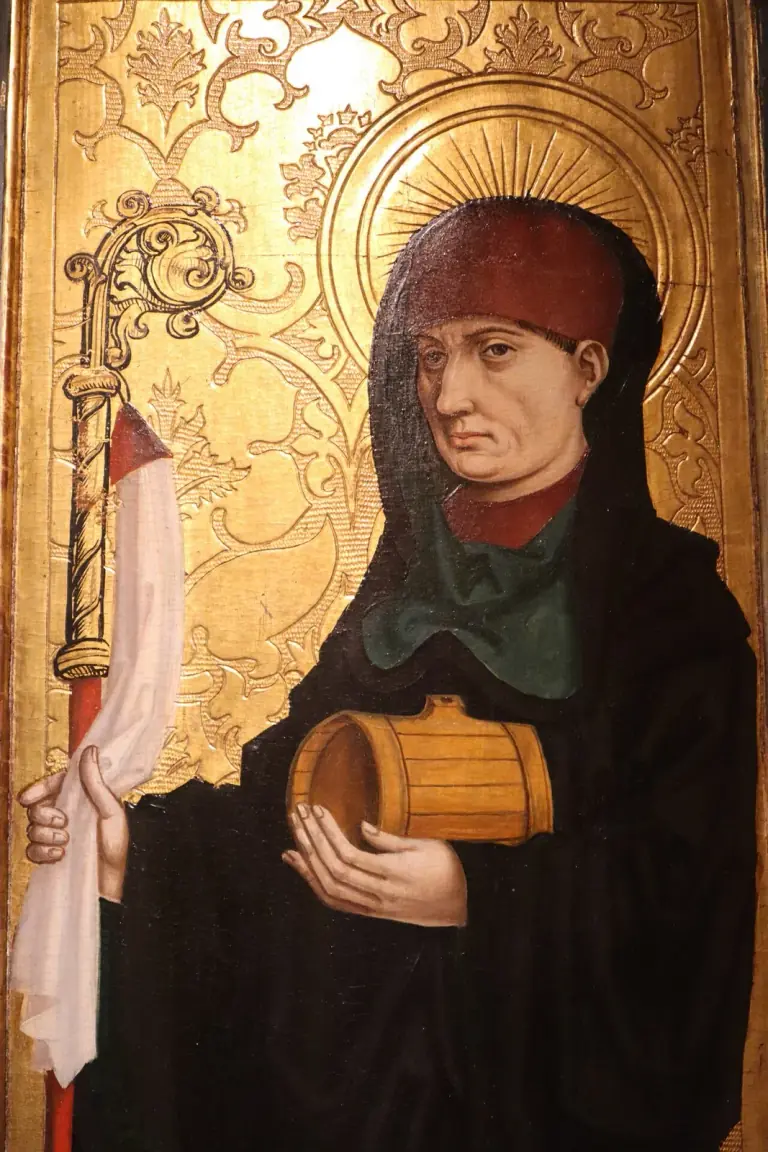
In art he holds a little barrel, and the two sources explain it differently. 12 The encyclopedia says it recalls a barrel of his that never ran empty however much he took from it for the poor. 1 Duft says it recalls the journey home: as the monks carried his body across Lake Constance, the wine they had brought to refresh themselves miraculously increased. 2 The encyclopedia describes him as shown in the habit of a Benedictine abbot; Duft, with episcopal insignia. 12
By the encyclopedia's time he was, after Saint Maurice and Saint Gall, the most popular saint in Switzerland. 1 Duft counts eighty-four churches under his patronage. 2
What is Saint Othmar the patron saint of?
Duft writes that Saint Othmar is venerated, with Saint Gall, as principal patron of the old abbey and of the present diocese of Saint Gall, and that he is invoked as patron of the sick, especially sick children, of people who have been slandered, and of the "Church of silence," the Church under persecution. 2
Saint Othmar's feast day
Saint Othmar's feast day is November 16, the day of his death. The current Roman Martyrology, as the Italian bishops print it, enters him that day as the abbot who founded a leprosarium and a Benedictine monastery at the site of Saint Gall's cell and died in exile on Werd. 4 The encyclopedia and Duft give the same day, and Duft says it is kept in the diocese of Saint Gall. 12
The Norwegian bishops' database gives November 16 in its text, though the heading of its entry prints November 20. 3
Praying with Saint Othmar
The first thing the sources say he built, after the monastery itself, was a place for people nobody else wanted: lepers, whom he nursed with his own hands, and the poor. 12
He kept the abbey's property out of the hands of men who wanted it, and it cost him everything. 12 In Duft's account it also cost him his name, because the charge brought against him was a lie told by one of his own monks. 2
He died old and alone on a small island, and the sources do not record any vindication in his lifetime. 12 It was his monks, ten years later, who went to fetch him. 12
Both stories about the barrel are about giving more than there seemed to be. 12
Saint Othmar, pray for us.
Sources
- 1.Michael Ott, "St. Othmar," The Catholic Encyclopedia, Vol. 11 (New York: Robert Appleton Company, 1911).
- 2.Johannes Duft, "Sant' Otmaro di San Gallo, Abate," Santi e Beati, santiebeati.it (in Italian).
- 3."Den hellige Othmar ( -759)," Den katolske kirke (Catholic Church in Norway), katolsk.no (in Norwegian).
- 4.Roman Martyrology, entries for November 16, Santo del giorno, Conferenza Episcopale Italiana (in Italian).
Saints to turn to next
Others in this collection who are turned to for some of the same things.
- Saint Bathildc. 630 - 680Poverty and simplicitySuffering and illness
- Saint Peter Claver1581 - September 8, 1654Suffering and illnessPoverty and simplicity
- Saint Rochc. 1295 - 1327 by tradition; 1340s - c. 1376-1379 by recent researchSuffering and illnessPoverty and simplicity
- Saint Teresa of CalcuttaAugust 26, 1910 - September 5, 1997Poverty and simplicitySuffering and illness