Saint Bathild
c. 630 - 680
- Patron saint of
- The sick, children and widows 4
Saint Bathild was sold as a slave into the household of the most powerful official in the Frankish kingdom, and within a few years she was its queen. 12 Married to Clovis II in 649 and left a widow with three small sons, she governed for the eldest, banned the trade in Christian slaves, and founded the abbeys of Corbie and Chelles. 135 She ended her life at Chelles as a nun, and the 1907 Catholic Encyclopedia says that she "desired to be the lowest in rank among the inmates." 1
From slave to queen
Nobody knows for certain where she came from. Pierre Auguste Fournet, who wrote the encyclopedia article, says that according to some chronicles she came from England and was descended from Anglo-Saxon kings, "but this is a doubtful statement." 1 The Norwegian bishops' saints database (katolsk.no) says her Life presents her as an Anglo-Saxon of good birth, perhaps a kinswoman of Ricbert, the last pagan king of East Anglia, while French sources make her the daughter of a prince of "Ascagnie." 2 Butler, in the life Catholic Culture prints, calls her simply "an Englishwoman, who was carried over whilst yet young into France, and there sold as a slave, at a very low price." 4
What is certain, Fournet says, is that she was a slave in the service of the wife of Erchinoald, mayor of the palace of Neustria. 1 Her qualities of mind and her virtues won her master's confidence, and he gave her charge of much of the household. 14 katolsk.no adds that she won the other servants too, cleaning their shoes and mending their clothes. 2 When Erchinoald's wife died, he wanted to marry her. She fled, or in katolsk.no's telling disguised herself in rags among the lowest servants, and did not come back until he had married someone else. 12
King Clovis II met her at the mayor's house and was taken with her beauty and grace and what he heard of her, and in 649 he freed and married her. 12 katolsk.no notes that some historians think Erchinoald offered her to the king to keep his own influence at court. 2 Fournet's judgment is that the sudden rise "did not diminish the virtues of Bathilde but gave them a new lustre," and Butler says she "seemed to become even more humble than before." 14
Regent of the Franks
Clovis died seven years later, in 656 by Fournet's reckoning and 657 by katolsk.no's, leaving her with three sons: Clothaire, Childeric and Thierry. 12 An assembly of the nobles proclaimed the five-year-old Clothaire III king under her regency. 1 The Roman Martyrology, as the Italian bishops print it, records that after her husband's death she took up the government of the Frankish kingdom. 3
She governed with Erchinoald and a group of bishops whose names fill the calendar: Eligius of Noyon, Ouen of Rouen, Leger of Autun and Chrodebert of Paris. 1 Fournet credits her with two reforms in particular. She "abolished the disgraceful trade in Christian slaves," and she firmly repressed simony among the clergy. 1 Butler says the same of the first: she "at once forbade the enslavement of Christians." 4
She spent much of her wealth on foundations. The abbey of Corbie was founded for men through her generosity, and the encyclopedia's Corbie article dates it to 657, with its first monks brought from Luxeuil. 15 Chelles near Paris was founded for women, with Bertilla from Jouarre as its first abbess, and Fournet thinks that Jumièges, Jouarre and Luxeuil also owed much to her. 1 The Martyrology says she founded monasteries under the rule of Saint Benedict according to the custom of Luxeuil. 3 Butler says she "filled France with hospitals and religious houses." 4
Her government did not escape criticism. katolsk.no reports that Eddius, the biographer of Saint Wilfrid, called her a Jezebel and blamed her for the killing of Bishop Annemund of Lyon and nine other bishops. No other source supports the charge, katolsk.no says; Eddius may have confused her with someone else, and she was probably innocent. 2 It also tells, and dismisses as pure invention, the legend that she had two rebellious sons hamstrung and set adrift on the Seine to be rescued by the monks of Jumièges. 2
The nun of Chelles
Erchinoald died in 659 and was succeeded by the ambitious Ebroin, but Bathild kept her authority. 12 The sources differ on how it ended. Fournet says that once her sons were established in their own territories, Childeric in Austrasia and Thierry in Burgundy, she returned to her old wish for a secluded life and withdrew to Chelles. 1 katolsk.no says that about 665 a palace revolution removed her, and that ambitious nobles sent her to Chelles without ceremony. 2
At Chelles she laid aside the signs of royalty. Fournet says she took her place after the novices, served the poor and the infirm with her own hands, divided her time between prayer and manual work, and wanted no mention made of her past. 1 katolsk.no says she obeyed Abbess Bertilla more humbly than any of the other nuns, and that several of the best-known Anglo-Saxon nuns were trained there. 2 Catholic Culture's own summary calls her Abbess of Chelles, which the longer accounts do not. 124
She spent about fifteen years there. 1 Early in 680 she sensed that death was near and prepared for it; before her own death came that of a little girl, Radegonde, whom she had held at the font and brought up. 1 katolsk.no says she died on January 30, 680, after a long and painful illness, not yet fifty, and was buried at Chelles beside her son Clothaire III. 2 Butler likewise gives January 30, 680, and says she bore the illness "with Christian patience." 4 Catholic Culture's brief summary has 679. 4
Her tomb drew pilgrims, says katolsk.no, and her relics were moved into a new church at Chelles in 833. 2 Both Fournet and katolsk.no say she was canonized by Pope Nicholas I. 12
What is Saint Bathild the patron saint of?
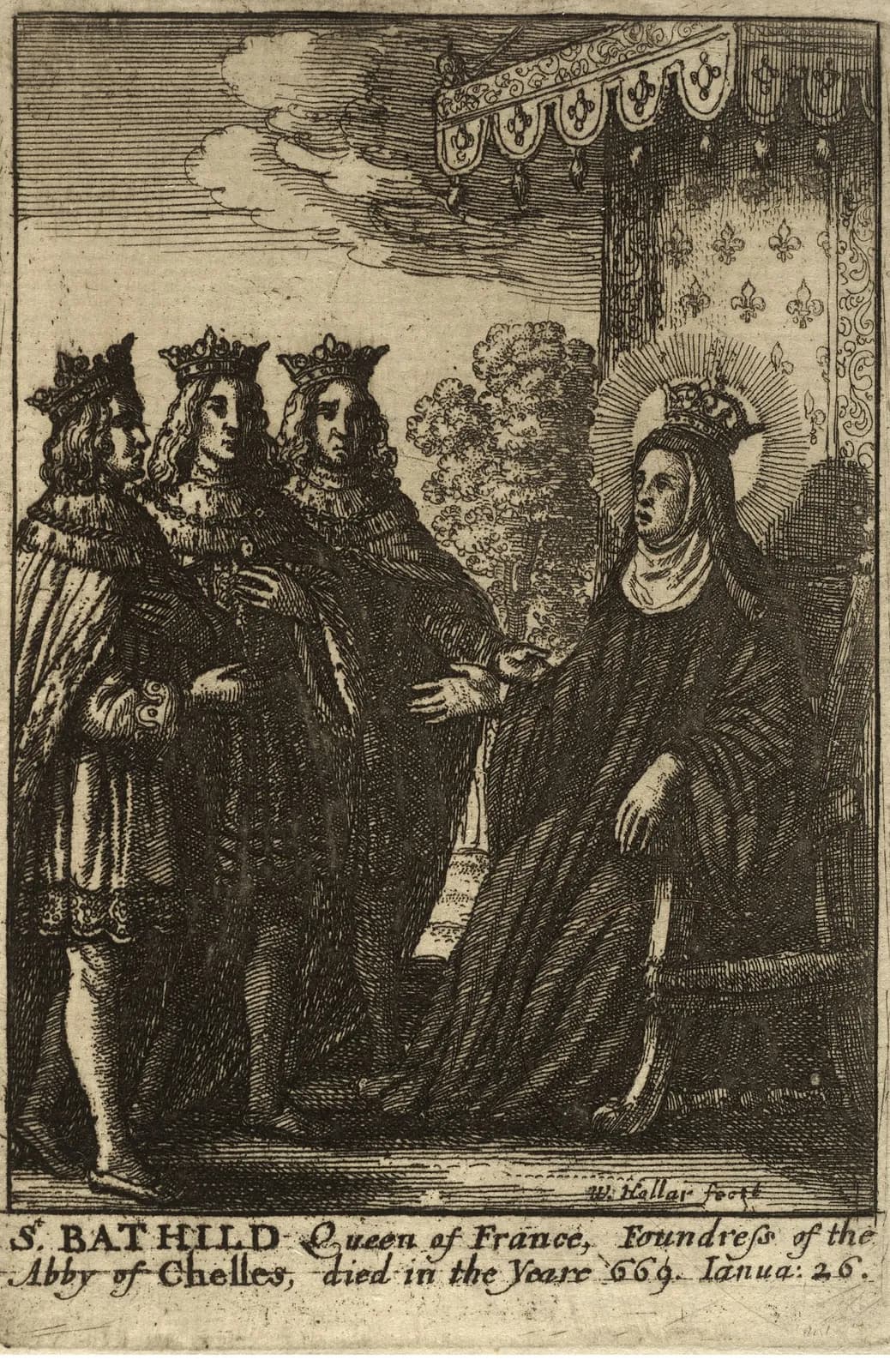
Catholic Culture lists Saint Bathild as a patron saint of the sick, and of those suffering from illness and bodily ills, as well as of children and of widows. 4 She is shown as a crowned nun, often doing menial work or giving alms to the poor. 24 Her emblem is a ladder reaching to heaven, which katolsk.no explains as a French pun on Chelles and échelle, the word for a ladder. 24
Saint Bathild's feast day
Saint Bathild's feast day is January 30. 234 Fournet wrote in 1907 that the Roman Martyrology placed her on January 26 and that France kept her on January 30. 1 katolsk.no explains that the Martyrology had followed Usuard in putting her on January 26, and that the 2001 edition moved her to January 30, the day of her death. 2 The current Martyrology enters her on that day at Chelles. 3
Praying with Saint Bathild
Bathild knew the bottom of her society from the inside. Fournet's first certain fact about her is that she was a slave, and the first thing he records her doing with power is abolishing the slave trade. 1 What she had suffered became the measure of what she would not let happen to others.
Her humility is the thread every source picks up, in the household of Erchinoald, on the throne, and at Chelles, where she placed herself after the novices and served the sick. 124 It is a humility that had been forced on her before it was chosen, and the sources treat the choosing as the remarkable part.
Her end at Chelles was perhaps not entirely her own choice. katolsk.no says she was pushed out of power; Fournet says she withdrew. 12 Either way the convent became the place where she lived the rest of her life fully, and where she nursed the sick until her own long illness came. 12
Saint Bathild, pray for us.
Sources
- 1.Pierre Auguste Fournet, "St. Bathilde," The Catholic Encyclopedia, Vol. 2 (New York: Robert Appleton Company, 1907).
- 2."Den hellige Bathild av Neustria (~630-680)," Den katolske kirke (katolsk.no), Catholic Diocese of Oslo (in Norwegian).
- 3.Roman Martyrology, entry for January 30, "Santa Batilde, regina," as printed in "Santo del giorno," Conferenza Episcopale Italiana (in Italian).
- 4."January 30," Liturgical Year calendar, Catholic Culture (Trinity Communications), with an excerpt from Alban Butler, Lives of the Saints (Benziger Bros., 1894).
- 5.George Cyprian Alston, "Monastery of Corbie," The Catholic Encyclopedia, Vol. 4 (New York: Robert Appleton Company, 1908).
Saints to turn to next
Others in this collection who are turned to for some of the same things.
- Saint Marguerite d'YouvilleOctober 15, 1701 - December 23, 1771Poverty and simplicitySuffering and illnessWork and vocation
- Saint Mary MacKillopJanuary 15, 1842 - August 8, 1909Poverty and simplicityWork and vocationSuffering and illness
- Saint André BessetteAugust 9, 1845 - January 6, 1937Suffering and illnessWork and vocationPoverty and simplicity
- Saint Giuseppe MoscatiJuly 25, 1880 - April 12, 1927Work and vocationSuffering and illnessPoverty and simplicity