Saint Marguerite d'Youville
October 15, 1701 - December 23, 1771
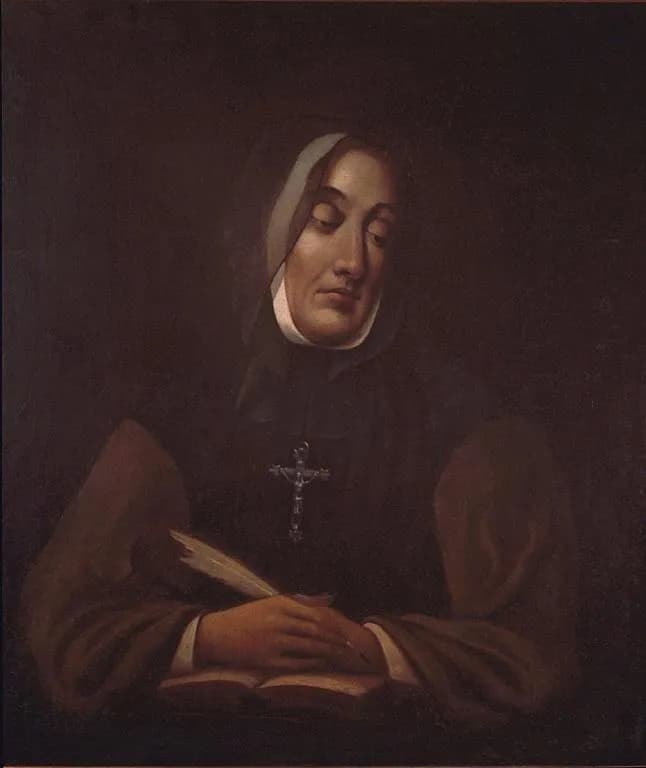
- Founded
- The Sisters of Charity of Montreal, the "Grey Nuns", with three companions, on December 31, 1737, by the Vatican's date 13
- Beatified
- May 3, 1959, by Pope John XXIII 1
- Canonized
- December 9, 1990, by Pope John Paul II 4
- Patronage
- Widows, difficult marriages, loss of parents and the death of children, among others, in Catholic Culture's list 6
Saint Marguerite d'Youville was a Montreal widow who buried her husband and four of her six children before she was thirty, then spent the rest of her life taking in people nobody else would house. 1 With three companions she founded the Sisters of Charity of Montreal, known as the "Grey Nuns", and from 1747 she ran the city's General Hospital. 12 The Vatican calls her "the first native Canadian to be elevated to sainthood." 1 Canada keeps her memorial on October 16. 5
Varennes and the Ursulines
She was born Marie-Marguerite Dufrost de Lajemmerais on October 15, 1701, at Varennes, near Montreal, the eldest of six children. 124 Her father, Christophe, had come from Brittany in 1687. Her mother, Marie-Renée Gaultier, was the daughter of a governor of Trois-Rivières and the sister of the explorer Pierre de la Vérendrye. 14
Her father died when she was seven, and the family was left poor. The Canadian bishops add that her mother waited six years for an officer's widow's pension. 14 Her great-grandfather, Pierre Boucher, arranged for Marguerite to spend two years with the Ursulines in Quebec. At twelve she came home to help her mother and teach her brothers and sisters. 124
A hard marriage
On August 12, 1722, she married François d'Youville. 4 The couple lived with his mother, who, in the Vatican's words, "made life miserable for her daughter-in-law." 1 François traded furs and liquor, was often away, and had no interest in a home. His illegal liquor trade with the native peoples caused her real grief. 14 The encyclopedia says only that he "treated her with indifference." 2
She was pregnant with their sixth child when he fell ill, and she nursed him until he died in 1730. 1 He left her a heavy debt, and she carried on a small trade to meet it. 24 The sources count the surviving children differently. The Vatican biography and the Canadian bishops say four of the six had died in infancy and two were living; the encyclopedia says he left her "with three children." 124 All agree that the two sons who grew up became priests. 12
The bishops date a change in her to the year she was twenty-seven, when, heartbroken over her husband, she was struck by the sense that God loved her personally. From then on her prayer was trust in Providence and in God as Father. 14 The encyclopedia calls her devotion to the Eternal Father "the keynote of her life." 2
Four women and a rented house
As a widow she visited the poor, the sick and prisoners, and begged money to give criminals who had died a proper burial. 4 She took a blind woman into her own home, and three young women joined her. 1 On December 31, 1737, the Vatican biography says, the four "consecrated themselves to God and promised to serve him in the person of the poor." 1 The encyclopedia names the companions as Louise Thaumur Lassource, Mademoiselle Demers and Mademoiselle Cusson, and dates the start to October 30, 1738, when they rented a small house and took in four or five poor people. 3
Montreal did not thank them. The bishops write that the women "were scorned, slandered and persecuted," and that Marguerite was accused of selling alcohol to the First Nations as her husband had done. "She was accused of drunkenness and even prostitution." 4 Her own relatives joined in the taunts. 1
A fire destroyed their house while she was in poor health and mourning one of her companions. 1 On February 2, 1745, she and the two who remained pledged to hold everything in common so they could help more people. 1 The rule they lived by had been drawn up by Father Normant, the Sulpician superior in Montreal. 23
The General Hospital
In 1747 she was asked to take over the hospital that a Monsieur Charon had founded in 1694, and which had fallen into debt and ruin under the brothers named for him. 12 She opened it to disabled soldiers, the aged, the insane, the incurable, foundlings and orphans, and later to epileptics, lepers and contagious patients whom the Hôtel-Dieu would not admit. 2 The bishops add battered women and sick priests. 4
She nearly lost it. The intendant Bigot, with the bishop's consent, decided to transfer its property to the General Hospital of Quebec, and she submitted. The Sulpician superior, Cousturier, intervened and her rights were upheld. 2 She offered to take on the debt, which the encyclopedia puts at 49,000 livres, and on June 3, 1753, Louis XV confirmed her as director and transferred to her community the rights the Charon Brothers had held. 234 Bishop Pontbriand approved the rule, in 1754 by one encyclopedia article and in 1755 by the other and by the bishops. 234 The sisters first wore their habit on August 25, 1755, and the encyclopedia says they are called "Grey Nuns because of the colour of their attire." 3
She paid for all of it with work. The sisters made clothing for the king's stores and for the traders of the upper country, which the encyclopedia says "constituted her chief revenue." 2 The bishops list needlework, military flags, hosts and candles, and add that she ran a tavern and sold tobacco, lime, building materials and sand. 4 In a memoir of 1752 she wrote, "Providence and our hard work are the resources we count on to carry on the work." 4
War, fire and her last years
During the Seven Years' War her doors were open to the sick and wounded of both sides. 24 So many English soldiers were treated that one ward was called "la salle des Anglais." 2 She ransomed an English prisoner whom his captors meant to torture, and hid several fugitives. One of them, the encyclopedia says, later prevented the bombardment of the hospital out of gratitude. 2 From 1754 she also took in abandoned children. 4
Then the hospital burned, in 1765 by the Vatican's and the bishops' date and in 1766 by the encyclopedia's. 124 She knelt with her sisters and recited the Te Deum. 24 The bishops give the words she said with them: "The Lord gave us everything, the Lord has taken everything away, may his Name be praised forever." 4 She was sixty-four, and she rebuilt it. It took four years. 14
On December 9 and 13, 1771, she suffered attacks of paralysis, and she died on December 23. 4 Near the end she said, "We have always been on the verge of losing everything, but we have always had what we needed." 4 Pope John XXIII beatified her on May 3, 1959, and called her "Mother of Universal Charity." 1 After the cure in 1978 of a young woman with leukemia, John Paul II canonized her on December 9, 1990. 14 Catholic Culture notes that in 2010 her remains were moved from the motherhouse to a sanctuary in Varennes, where she was born. 6
What is Saint Marguerite d'Youville the patron saint of?
Neither the Vatican biography, the encyclopedia nor the Canadian bishops names a patronage for Saint Marguerite d'Youville. 124 Catholic Culture lists her as patron of widows, of difficult marriages and in-law problems, of those who have lost parents, against the death of children, of victims of adultery and unfaithfulness, and of people ridiculed for their piety. It gives no authority for the list. 6
The Vatican biography says something similar without the word patron: that she can sympathize with orphans, with married women "suffering from unrequited love" and with single parents, and is "a kindred spirit with all who have given their lives to helping others." 1
Saint Marguerite d'Youville's feast day
In Canada her memorial is October 16, the day after her birthday. 56 Catholic Culture notes that the Canadian calendar moves Saint Hedwig and Saint Margaret Mary Alacoque to October 20 to make room for her. 6 The Roman Martyrology lists her on December 23, the day she died, and remembers her as a widowed mother who raised two sons for the priesthood and founded the Sisters of Charity for the sick, the old and the needy. 7
Praying with Saint Marguerite d'Youville
Very little went right for her. Her father died early, her marriage was lonely, four of her children died, and her husband left her debts. 14 Her first house burned, and so did the hospital she had spent eighteen years rescuing. 1 The sources do not describe a woman who was spared anything.
What they describe is a prayer addressed to the Father. The bishops quote her: "It is by the Heart of my Jesus, my Way, my Truth, and my Life, that I approach you, O eternal Father." 4 They sum up her spirituality in three words: "Father, Providence, Poor." 4
Her trust was never an excuse for idleness. She ran a tavern and sold sand to keep the hospital going. 4 She also would not let her sisters wear themselves out for the cause. She asked each one, the bishops write, "to make known her needs, without hiding her infirmities, and not to undertake anything that would damage her health." 4
People came to say, "Go to the Grey Nuns. They will never refuse to help you." 4 That reputation was built by a woman who had once been accused of drunkenness. 4 She did not answer the slander, as far as the sources record. She kept the door open, to English soldiers as well as French ones. 24
Saint Marguerite d'Youville, pray for us.
Sources
- 1."Marie Marguerite d'Youville (1701-1771), foundress of the Sisters of Charity," biography published by the Holy See for her canonization, December 9, 1990.
- 2.Lionel Lindsay, "Marie-Marguérite d'Youville," The Catholic Encyclopedia, vol. 15 (New York: Robert Appleton Company, 1912).
- 3.Sister Mary Elizabeth Ward, "Grey Nuns," The Catholic Encyclopedia, vol. 7 (New York: Robert Appleton Company, 1910).
- 4."Saint Marguerite d'Youville (1701-1771)," Canadian Conference of Catholic Bishops.
- 5."The Life and Spirituality of Saint Marguerite d'Youville," Canadian Conference of Catholic Bishops.
- 6."St. Marguerite d'Youville, Religious (Memorial, CAN)," Liturgical Year, October 16, Catholic Culture.
- 7."Santa Maria Margherita d'Youville, religiosa," Santo del giorno, 23 dicembre, from the Roman Martyrology, Conferenza Episcopale Italiana (in Italian).
Saints to turn to next
Others in this collection who are turned to for some of the same things.
- Saint André BessetteAugust 9, 1845 - January 6, 1937Suffering and illnessWork and vocationPoverty and simplicity
- Saint Gerard MajellaApril 1726 - October 16, 1755Marriage and familyPoverty and simplicitySuffering and illness
- Saint Germaine Cousin1579 - 1601Suffering and illnessMarriage and familyPoverty and simplicity
- Saint Gianna Beretta MollaOctober 4, 1922 - April 28, 1962Marriage and familyWork and vocationSuffering and illness