Saint Gerard Majella
April 1726 - October 16, 1755
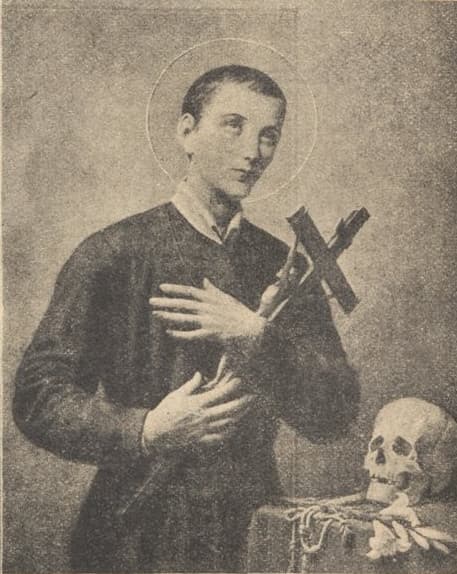
- Patron saint of
- Expectant mothers; John Paul II calls him "a special Protector of mothers-to-be" 2
- Feast day
- October 16 3
- Born
- Muro, about fifty miles south of Naples, April 1726 1
- Religious life
- Lay brother of the Congregation of the Most Holy Redeemer (the Redemptorists), entered 1749 1
- Beatified
- January 29, 1893, by Leo XIII 1
Saint Gerard Majella was a tailor from southern Italy who joined the Redemptorists as a lay brother, did the work of three men in a weak body, and was dead at twenty-nine. 1 He is invoked today as "a special Protector of mothers-to-be," in the words of Pope John Paul II, because of the care he gave to expectant mothers and newborn life. 2 The record of his life is short, and a large part of what is told about him is not in it.
A tailor from Muro
Gerard was born in April 1726 at Muro, a town about fifty miles south of Naples. 1 His father, Dominic Majella, died while Gerard was still a child, and the family was poor enough that his mother had to apprentice him to a tailor. 1 The master was fond of the boy. The foreman was not, and the 1909 Catholic Encyclopedia says plainly that he "treated him cruelly." 1
He left the shop for a while to go into service in the household of a prelate, and the encyclopedia's explanation of why is unusual: it was "his reverence for the priesthood and his love of suffering," and the prelate was "very hard to please." 1 When that man died, Gerard went back to tailoring, first as a journeyman and then working for himself. 1
What he earned he split three ways: some to his mother, some to the poor, and some in offerings for the souls in purgatory. 1 He was a young craftsman with a trade of his own and no money left over, by choice.
Three tries at religious life
He did not find his way in at the first attempt. The encyclopedia records "futile attempts first to become a Franciscan and then a hermit" before he was accepted into the Congregation of the Most Holy Redeemer, the Redemptorists founded by Saint Alphonsus Liguori, in 1749. 12 He was about twenty-three. John Paul II, writing two and a half centuries later, says he entered "with the firm determination to 'become holy'." 2
He came in as a lay brother, not as a candidate for the priesthood. He had, in the Pope's phrase, "no particular academic qualifications." 2 Two years after entering he made his profession, and to the ordinary vows of religious life he added one of his own, binding himself always to do whatever seemed to him the more perfect thing. 1
Obedience, and the work of three
Alphonsus Liguori regarded him as "a miracle of obedience." 1 The encyclopedia goes further than most biographers would: it says Gerard obeyed his superiors not only when they gave orders in person but, when they were absent, "knew and obeyed their desires." 1 That claim is reported here as the encyclopedia makes it.
His body was weak, and he did the work of three anyway. 1 His charity toward the poor was such that people gave him the title "Father of the Poor." 1 John Paul II describes the same thing in different words, a charity "attentive to the spiritual and material needs of his neighbour, especially the poorest." 2
The other side of that life was prayer. The encyclopedia says he was "so drawn to Our Lord in the tabernacle that he had to do violence to himself to keep away." 1 John Paul II names three loves at the center of it: the Crucified, the Eucharist, and Our Lady. 2
The accusation
The hardest episode in the record is told in a single sentence. Gerard, whom the encyclopedia calls "an angel in purity," "was accused of a shameful crime." 1 It gives no details of the charge or of who made it, and this page does not supply any.
What it does record is how he took it. He bore the calumny with such patience that Alphonsus said of him, "Brother Gerard is a saint." 1 The encyclopedia does not say how the matter ended, only how he carried it.
Missions, sinners, and the wonders told of him
Gerard went out with the Redemptorist Fathers on their missions and was sent on the community's business, and the encyclopedia says that on those journeys "he converted more souls than many missionaries." 1 John Paul II puts the conversion of sinners at the heart of him: "For sinners, Gerard spared no efforts, prayers or penance." 2 The Pope quotes one of Gerard's own prayers, which asks to convert sinners "as many as the grains of sand on the seashore and on land, the branches of trees, the leaves of the fields, the atoms of the air, the stars in the sky." 2 He also helped and encouraged people who were discerning a call to religious life. 2
A great many miracle stories are attached to his name, and this page tells none of them individually, because none appears in the sources it relies on. The encyclopedia lists his gifts in one sentence: infused knowledge, ecstasies, prophecy, discernment of spirits, "penetration of hearts," bilocation, and "what seemed an unlimited power over nature, sickness, and the devils." 1 It adds that he "predicted the day and hour of his death," and closes the article with one more line: "A wonderworker during his life, he has continued to be the same since his death." 1
Death and canonization
Gerard died on October 16, 1755, about six years after he had entered the Redemptorists. 12 Leo XIII beatified him on January 29, 1893, and Pius X canonized him on December 11, 1904. 1 In 2004 the Redemptorists prepared to keep a "Gerardian Year" for the centenary of the canonization and the 250th anniversary of his death, and John Paul II wrote to the congregation's Superior General for the occasion. 2
What is Saint Gerard Majella the patron saint of?
Saint Gerard Majella is the patron saint of expectant mothers. John Paul II gives both the patronage and the reason for it: Gerard "paid special attention to newborn life and to expectant mothers, especially those with physical and spiritual problems. This is why today he is still invoked as a special Protector of mothers-to-be." 2
The Pope draws a line from that devotion to the defense of human life, asking the Redemptorists and the faithful to let this "typical feature of his charity" encourage them "always to love, defend and serve human life." 2 The 1909 encyclopedia does not mention the patronage at all. 1
Saint Gerard Majella's feast day
Praying with Saint Gerard
Most of Gerard's life was spent in ordinary work: a tailor's bench, a difficult employer, and the chores of a religious house done by a man whose body could not easily bear them. 1 The encyclopedia's summary of his ambition is a single line, that he wanted "to be like Jesus Christ in his sufferings and humiliations." 1 He did not get there by escaping his circumstances. He was turned away by the Franciscans and failed as a hermit before anyone would take him. 1
He was also accused of something shameful that he had not done, and he bore it with such patience that his founder called him a saint. 1 That part of his story is not tidy. Patience under a false charge is admirable from a distance and very hard up close, and the sources do not say it cost him nothing.
Expectant mothers come to him because, as John Paul II wrote, he paid "special attention to newborn life and to expectant mothers, especially those with physical and spiritual problems." 2 The words "physical and spiritual problems" matter. His patronage was never only for pregnancies that are going well. It includes mothers who are unwell or afraid.
He died at twenty-nine, a lay brother with no academic qualifications, and the Pope who wrote about him called him one of the lowly in whom God made the power of his mercy radiant. 2
Saint Gerard Majella, pray for us.
Sources
- 1.John Magnier, "St. Gerard Majella," The Catholic Encyclopedia, Vol. 6 (New York: Robert Appleton Company, 1909).
- 2.John Paul II, Letter to the Superior General of the Congregation of the Most Holy Redeemer on the occasion of the celebration of the "Gerardian Year," August 6, 2004.
- 3."Saint of the Day: 16 October," Vatican News, Dicastery for Communication.
Saints to turn to next
Others in this collection who are turned to for some of the same things.
- Saint Bridget of Swedenc. 1303 - July 23, 1373Marriage and familySuffering and illness
- Saint Charles de FoucauldSeptember 15, 1858 - December 1, 1916Poverty and simplicitySuffering and illness
- Saint Elizabeth of Hungary1207 - November 17, 1231Poverty and simplicityMarriage and family
- Saint Elizabeth of Portugal1271 - July 4, 1336Marriage and familySuffering and illness