Saint Roch
c. 1295 - 1327 by tradition; 1340s - c. 1376-1379 by recent research
- Patron saint of
- Invoked for protection against the plague and other contagious diseases such as cholera, and as a protector of domestic animals 3
- Also known as
- Saint Rocco in Italy and San Roque in Spain 3
Saint Roch was a pilgrim from Montpellier who, according to tradition, gave away his inheritance and spent his journey through Italy nursing victims of the plague, until he caught it himself. 134 The best-known detail of his story is a dog that brought him bread while he lay sick in a forest near Piacenza, and it belongs, as the Franciscan historian Dominic Monti puts it, to "his legend." 3 No contemporary life of him survives, and even his century is disputed. 3 He was being invoked against the plague by 1414, when a Church council prayed to him for relief, and his feast is August 16. 13
What the sources can and cannot say
"There is no contemporary life of Saint Roch," Monti writes for the Franciscan Institute, and what follows in his account is introduced with "according to popular tradition." 3 The Scuola Grande di San Rocco in Venice, the confraternity that keeps his relics, is just as plain: "Historical information regarding the life of St. Roch is limited and uncertain, besides being intermixed with popular hagiography." 4 The Scuola traces the Venetian version of his life to a single book, Francesco Diedo's Vita Sancti Rochi, written in 1478. 4
The 1912 Catholic Encyclopedia tells the story with fewer reservations. Its article states his birth, travels, cures and death as a sequence of events and hedges only three points: the red cross on his chest, which he "is said to" have been born with; the identity of the governor who jailed him; and his membership in the Third Order of Saint Francis. 1 The Scuola, for its part, insists that whatever the legend has added, "the historical existence of St. Roch, doubted on occasions in the past, is now certain and universally accepted." 4 This page tells the traditional story and marks which source tells which part.
A pilgrim among the plague-stricken
In the encyclopedia's account Roch was the son of the governor of Montpellier. 1 Orphaned at about twenty, he gave his fortune to the poor, handed the government of the city to his uncle, and set out for Italy "in the disguise of a mendicant pilgrim." 1 Monti, following popular tradition, has him born into a noble family and, at around twenty, renouncing his wealth to become "a lay Franciscan penitent" and an itinerant pilgrim. 3 The Scuola says he meant to visit the shrines of Christendom, beginning with Rome. 4
He did not get far before stopping. At Acquapendente he found a town stricken by plague and stayed to care for the sick. 14 The encyclopedia says he cured them with the sign of the cross, then went on to Cesena, Rome, Mantua, Modena, Parma and other cities, and that "everywhere the terrible scourge disappeared before his miraculous power." 1 Monti describes the work more modestly: Roch stayed in hospices for a time in town after town, "treating and sometimes healing" the victims of bubonic plague before moving on. 3
The Scuola adds a scene in Rome. There, it says, he was received by Pope Urban V and cured a cardinal of the plague by marking an indelible sign of the cross on his forehead, and he stayed in the city three years before starting home by way of Cesena and Rimini. 4
Gothard and the dog
At Piacenza, Roch caught the plague himself. 134 All three accounts agree that he withdrew into solitude, into a hut in the forest near the city in the encyclopedia's version. 14 They differ on how he survived.
The encyclopedia names only a gentleman called Gothard, who supplied his needs after learning "by a miracle" where he was hiding. 1 It does not mention a dog. In Monti's telling, "his legend tells us" that a dog nursed him back to health by bringing him bread and licking his wounds. 3 The Scuola has both: a dog that brought him food, and the dog's owner, Gottardo, who helped him too. 4 It adds that "animals as well as the sick came to seek his assistance." 4
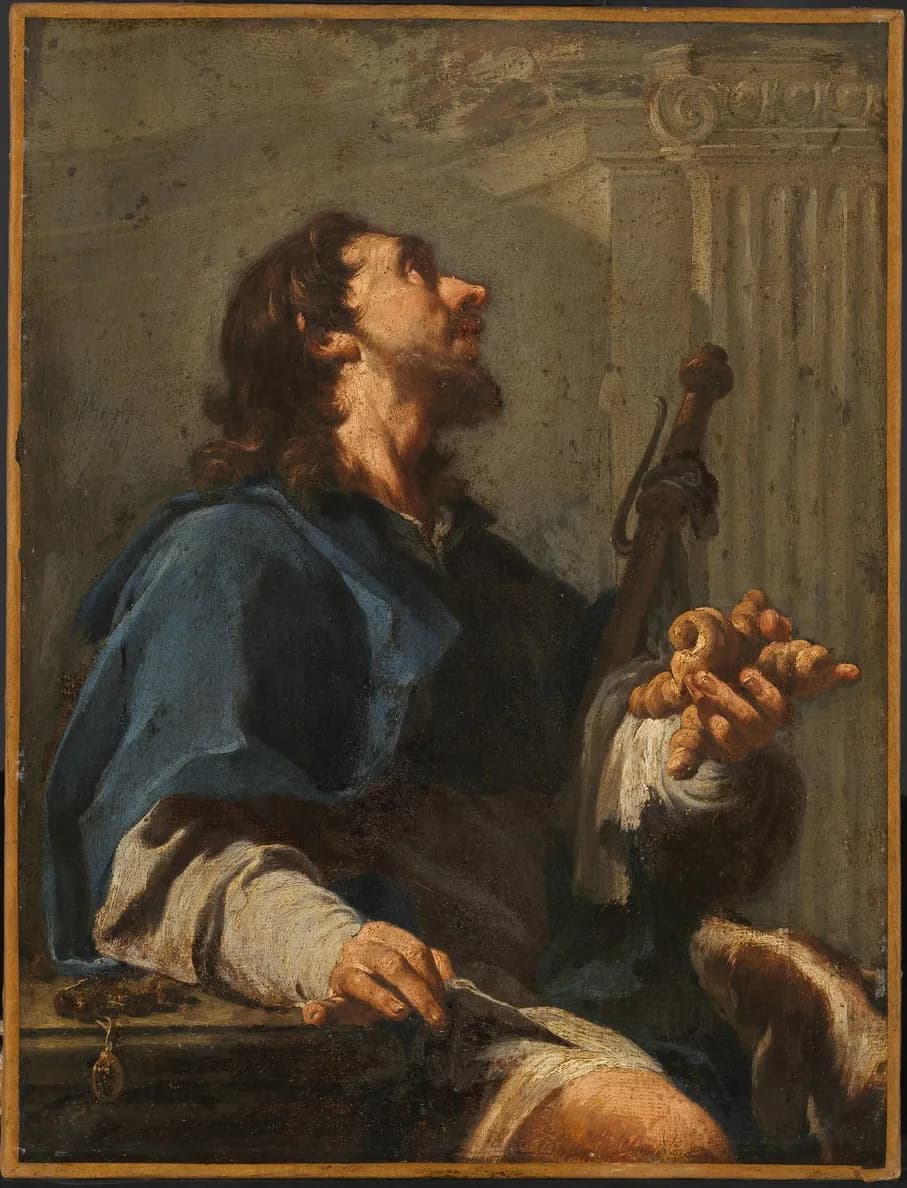
Once he had recovered, the Scuola says, he resumed his journey at an angel's urging. 4 The dog stayed with him in the paintings. Monti notes that artists usually show Roch as a pilgrim with staff and hat, pointing to the plague sore on his leg, with his dog beside him, and that for this reason he is also invoked as a protector of domestic animals. 3
A prisoner at the end
The last part of the story is the strangest, and the sources tell it in different ways. In the encyclopedia, Roch returned to Montpellier and refused to say who he was. Taken for a spy disguised as a pilgrim, he was imprisoned on the governor's orders, "his own uncle, some writers say," and died in prison five years later. 1 Only then was he identified, by the cross on his chest and a document he was carrying, and he was given a public funeral. 1
The Scuola places the arrest at Montpellier too, and says he could easily have been released by giving his name and appealing to an influential relative. 4 It says that, in order to be closer to Christ, he "opted instead for the way of suffering" and stayed in prison of his own accord until his death in 1327. 4 Monti says only that he went to a town where he was falsely accused of being a spy from enemy territory, and died in prison there. 3
When did he live?
The encyclopedia dates his birth "towards 1295" and his death to 1327, and the Scuola gives the same years from the Venetian tradition. 14 Monti points out a problem with them: "the bubonic plague was yet unknown in Europe at that time." 3 He reports that recent research places Roch's birth at Montpellier in the 1340s, half a century later, and his death at Voghera, Italy, between 1376 and 1379. 3 "These dates correspond much better with the traditional details of his life," he writes. 3 The page gives both and settles neither.
Venice, Constance and a confraternity
Devotion to him spread quickly, Monti says, especially in Italy, southern France and Spain. 3 The encyclopedia records that in 1414, when plague broke out in Constance during the Church council being held there, the council fathers ordered public prayers and processions in his honor, and "immediately the plague ceased." 1 In 1485 his body was brought to Venice: "carried furtively," according to the Franciscan annalist Wadding as the encyclopedia reports him, and from Voghera, according to Monti. 13 A church was built in Venice to hold the relics, and a charitable confraternity dedicated to him there, founded in 1478, is now famous for its paintings by Tintoretto. 3
In Rome, Paul III founded a confraternity in his name to look after a church and hospital that had been built under Alexander VI, and it grew so fast that Paul IV raised it to an archconfraternity. 1 The encyclopedia lists favors granted to it by Pius IV, Gregory XIII and Gregory XIV, and ends with the words "It still flourishes." 1
Whether Roch was a Franciscan is an old question. The encyclopedia says it is "commonly held" that he belonged to the Third Order of Saint Francis, "but it cannot be proved," and that Wadding left it open. 1 Monti, writing for the Franciscan Institute, calls him a Secular Franciscan and sees in his life the Franciscan tradition of caring for the sick. 3
What is Saint Roch the patron saint of?
According to Monti, Roch was invoked "for protection against the plague and other contagious diseases such as cholera," and because of the dog in his story he is also invoked as a protector of domestic animals. 3 The encyclopedia names no patronage directly, though the processions it records at Constance were made against the plague. 1
Many other patronages are attached to him in popular lists, among them dogs, invalids, surgeons and the falsely accused. None of the sources used for this page states them, so they are not given here.
Saint Roch's feast day
His feast is August 16. 123 The encyclopedia records that Urban VIII approved the ecclesiastical office to be recited on that day, and Vatican News lists "St. Roch, Pilgrim" on its calendar for August 16, alongside Saint Stephen of Hungary. 12
Monti writes that the day "is celebrated in many places with great festivity." 3 Processions are held in many Italian towns and in Italian emigrant communities around the world, and he pictures one crossing Canal Street toward the Church of the Transfiguration on Mott Street, in New York's Little Italy. 3 He also mentions a San Roque festival in the Junín region of Peru. 3
Praying with Saint Roch
Every version of his story turns on the same choice. A man with money and a city to govern gives both away, sets out on foot, and stops at the first town where people are dying of the plague. 14 Whether he healed them by miracle, as the encyclopedia says, or treated them in hospices and sometimes saw them recover, as Monti puts it, he stayed among the sick. 13
Then he became one of them. The traditional story does not spare him: he catches the disease he has been nursing, goes off alone to the forest, and survives because somebody else, a stranger or a dog, brings him what he needs. 134 People who have cared for the sick and then fallen ill themselves will recognize that turn.
The ending is not a reward. He comes home and nobody knows him, and he dies in prison under suspicion of being a spy. 13 The Scuola reads his silence as a choice made to be closer to Christ; the encyclopedia records only that he refused to say who he was. 14 He was identified after he died.
Much of this cannot be checked, and the Franciscan historian and the Venetian confraternity who keep his memory both say so. 34 What can be checked is the devotion: the processions at Constance in 1414, the relics in Venice, a Roman archconfraternity, and feasts still kept every August 16 from Italy to Peru to lower Manhattan. 13
Saint Roch, pray for us.
Sources
- 1.Gregory Cleary, "St. Roch," The Catholic Encyclopedia, Vol. 13 (New York: Robert Appleton Company, 1912).
- 2."16 August," Saint of the Day, Vatican News.
- 3.Dominic Monti, OFM, "Saint Roch: Provider of Loving Care to Humans and Animals," Commission on the Franciscan Intellectual Tradition, Franciscan Institute, St. Bonaventure University, August 14, 2026.
- 4."St. Roch," Scuola Grande di San Rocco, Venice.
Saints to turn to next
Others in this collection who are turned to for some of the same things.