Saint Optatus of Milevis
Fourth century; living in 384
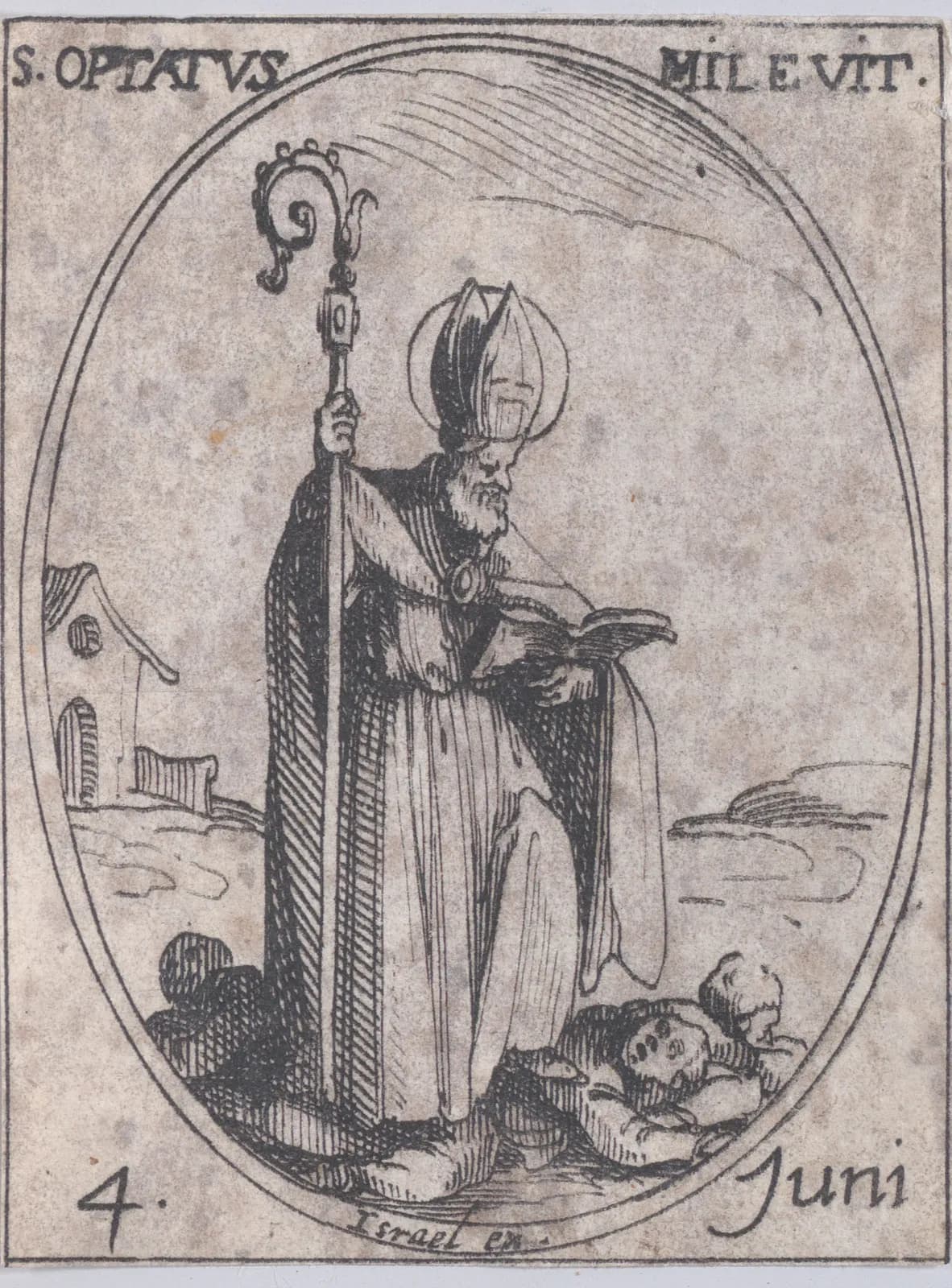
- Wrote
- Against Parmenian, the Donatist bishop of Carthage: six books under Valentinian and Valens, says Jerome 4; seven survive 1
Saint Optatus was a bishop of Milevis in Numidia, in what is now Algeria, who wrote the first full Catholic answer to the Donatist schism that divided the African Church in the fourth century. 136 Augustine counted him among the converts who brought the learning of the pagan world into the Church. 5 Almost nothing is known of his life; his one book, written to win back men he insisted on calling his brothers, is the reason he is remembered. 167
A bishop known by one book
Optatus was, in the words of his English translator, "perhaps the least known of all the Fathers of the Church." 6 O. R. Vassall-Phillips, publishing the first English version in 1917, writes that "Concerning the life of St. Optatus hardly anything is known." 6 He was bishop of Milevis, the modern Mila, in Numidia. 13
He came to the faith from outside it. John Chapman, writing in the 1911 Catholic Encyclopedia, takes this from Augustine and adds that Optatus "probably had been a pagan rhetorician." 1 The passage he means is in Augustine's On Christian Doctrine, where Augustine compares Christian scholars to the Israelites who left Egypt carrying its gold: "Do we not see with what a quantity of gold and silver and garments Cyprian, that most persuasive teacher and most blessed martyr, was loaded when he came out of Egypt? How much Lactantius brought with him? And Victorinus, and Optatus, and Hilary." 5 Butler's Lives of the Saints, as Catholic.net prints it in Spanish, says the same: Augustine compared him to Cyprian and Hilary, converted like him from paganism. 2
Jerome, in his Illustrious Men, gives him one sentence: "Optatus the African, bishop of Milevis, during the reign of the Emperors Valentinianus and Valens, wrote in behalf of the Catholic party six books against the calumny of the Donatian party." 4 Butler says he was still alive in 384 and that the date of his death was not recorded. 2
The answer to Parmenian
The Donatists had broken from the Catholic bishops of Africa over a disputed election at Carthage, and had set up a rival hierarchy that rejected Catholic orders and sacraments. 12 Their bishop at Carthage, Parmenian, wrote a book in their defense, and Optatus answered it. 16 Vassall-Phillips says he wrote because the Donatists refused to meet the Catholics in public discussion. 6
The dates are close but not settled. Chapman puts the first edition about 366 to 370, from Optatus's own remark that more than sixty years had passed since the persecution of Diocletian, and a second edition about 385 to 390, since the list of popes runs to Siricius. 1 Vassall-Phillips dates the first edition about 373 and the revision after 384. 6 Butler says about 370, revised fifteen years later. 2 Jerome knew six books; seven survive, and both Chapman and Vassall-Phillips take the seventh as an appendix added in the second edition. 146
Chapman is warm about the result. He praises "the gentleness and charity which is so admirable in his polemics against his 'brethren', as he insists on calling the Donatist bishops," and calls the work "a monument of convincing dialectic, of elegant literary form, and of Christian charity." 1 He is less impressed by its allegorical readings of Scripture, which he calls "far-fetched." 1
One Church, through all the world
Optatus opens by explaining the word he will use for his opponents. "They therefore are without doubt brothers, though not good brothers," he writes; "They and we have one spiritual birth, though widely differing is our conduct." 7 Chapman notes that he treats schismatics, unlike heretics, as holding true doctrine and true sacraments, a mildness in sharp contrast to many Fathers. 1
Both sides agreed that the Church was one. The question, as Chapman puts it, was where that one Church is, and Optatus argues that it cannot be confined to a corner of Africa: it is the Catholic Church spread through the whole world. 1 Of the marks of the Church that Parmenian had listed, the first was the episcopal chair, and Optatus places it at Rome: "You cannot deny that you know that in the city of Rome upon Peter first the chair of the bishop was conferred, in which sat the head of all the Apostles, Peter." 1 He follows it with a list of the popes, inaccurate in places, down to Siricius, "with whom the whole world with us agrees." 12
Against the Donatist practice of rebaptizing, he argues that the faith of the minister does not decide the sacrament, since it is God who gives the grace. 1 His phrase for this, "Sacramenta per se esse sancta, non per homines," became famous; Vassall-Phillips translates it "the Sacraments are holy through themselves, not through men." 18 Butler adds that the book describes exorcism and anointing at baptism, the Mass as a sacrifice, the penances of the time and the honor paid to relics. 2
The translator does not hide the book's hardest pages. Optatus defended the punishment of Donatists by imperial officers, and Vassall-Phillips writes that where he went beyond saying the State and not the Church was responsible, and suggested the sufferings might be God's will, this is "exceedingly regrettable." 6 His judgment is that Optatus "was not ahead of his age." 6
Later Catholics leaned on the book. Vassall-Phillips says Augustine drew on it, called its author a Catholic bishop of venerable memory, and set him beside Ambrose; and that Fulgentius named him with Ambrose and Augustine. 6 Butler says the same of Fulgentius, and that Parmenian's treatise has not been read for centuries while Optatus's still is. 2 Vassall-Phillips adds that his history of the schism was never contradicted, and retells a story from the acts of the Conference of Carthage: Donatist bishops there appealed to Optatus's account of Constantine and the bishop Caecilian, and the laugh turned against them when the whole passage was read aloud. 6
What is Saint Optatus the patron saint of?
None of the sources consulted names a patronage for Saint Optatus. The Roman Martyrology remembers him as the bishop who, writing against the Donatist heresy, upheld the universality of the Church and the deep need of Christians for unity. 3
Saint Optatus's feast day
Saint Optatus's feast day is June 4. 12 The current Roman Martyrology enters him on that day as a commemoration at Mila in Numidia. 3 Chapman is frank about how he got there: "St. Optatus has apparently never received any ecclesiastical cultus; but his name was inserted in the Roman Martyrology on the fourth of June, though it is quite unknown to all the ancient Martyrologies and calendars." 1 Butler says it was Cardinal Baronius who added him. 2 Vassall-Phillips, for his part, says Optatus was always held in honor in the Church for the tradition of his holy life as well as for his learning. 6
Praying with Saint Optatus
Optatus wrote against people who refused to speak with him, and he began by calling them brothers. 67 He held that what bound the two sides together, one baptism and one birth in the Spirit, was deeper than the quarrel, and that the sacraments their bishops gave were real. 17
He was also a man of his time, and the same book that pleads for unity excuses the force used to impose it. 6 His translator did not cut those pages, and this page does not leave them out. 6
Little else about him survives. Chapman admires the gentleness of his argument, and the Martyrology remembers him for one conviction: that the Church is spread through all the world and that Christians need to be one. 13
Saint Optatus of Milevis, pray for us.
Sources
- 1.John Chapman, "St. Optatus," The Catholic Encyclopedia, Vol. 11 (New York: Robert Appleton Company, 1911).
- 2.Alban Butler, "Optato de Milevi, Santo," Vidas de los santos, trans. Wilfredo Guinea, S.J. (1965), as published on Catholic.net (in Spanish).
- 3.Roman Martyrology, entry for June 4, "Sant'Ottato, vescovo," as printed in "Santo del giorno," Conferenza Episcopale Italiana (in Italian).
- 4.Jerome, De Viris Illustribus (Illustrious Men), chapter 110, trans. Ernest Cushing Richardson, Nicene and Post-Nicene Fathers, Second Series, Vol. 3 (1892), via New Advent.
- 5.Augustine, On Christian Doctrine, Book II, chapter 40, trans. J. F. Shaw, Nicene and Post-Nicene Fathers, First Series, Vol. 2 (1887), via New Advent.
- 6.O. R. Vassall-Phillips, translator's preface and introduction, The Work of St. Optatus, Bishop of Milevis, against the Donatists (London: Longmans, Green, 1917), transcribed by Roger Pearse.
- 7.Optatus of Milevis, Against the Donatists, Book I, chapter 3, trans. O. R. Vassall-Phillips (London: Longmans, Green, 1917), transcribed by Roger Pearse.
- 8.Optatus of Milevis, Against the Donatists, Book V, chapter 4, trans. O. R. Vassall-Phillips (London: Longmans, Green, 1917), transcribed by Roger Pearse.
Saints to turn to next
Others in this collection who are turned to for some of the same things.
- Saint Augustine of HippoNovember 13, 354 - August 28, 430ConversionStudy and teaching
- Saint Cyril of AlexandriaBirth unknown - 444Study and teachingConversion
- Saint Dionysius the AreopagiteFirst centuryConversionStudy and teaching
- Saint Edmund CampionJanuary 25, 1540 - December 1, 1581Study and teachingConversion