Saint Olympias
Born between 361 and about 368; died about 408
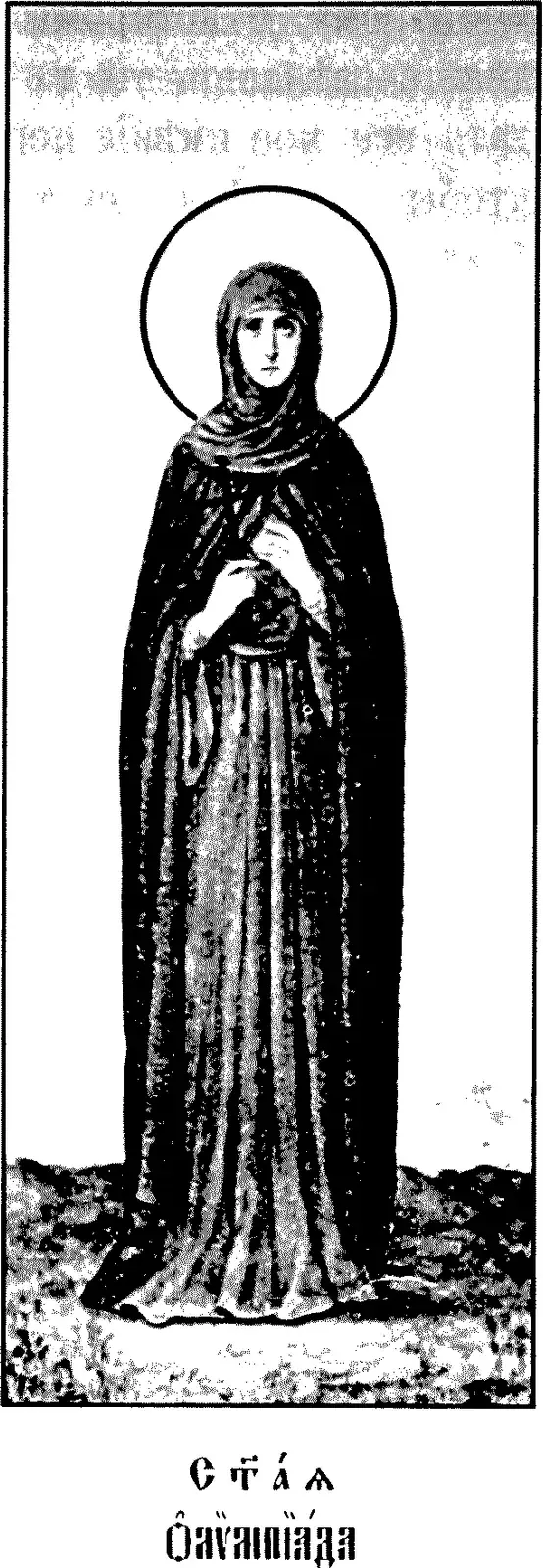
- Also called
- Olympiades, in the 1897 Martyrology 8
- Born
- In Constantinople; between 361 and 365, says the Catholic Encyclopedia 1; about 368, say Stephens and katolsk.no 26
- Known for
- Her charity, and her loyalty to Saint John Chrysostom, whose seventeen surviving letters to her come from his exile 126
Saint Olympias was a young widow of great wealth in Constantinople who refused to marry again, was ordained a deaconess, and spent her fortune on the poor and on the Church. 134 She was a faithful friend and disciple of Saint John Chrysostom, and when he was driven into exile she was put on trial, fined, and forced out of the city herself for refusing to accept the bishop installed in his place. 123 The Church remembers her on July 25. 7
An heiress of Constantinople
She came, the Catholic Encyclopedia says, from an illustrious family of the capital. Her father, whom the sources call Secundus or Seleucus, was a count of the empire, and an ancestor, Ablabius, had been consul in 331 and praetorian prefect of the East. 1 Palladius, who knew her, calls her the daughter of Seleucus the ex-count and the granddaughter of Ablavius the ex-prefect. 5 The encyclopedia puts her birth between 360 and 365, and not before 361; W. R. W. Stephens, introducing Chrysostom's letters to her, and the Norwegian bishops' saints database (katolsk.no) both say about 368. 126
Her parents died while she was young and left her an immense fortune. 1 Stephens says she was brought up under the guardianship of an uncle, Procopius, a friend of Saint Gregory of Nazianzus, and that Gregory took a close interest in the girl, calling her "his own Olympias." 2
She married Nebridius, prefect of Constantinople. The encyclopedia dates the wedding to 384 or 385; Stephens says 384, when she was sixteen, and katolsk.no says she was eighteen. 126 Within a short time Nebridius was dead. 1 Palladius says the marriage did not last even twenty months; Stephens says about two years; katolsk.no, less than two. 246 The Lausiac History calls her "bride for a few days of Nebridius," and "the wife of no man," and reports that she was said to have died a virgin. 5
The widow who would not remarry
She was young, rich and, Palladius says, beautiful, and she refused every new offer of marriage. 14 The emperor Theodosius wanted her to marry a kinsman of his, a Spaniard named Elpidius, and pressed her again and again. 4 She answered that if her King had wanted her to live with a husband, he would not have taken away her first. 4 Theodosius then ordered her property held in trust until she was thirty, and the prefect in charge, Palladius says, used the order to keep her from seeing bishops or going to church. 4
Palladius also keeps her letter to the emperor. She thanked him for taking so heavy a burden off her hands, and added: "you will do better yet, if you order it to be dispersed among the poor, and the Churches." 4 When Theodosius came back from the war against Maximus and heard how she was living, he gave her back control of her fortune. 4 The Catholic Encyclopedia gives the same ending without the suitor: the emperor had placed her property under the urban prefect when her husband died, and restored it in 391. 1
Nectarius, bishop of Constantinople, ordained her a deaconess. 13 She built a convent beside the principal church of the city, and three of her relatives and a large number of young women entered it with her. 1 Palladius records her way of life: she ate no meat, seldom went to the baths, and suffered from chronic stomach trouble. 4
Chrysostom and the fortune
She gave on a scale that drew the attention of the whole Church. Palladius lists bishops she supported with land and money, among them Amphilochius, Gregory, Peter the brother of Basil, and Epiphanius of Cyprus, and he says that when Bishop Optimus was dying in Constantinople, she closed his eyes with her own hands. 4
When John Chrysostom became bishop in 398, he became her spiritual guide. 1 He saw that she gave to anyone who asked, and Sozomen records his warning: "You, however, have been bestowing wealth on the wealthy, which is as useless as if you had cast it into the sea." 3 Her wealth belonged to her Master, he told her, and she would answer for how it was spent. 3 The advice, Sozomen says, helped turn the clergy against Chrysostom. 3 Olympias, for her part, made sure he ate. Palladius says she spared him "anxiety for his daily barley bread." 4
Theophilus, bishop of Alexandria, had other reasons to dislike her. Palladius says she took in the desert monks whom Theophilus had driven out of Egypt, and that Theophilus, who had once flattered her for money, now reviled her for it. 4 Asked what kind of woman she was, Palladius's narrator answers that she is "a man in everything but body." 4
On trial for Chrysostom
Chrysostom was driven out of Constantinople in 404, and his followers were persecuted. 2 As soon as he had gone, fire destroyed the great church and the senate house beside it, and his enemies accused his partisans of setting it. 23 Sozomen tells what happened when Olympias was brought before the prefect and asked why she had set the church alight. "My past life ought to avert all suspicion from me," she said, "for I have devoted my large property to the restoration of the temples of God." 3
The prefect then dropped the charge and tried persuasion, urging her and the other women to accept communion with Arsacius, the bishop put in Chrysostom's place. The others gave way. 3 Olympias told him she would not be tried for one thing under cover of another, and that even under unlawful compulsion she would not hold communion with those she ought to shun. 3 He sent for her again later and fined her heavily. She paid, Sozomen says, and left Constantinople for Cyzicus. 3
Where she spent the rest of her life is not agreed. The Catholic Encyclopedia says she was exiled; katolsk.no says she was driven from place to place and withdrew at last to Nicomedia; Stephens says it is not certain whether she was driven out or left on her own, and that nothing definite is known of her later life. 126
The letters from exile
From exile in Armenia, Chrysostom wrote to her often; seventeen of the letters survive. 12 She was ill and sunk in despondency, and he scolded, argued and comforted by turns: "there is only one thing, Olympias, which is really terrible, only one real trial, and that is sin." 2 He told her to see good doctors and take her medicine, and refused to believe she had shaken off her despondency until she was physically well. 2
One letter describes two months of a bitter Armenian winter shut in one smoky room, sick and sleepless, and begins, "Having risen from the very gates of death." 2 And he used her as his agent in the capital. He asked her to look after Maruthas, a bishop with business in Persia, and when the bishop he had sent to the Goths died, he asked her to see that his enemies did not appoint a successor. 2 Sozomen adds that her money helped him buy back captives from the Isaurian raiders. 3
When news of her courage reached him, he wrote that he leapt for joy. 2 Without going out into the forum, "sitting all the while in a small house and confined chamber," she had become for the whole city "a tower, a haven, and a wall of defense." 2
Her death and her convent
She died, the Catholic Encyclopedia says, a few months after Chrysostom, on July 25, 408, probably at Nicomedia. 1 katolsk.no puts her death there about 408, at no more than forty. 6 The Lausiac History says the people of Constantinople counted her among the confessors, "for she died thus and went away to the Lord in the midst of her struggles for God's honour." 5
She was venerated as a saint soon after her death, the encyclopedia says, and a Life of her was written in the later fifth century. 1 Her convent and its church were destroyed in the riot of 532 and rebuilt by Justinian, and the prioress, Sergia, brought the foundress's remains back to it from the ruined church of Saint Thomas where she had been buried. 1
What is Saint Olympias the patron saint of?
Saint Olympias's feast day
Saint Olympias's feast day is July 25. The current Roman Martyrology, as the Italian bishops print it, commemorates on that day the death at Nicomedia of Saint Olympias, widow, who lost her husband young, spent the rest of her life at Constantinople among the women consecrated to God, helped the poor, and remained a faithful collaborator of Saint John Chrysostom during his exile. 7
Older calendars kept her on December 17. The Catholic Encyclopedia gives that as her feast in the Roman Church, and July 24 in the Greek Church. 1 The 1897 English Martyrology lists on December 17 "At Constantinople, of St. Olympiades, widow." 8 katolsk.no still gives December 17. 6
Praying with Saint Olympias
The words of hers that the sources keep were spoken to men with power over her: an emperor who wanted to marry her off, and a prefect who wanted her to change bishops. 34 Both times she answered plainly and took the cost. The first cost her control of her fortune for years, and the second cost her a heavy fine and her home. 34
She was not given to moderation, and the man she trusted most told her so. Chrysostom warned her that money handed to anyone who asked was money thrown into the sea, and that she would answer for it. 3 Years later he was writing to tell her to see a doctor and stop punishing herself. 2
Her last years were spent in sickness and in exile, and Chrysostom's letters do not pretend otherwise. 2 He called her a tower and a wall of defense for her city, and Palladius says that Constantinople counted her death as a confessor's. 25
Saint Olympias, pray for us.
Sources
- 1.Johann Peter Kirsch, "St. Olympias," The Catholic Encyclopedia, vol. 11 (New York: Robert Appleton Company, 1911).
- 2.John Chrysostom, Letters to Olympias, with the translator's introduction, trans. W. R. W. Stephens, Nicene and Post-Nicene Fathers, First Series, vol. 9 (1889), at New Advent.
- 3.Sozomen, Ecclesiastical History, Book VIII, chapters 9, 22, 24 and 27, trans. Chester D. Hartranft, Nicene and Post-Nicene Fathers, Second Series, vol. 2 (1890), at New Advent.
- 4.Palladius, The Dialogue concerning the Life of St. John Chrysostom, chapters 16 and 17, trans. Herbert Moore (1921), as transcribed by the Tertullian Project.
- 5.Palladius, The Lausiac History, chapter 56, "Olympias," trans. W. K. Lowther Clarke (London: SPCK, 1918), as transcribed by the Tertullian Project.
- 6."Den hellige Olympias," Den katolske kirke, the saints database of the Catholic Church in Norway, katolsk.no (in Norwegian).
- 7.Roman Martyrology, entry for July 25, "Santa Olimpiade, vedova," Santo del giorno, Conferenza Episcopale Italiana (in Italian).
- 8.The Roman Martyrology, December 17 (Baltimore: John Murphy Company, 1897), Internet Archive.
Saints to turn to next
Others in this collection who are turned to for some of the same things.
- Saint Alphege954 - April 19, 1012CouragePoverty and simplicitySuffering and illness
- Saint LawrenceDied August 10, 258CouragePoverty and simplicitySuffering and illness
- Saint Louis de MontfortJanuary 31, 1673 - April 28, 1716Poverty and simplicityCourageSuffering and illness
- Saint MartinaMartyred at Rome in the third century, traditionally about 228CourageSuffering and illnessPoverty and simplicity