Saint Oliver Plunkett
1625 or 1629 - 1681
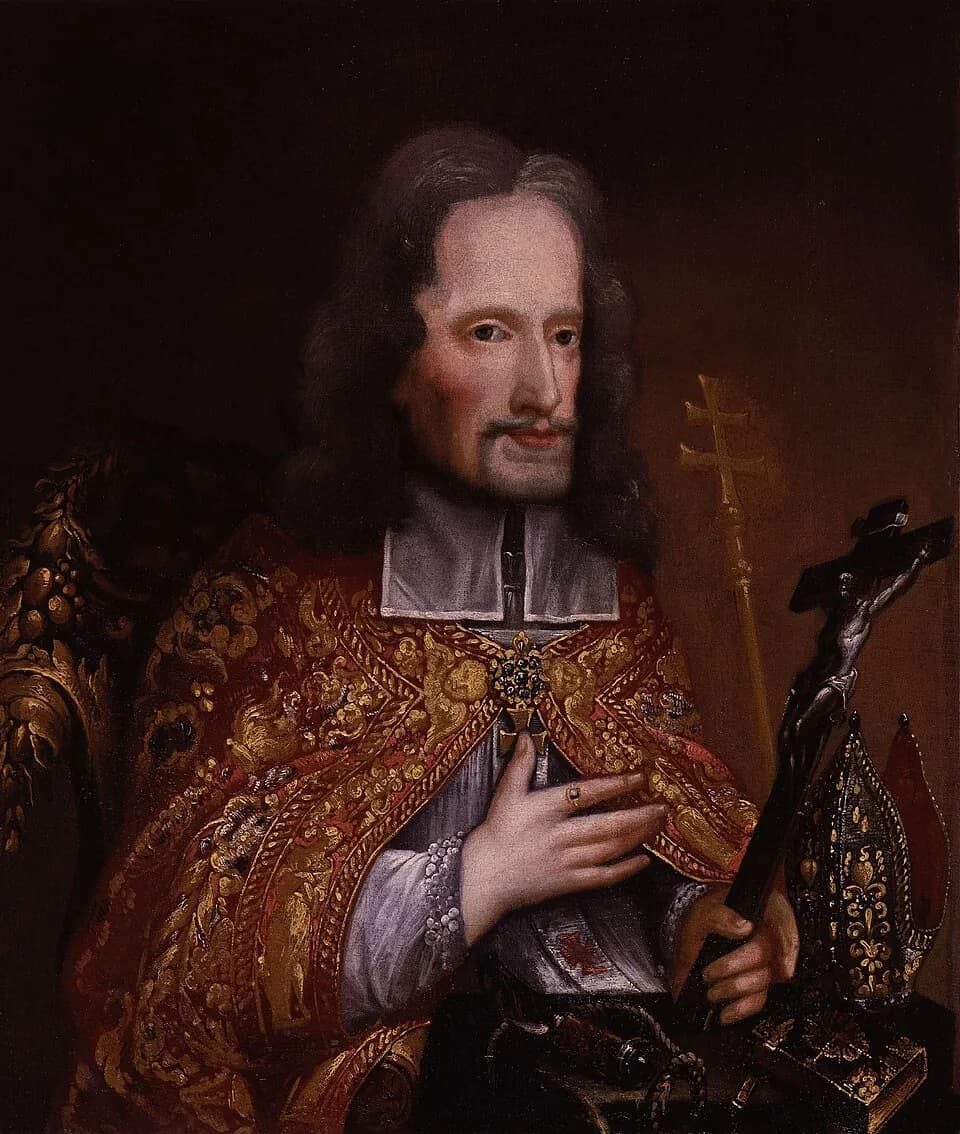
- Born
- At Loughcrew, near Oldcastle, County Meath; 1629 according to the 1911 encyclopedia and Franciscan Media, November 1, 1625 according to the Archdiocese of Armagh 123
- Archbishop of Armagh
- Appointed July 9, 1669; Primate of All Ireland 1
- Arrested
- December 6, 1679, and imprisoned in Dublin Castle 1
- Died
- Hanged, drawn and quartered at Tyburn, London, on July 1, 1681, by the English calendar of the day, which was July 11 by the modern one 123
- Beatified
- 1920, by Pope Benedict XV 3
Saint Oliver Plunkett was the Archbishop of Armagh and Primate of All Ireland who was hanged, drawn and quartered at Tyburn in 1681, after a treason case that could not be made to stand in Ireland was moved to London. 123 He was the last Catholic to die for the faith at Tyburn. 1 John Paul II, preaching beside his relics in Drogheda, called him "the defender of the oppressed and the advocate of justice" who "would never condone violence," and whose "dying words were words of forgiveness for all his enemies." 4 His feast is July 1. 3
A Meath family and a Roman education
He was born at Loughcrew, near Oldcastle in County Meath, into a family connected with the Earls of Roscommon and Fingall. 1 The year is uncertain. The 1911 Catholic Encyclopedia and Franciscan Media give 1629; the Archdiocese of Armagh says "the accepted date" is November 1, 1625. 123 Until he was sixteen he was taught by a relative, Patrick Plunket, then Abbot of St. Mary's in Dublin and later a bishop. 1
He left for Rome as a candidate for the priesthood under the care of an Oratorian, Father Scarampo, in 1645 by the encyclopedia's account, or in 1647 with "Father Scarampi" by Armagh's. 13 At the Irish College he did well enough that its rector later recalled him studying philosophy, theology and mathematics "with such ardour" that he was "justly ranked amongst the foremost," and calling him "a model of gentleness, integrity, and piety." 1
He was ordained in Rome in 1654; Armagh dates it January 1. 123 He did not go home. Armagh says he asked to be excused for the time being from his student oath to return to Ireland, served as a chaplain with the Oratorians, and studied law at the Sapienza. 3 From 1657 he taught theology at the College of Propaganda, and the Irish bishops used him as their agent in Rome through the Cromwellian years. 13 Franciscan Media remembers this period for his teaching "and service to the poor of Rome." 2
Archbishop of a shattered Church
On July 9, 1669, he was named Archbishop of Armagh. 1 The encyclopedia says he was consecrated at Ghent on November 30; Armagh says December. 13 He reached his diocese in March 1670. 13 What he found, in Armagh's words, was a Church "shattered by Cromwell's persecution": bishops killed or exiled, churches and schools destroyed, priests poorly trained, "the people like sheep without a shepherd." 3
He worked fast. The encyclopedia records that within three months he had confirmed about ten thousand people, some of them sixty years old, and that by December 1673 he could report 48,655 confirmations in four years, usually given outdoors on mountains and in woods, in wind and rain, on a diet of little more than oaten bread. 1 He held two synods and ordained priests. 13 At Drogheda he opened a school run by Jesuits, which soon had a hundred and fifty boys, forty of them sons of Protestant gentry. 1
One piece of work stands out in both accounts. The "Tories" of Ulster were Catholics dispossessed of their land who lived as outlaws in the hills, and anyone who sheltered them faced death from the government while anyone who refused them faced it from the outlaws. 13 With the Lord Lieutenant's permission, Plunkett went to find them, talked them down, and obtained pardons so that they could leave the country. 1 Armagh says that to "diocese after diocese in the north he brought peace where before there had been discord." 3
A difficult man, by his own diocese's account
The Archdiocese of Armagh does not present him as easy. His closest friend, Bishop Brenan, later Archbishop of Cashel, described him as "touchy and hot-tempered." 3 He disciplined clergy with outlaw connections and earned their resentment, fell into what Armagh calls "an unseemly personal dispute" with Archbishop Talbot of Dublin over which see held the primacy, and turned the Franciscans and many of their lay friends against him by deciding a dispute over alms-collecting "uncompromisingly in favour of the Dominicans." 3 In 1672 he published a short book, Jus Primatiale, arguing for the precedence of Armagh. 1
He also had sympathy for the old Gaelic families stripped of their lands, writing that "it would break your heart" to see them, but Armagh says he had resolved from the start to keep out of politics. 3
In hiding
In 1673 the bishops and religious were ordered out of Ireland. 3 The schools closed and the chapels shut. 12 Plunkett stayed, living in disguise and hiding with Bishop Brenan. 123 In a letter of December 15, 1673, quoted by Armagh, he wrote that the house they shared was "made of straw" and roofed so that "from the bed we can see the stars," and that "we would rather die of hunger and cold than abandon our flocks." 3
Arrest, trial and death
The persecution eased and then returned. In 1679 he was caught up in the Earl of Shaftesbury's intrigues and Titus Oates's false revelations of a Catholic conspiracy. 3 The encyclopedia explains that the conspiracy could not be sustained in England without a supposed rebellion in Ireland, and the primate would naturally be its leader. 1 He was arrested on December 6, 1679, and held in Dublin Castle. 1 Armagh says he was taken to Dundalk for trial, but the witnesses against him failed to appear. 3 The encyclopedia says no Irish jury would believe them. 1 The case was moved to London. 123
There, according to Armagh, he was tried on June 8 before his own witnesses could arrive from Ireland and found guilty of high treason. 3 Franciscan Media says the jury deliberated for fifteen minutes. 2 The encyclopedia records that the presiding judge, Chief Justice Pemberton, declared from the bench that there could be no greater crime than to endeavor to propagate the Catholic faith, "than which (he declared) there is not anything more displeasing to God or more pernicious to mankind in the world," and that Plunkett answered the death sentence with "Deo Gratias." 1
He was hanged, drawn and quartered at Tyburn on Friday, July 1, 1681, by the calendar England then used. 12 The encyclopedia gives the date as July 11, "old style the 1st," and Armagh also gives July 11. 13 Archbishop Brenan, reporting to Rome, wrote that he went to the scaffold looking "rather a spouse hastening to the nuptial feast, than a culprit led forth to the scaffold." 1 John Paul II said that "his dying words were words of forgiveness for all his enemies." 4
Relics and canonization
Friends recovered his remains. 3 The body was buried at St. Giles and later taken to the Benedictine monastery at Lambspring in Germany, in 1684 by the encyclopedia's account or 1683 by Armagh's, and two hundred years afterward to Downside Abbey in England. 13 His head went to Rome and then to Drogheda, where Dominican nuns kept it for some two hundred years; since 1921 it has been in St. Peter's Church there. 13
Benedict XV beatified him in 1920, and Paul VI canonized him in 1975, on October 12 according to Armagh, or October 10 according to New Advent's note. 13 John Paul II, then Cardinal of Kraków, was present, and recalled it at Drogheda in 1979. 4
What is Saint Oliver Plunkett the patron saint of?
None of the sources used for this page names a patronage for Saint Oliver Plunkett, and this page does not supply one. 1234 Franciscan Media suggests that "a prayer to Saint Oliver Plunkett for peace and justice might be appropriate" in the face of "false accusations, prejudice, anti-Catholic sentiments," which is as close as any of them comes. 2 John Paul II invoked him, with Saint Patrick, to "watch over Ireland." 4
Saint Oliver Plunkett's feast day
Praying with Saint Oliver Plunkett
Much of his life was administration: confirmations by the thousand, a school, synods, rulings on who could collect alms where. 13 His own diocese admits that he was quick-tempered and that some of his quarrels did him no credit. 3 The holiness was carried out by a man with a temper, which may be more use to most people than the alternative.
He went looking for armed outlaws in the hills, at real risk to himself, and talked them into peace. 1 John Paul II chose that side of him to put before Ireland in 1979: a bishop who defended the oppressed and "would never condone violence." 4
Then came the straw house where he could see the stars from the bed, and the choice to stay rather than leave. 3 The trial was a fraud and everyone knew it. 123 He answered the sentence with thanks and went to his death forgiving the people who arranged it. 14
Franciscan Media points out that false accusation and prejudice did not end in 1681, and suggests praying to him about them. 2 He is a fitting saint to bring them to.
Saint Oliver Plunkett, pray for us.
Sources
- 1.Patrick Francis Cardinal Moran, "Blessed Oliver Plunket," The Catholic Encyclopedia, Vol. 12 (New York: Robert Appleton Company, 1911), with New Advent's editor's note on the canonization.
- 2."Saint Oliver Plunkett," Saint of the Day, July 2, Franciscan Media.
- 3.Dermot McDermott, CFC, "St Oliver Plunkett," Archdiocese of Armagh, May 2001.
- 4.Pope John Paul II, Homily at the Mass in Drogheda, Ireland, September 29, 1979.
Saints to turn to next
Others in this collection who are turned to for some of the same things.