Saint Nilus of Sinai
Died about 430 or later
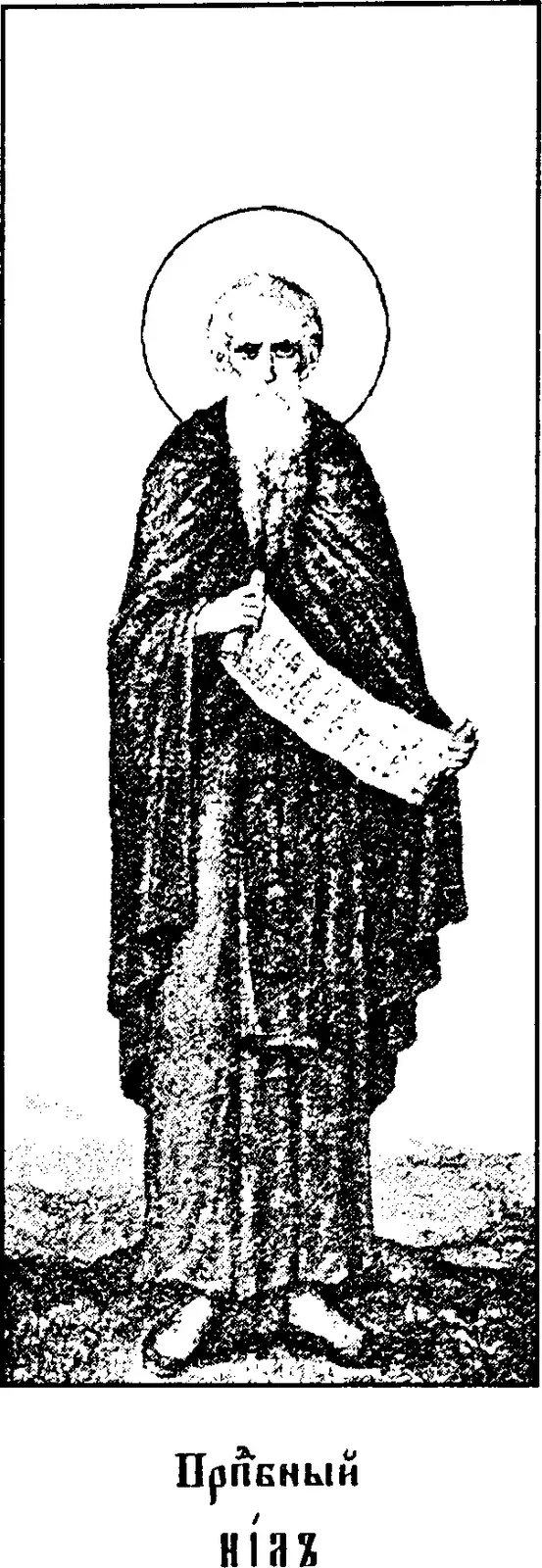
- Also called
- Nilus the Elder; Neilos 1
- Before the monastery
- A married official at the court of Constantinople, said to have been a praetorian prefect 1; prefect or governor of the city, say Butler and the 1897 Martyrology 24
- Monastery
- On Mount Sinai, say the Catholic Encyclopedia and Butler 12; near Ancyra in Galatia, says the current Martyrology 3
Saint Nilus was a married man with two sons and a high office at the imperial court of Constantinople, who left it all about the year 390 and went with his younger son to the monks of Mount Sinai. 12 From his cell he became one of the leading ascetic writers of the fifth century, consulted by letter by people of every rank up to the emperor, whom he did not hesitate to rebuke. 1 The Church remembers him on November 12. 3
An official of Constantinople
The first we know of him, Adrian Fortescue writes in the Catholic Encyclopedia, is as a layman, married with two sons, and an officer at the court of Constantinople, who "is said to have been one of the Prætorian Prefects." 1 Alban Butler, in his Lives of the Saints, calls him prefect or governor of Constantinople, appointed by the emperor, and the 1897 Martyrology calls him governor of the city. 24 Butler adds, following the historian Orsi, that he seems to have been a native of Ancyra in Galatia, and that his writings show a good education in which piety always came first. 2
Both sources connect him with Saint John Chrysostom. 12 Fortescue says that while Chrysostom was patriarch of Constantinople, before his first exile, he directed Nilus in the study of Scripture and in works of piety. 1 Butler thinks it must have been earlier, at Antioch, perhaps when Nilus had already left his post. 2 The current Roman Martyrology is more careful still, and says only that he is "held to be" a disciple of Chrysostom. 3
Leaving the court
Butler imagines the conscience of a careful magistrate at the court of Arcadius, surrounded by ambition, avarice and jealousy, and afraid above all of authorizing or conniving at injustice. 2 The desire to live for God alone grew so strong, he says, that Nilus obtained his wife's consent, "though with some difficulty," to withdraw from the world. 2
The date is uncertain. The historian Tillemont, as Fortescue reports, put it about 390, and so does Butler; Leo Allatius, who edited his letters in 1668, thought perhaps 404. 12 Nilus took his younger son, Theodulus, with him to Mount Sinai to be a monk. 12 Butler says the elder son stayed with his mother to be trained for his place in the world; Fortescue, that the mother and the other son also embraced the religious life, in Egypt. 12
The raid on Sinai
Father and son lived together on Sinai for years. 12 Then, about 410 in Fortescue's reckoning, Saracens raided the monasteries, killed many of the monks, and carried off Theodulus with other captives. 12 Fortescue says they meant to sacrifice him to their gods, but instead sold him as a slave, and he came into the hands of the bishop of Eleusa in Palestine, who took him among his clergy and made him doorkeeper of the church. 1
Nilus left the monastery to search for him. 1 Butler says he fell into the raiders' hands himself but soon got free, and that he found his son at last at Eleusa with the bishop, who had ransomed the boy out of charity. 2 The bishop gave the son back to his father and made the father accept ordination as a priest; Fortescue says he ordained them both and let them return to Sinai. 12 Butler says Nilus was then fifty years old. 2 Nilus himself told the story, Fortescue notes, in a work in seven parts on the slaughter of the monks of Sinai and the captivity of his son. 1
The writer and the letters
From Sinai, Fortescue writes, Nilus was known throughout the Eastern Church, and "people of all kinds, from the emperor down, wrote to consult him." 1 His works are treatises on the virtues and vices, on prayer, on voluntary poverty and on the monastic life; about two hundred short maxims, probably collected by his disciples; and letters, of which Leo Allatius printed 1,061 in four books, some incomplete, some excerpts, and some spurious. 1
He "warns and threatens people in high places, abbots and bishops, governors and princes, even the emperor himself, without fear." 1 He wrote again and again to Gainas, the leader of the Goths, trying to bring him out of Arianism, and he denounced the persecution of Chrysostom both to the Emperor Arcadius and to his courtiers. 1 Butler adds that he warned priests against harshness to sinners, telling of a bishop in the time of the apostles who was rebuked by Christ in a vision for his rigor toward penitents. 2
One letter was later fought over. Nilus reproached a nobleman named Olympiodorus for having the shapes of beasts and other strange forms painted on the walls of a church, and told him to paint only the cross in the sanctuary and, around the church, scenes from the Old and New Testaments, so that those who could not read might learn the history of the Bible. Butler says the Iconoclasts later falsified the passage to read that the walls should be whitewashed. 2 In another letter, Butler says, Nilus wrote that Chrysostom, celebrating the liturgy, saw angels attending the priests as they gave Communion. 2
On prayer and temptation
Butler summarizes his treatise on prayer, a work Photius particularly admired. 2 Nilus tells the reader to ask God first for the gift of prayer itself, and for the Holy Spirit to form in the heart the pure desires that God has promised to hear, and to teach the soul from within how to pray; and above all to ask that God's will be done. 2 To people in the world he recommends temperance, humility, prayer, contempt of the world, constant thought of death, and generous almsgiving. 2
Butler adds that Nilus knew the hermit's life from the inside. He held it to be higher than life in a community in the city, but only for those who had first been trained under an experienced master, and he did not hide its trials. 2 He had suffered long and violent temptations and troubles of mind himself, and had overcome them, Butler writes, by reading, prayer, the psalms, frequent prostrations, patience, humility and the sign of the cross. 2
His death
No one recorded when he died. Fortescue says Nilus was certainly alive in 430, and that some writers, following Leo Allatius, have him living until 451, as the Byzantine menology for his feast supposes. 1 But none of his works mentions the Council of Ephesus of 431, and he seems to know only the beginning of the Nestorian troubles, so there is no evidence of his life after about 430. 1 Butler says he died at a great age in the reign of the Emperor Marcian, and that "his love of obscurity followed him to the grave." 2 His body, Butler adds, was later brought to Constantinople in the reign of Justin the Younger and laid in the Church of the Apostles. 2
What is Saint Nilus the patron saint of?
Saint Nilus's feast day
Saint Nilus's feast day is November 12. The current Roman Martyrology, as the Italian bishops print it, commemorates him on that day, near Ankara in Galatia, in present-day Turkey, as an abbot who is held to be a disciple of Saint John Chrysostom, who governed a monastery for a long time and spread ascetic teaching through his writings. 3 It places him at Ancyra rather than on Sinai, where Fortescue and Butler put him; none of the sources read for this page explains the difference. 123
Fortescue says the Byzantine calendar keeps his feast on November 12, that the Roman Martyrology commemorated him on the same date, and that the Armenians remember him with other Egyptian fathers in their Advent season. 1 The 1897 English Martyrology enters him on November 12 at Constantinople: "of St. Nilus, abbot, who, being governor of the city, became a monk, and was distinguished for learning and sanctity, under Theodosius the Younger." 4
Praying with Saint Nilus
Nilus left a marriage, a family and a great office for the desert, and the sources do not pretend it was simple. His wife agreed only with difficulty, and the son he took with him was carried off by raiders. 12 The father who went looking for him was captured himself. 2
He did not use the distance to stop speaking. From a cell on Sinai he wrote to generals, bishops and the emperor, and he denounced the persecution of Chrysostom to the emperor himself. 1 He told priests not to be hard on sinners. 2
His advice on prayer begins before any words are said: ask God for the gift of prayer, and let the Holy Spirit teach the heart what to want. 2 It came from a man who, Butler says, had fought long and violent temptations of his own. 2
Saint Nilus of Sinai, pray for us.
Sources
- 1.Adrian Fortescue, "St. Nilus," The Catholic Encyclopedia, vol. 11 (New York: Robert Appleton Company, 1911).
- 2.Alban Butler, "St. Nilus, Anchoret, Father of the Church, C.," November 12, in The Lives of the Fathers, Martyrs, and Other Principal Saints, vol. XI (Derby: Richardson and Son), Internet Archive.
- 3.Roman Martyrology, entry for November 12, "San Nilo, abate," Santo del giorno, Conferenza Episcopale Italiana (in Italian).
- 4.The Roman Martyrology, November 12 (Baltimore: John Murphy Company, 1897), Internet Archive.
Saints to turn to next
Others in this collection who are turned to for some of the same things.
- Saint AbrahamPatriarch of Genesis; dates unknownPrayerDiscernmentMarriage and family
- Saint Catherine of Sweden1331 or 1332 - March 24, 1381Marriage and familyPrayerDiscernment
- Saint Ethelburga of Faremoutiersd. 664 or 695PrayerDiscernmentMarriage and family
- Saint Nicholas of FlüeMarch 21, 1417 - March 21, 1487PrayerDiscernmentMarriage and family