Saint Abraham
Patriarch of Genesis; dates unknown
- Family
- Husband of Sarah; father of Ishmael by Hagar and of Isaac by Sarah 1
- Known for
- Leaving his country at God's call; his faith in the promise; his intercession for Sodom; the sacrifice of Isaac 2345
- Died
- At a hundred and seventy-five, says Genesis; buried with Sarah in the cave of Machpelah near Mamre 11
- Not to be confused with
- Saint Abraham Kidunaia, a fourth-century hermit kept on October 29
Abraham is the patriarch of the Book of Genesis who left his homeland at God's call, believed God's promise of a son and a people when he was old and childless, and was ready to offer that son back to God. 12 The Church calls him "the father of all who believe," and the Catechism offers him as the model of the obedience of faith. 4 The Roman Martyrology commemorates him on October 9. 2
Called out of Haran
The story of Abraham runs from the eleventh chapter of Genesis to the twenty-fifth, and James Howlett, writing in the 1907 Catholic Encyclopedia, begins with the family. 1 Thare had three sons, Abram, Nachor and Aran. Abram married Sarai, and Thare took them and his grandson Lot from Ur of the Chaldees to Haran, where he died. 1
Then came the call. "Go forth out of thy country, and from thy kindred, and out of thy father's house, and come into the land which I shall shew thee," the Lord says in Genesis, with a promise attached: "IN THEE shall all the kindred of the earth be blessed." 7 Abram went, "as the Lord had commanded him," at seventy-five. 7 The current Roman Martyrology sums up the beginning the same way: called by God, he left his own land, Ur of the Chaldees, and set out for the land God promised to him and his descendants. 2
He did not travel as a saint in a picture. Howlett's outline includes the famine that drove him into Egypt, where, afraid he would be killed for his wife's sake, he told Sarai to say she was his sister; Pharaoh took her into his house, found out, and sent them both away with a rebuke. 1 Abraham did the same thing again later at Gerara. 1 The Catechism notices something else about these years: "a man of silence, he constructs an altar to the Lord at each stage of his journey." 5
Abram believed God
The promise of descendants took a long time to show any sign of coming true, and Abram said so. "Lord God, what wilt thou give me? I shall go without children." 8 The Catechism calls this his first prayer in words, "a veiled complaint reminding God of his promises which seem unfulfilled." 5 God brought him outside and told him to count the stars: "So shall thy seed be." 8
Genesis then gives the line on which so much would later rest: "Abram believed God, and it was reputed to him unto justice." 8 Howlett makes it central. Abraham, he writes, is treated as "the starting-point or source of Old Testament religion," and God comes to be called "the God of Abraham," because of "his faith, trust, and obedience." 1
Sarai, still childless, gave Abram her maid Hagar, who bore Ishmael. 1 Thirteen years later God renewed the promise, changed Abram's name to Abraham and Sarai's to Sarah, and gave the sign of circumcision. 1 Howlett notes that the meaning Genesis gives the new name is "popular word play," and that the real meaning of the name is unknown. 1
Guests at Mamre, and a prayer for Sodom
The Lord appeared to Abraham "in the vale of Mambre as he was sitting at the door of his tent, in the very heat of the day," as three men standing near him; Abraham ran to meet them, had water brought for their feet, and set food before them. 9 The Catechism says that this "remarkable hospitality at Mamre foreshadows the annunciation of the true Son of the promise." 5 The guests repeated the promise of a son, and the aged Sarah laughed when she heard it. 1
Then the Lord told Abraham what he meant to do to Sodom and Gomorrah, and Abraham argued. "Wilt thou destroy the just with the wicked?" 9 He began at fifty innocent people and bargained his way down to ten: "I beseech thee, saith he, be not angry, Lord, if I speak yet once more: What if ten should be found there?" 9
Benedict XVI chose this passage to begin his catecheses on prayer in 2011. Abraham, he said, "does not stop at asking for salvation for the innocent. Abraham asks forgiveness for the whole city." 3 He was not asking God for anything against God's nature; "he knocks at the door of God's heart knowing what he truly desires." 3 Ten were not found, and the cities were destroyed. 13 The pope did not soften that. He read it as showing that God was ready to forgive and that the cities had left him nothing to start from, and he followed the thread through Jeremiah to Christ, the one righteous man who would bring salvation to the whole world. 3
The sacrifice of Isaac
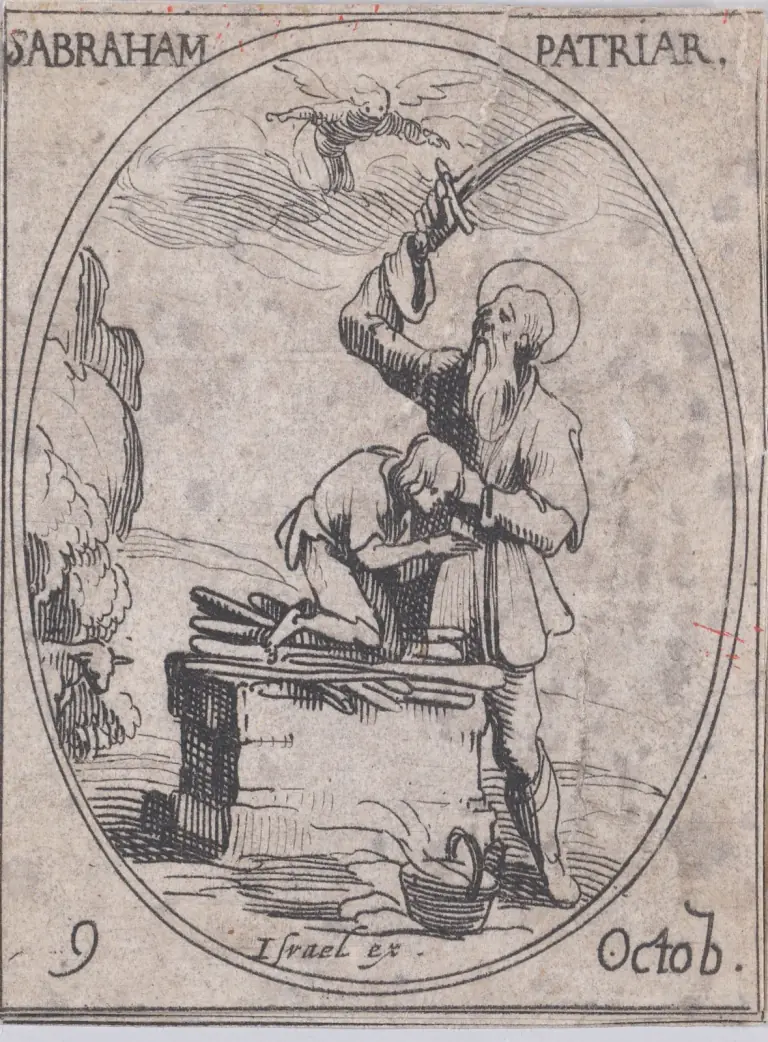
In old age Sarah bore Isaac. 1 Some years later, "God tempted Abraham," and told him to take "thy only begotten son Isaac, whom thou lovest," and offer him as a holocaust on a mountain he would be shown. 10 On the way the boy asked where the victim was. "God will provide himself a victim for an holocaust, my son. So they went on together." 10
At the last moment an angel stopped his hand: "Lay not thy hand upon the boy." 10 Abraham saw "a ram amongst the briers sticking fast by the horns" and offered it instead of his son, and the promise was sworn again, "because thou hast obeyed my voice." 10 Howlett calls this "the great trial of the faith of Abraham." 1 The Catechism treats it as the final purification of his faith, in which "the father of believers is conformed to the likeness of the Father who will not spare his own Son but will deliver him up for us all." 5 The current Martyrology singles it out too: hoping against hope, Abraham did not refuse to offer his only son, given to him in old age by a barren wife. 2
Sarah died at a hundred and twenty-seven, and Abraham bought the cave of Machpelah near Mamre to bury her. 1 Genesis gives his own age at death as a hundred and seventy-five, and says that Isaac and Ishmael buried him there beside her. 11
Father of all who believe
The New Testament comes back to Abraham again and again. Howlett notes that Matthew traces the genealogy of Christ from him, and that Luke ties the blessings of Israel to the promises made to him in both the Magnificat and the Benedictus. 1 He stresses that Jesus and Saint Paul refuse to make descent from Abraham a matter of blood: "If ye be the children of Abraham, do the works of Abraham," and "If you be Christ's, then you are the seed of Abraham." 1
The Catechism builds on the Letter to the Hebrews. "By faith, Abraham obeyed when he was called to go out to a place which he was to receive as an inheritance; and he went out, not knowing where he was to go." 4 It calls him the model of obedience in faith, the Virgin Mary being its most perfect embodiment, and says that because he was "strong in his faith," Abraham "became the 'father of all who believe.'" 4
As for history in the modern sense, Howlett is frank that "all we know about Abraham is contained in the book of Genesis," since the ancient historians who mention him add nothing reliable. 1 Writing in 1907, he judged that archaeology had settled nothing definite about Abraham himself, but was "putting an end to the idea that the patriarchal legends are mere myth." 1
What is Saint Abraham the patron saint of?
Saint Abraham's feast day
Saint Abraham's feast day is October 9. The current Roman Martyrology, in the text the Italian bishops publish, keeps on that day the commemoration of Saint Abraham, patriarch and father of all believers. 2 The older Martyrology had the same entry on the same day; the 1897 English edition reads "the commemoration of St. Abraham, patriarch, and father of all believers." 6
The library has a second Abraham, the fourth-century hermit Abraham Kidunaia, whose day is October 29. He is a different man.
Praying with Saint Abraham
The Catechism describes Abraham's prayer in stages. It begins in deeds, with altars built along the road; it becomes words only later, and the first words are a complaint that God's promises have not come true. 5 "Thus one aspect of the drama of prayer appears from the beginning: the test of faith in the fidelity of God." 5
Then it becomes intercession. Benedict XVI pointed out that Abraham's prayer for Sodom asked for more than justice for the innocent; it asked mercy for the guilty, and he kept pressing it until the number reached ten. 3 "The prayer of intercession of Abraham, our father in the faith," the pope said, "teaches us to open our hearts ever wider to God's superabundant mercy." 3 It did not save Sodom. 3
And it ends on the mountain, where the boy carried the wood and Abraham the fire and the sword, with nothing between them but the answer he had given his son: God will provide. 10 Genesis gives no account of what he felt. 10 The Catechism says only that "Abraham's faith does not weaken." 5
Saint Abraham, pray for us.
Sources
- 1.James Howlett, "Abraham," The Catholic Encyclopedia, vol. 1 (New York: Robert Appleton Company, 1907).
- 2.Roman Martyrology, entry for October 9, "Sant'Abramo, patriarca e padre di tutti i credenti," Santo del giorno, Conferenza Episcopale Italiana (in Italian).
- 3.Benedict XVI, General Audience on the intercession of Abraham, May 18, 2011, Libreria Editrice Vaticana.
- 4.Catechism of the Catholic Church, paragraphs 144-146, "Abraham - 'father of all who believe'," Libreria Editrice Vaticana.
- 5.Catechism of the Catholic Church, paragraphs 2570-2572, "The Promise and the Prayer of Faith," Libreria Editrice Vaticana.
- 6.The Roman Martyrology, October 9 (Baltimore: John Murphy Company, 1897).
- 7.Genesis 12, Douay-Rheims Bible (Challoner revision), as hosted by drbo.org.
- 8.Genesis 15, Douay-Rheims Bible (Challoner revision), as hosted by drbo.org.
- 9.Genesis 18, Douay-Rheims Bible (Challoner revision), as hosted by drbo.org.
- 10.Genesis 22, Douay-Rheims Bible (Challoner revision), as hosted by drbo.org.
- 11.Genesis 25, Douay-Rheims Bible (Challoner revision), as hosted by drbo.org.
Saints to turn to next
Others in this collection who are turned to for some of the same things.
- Saint Catherine of Sweden1331 or 1332 - March 24, 1381Marriage and familyPrayerDiscernment
- Saint Ethelburga of Faremoutiersd. 664 or 695PrayerDiscernmentMarriage and family
- Saint Nicholas of FlüeMarch 21, 1417 - March 21, 1487PrayerDiscernmentMarriage and family
- Saint Agnes of Bohemiac. 1200-1205 - March 1281 or 1282PrayerDiscernment