Saint Ethelburga of Faremoutiers
d. 664 or 695
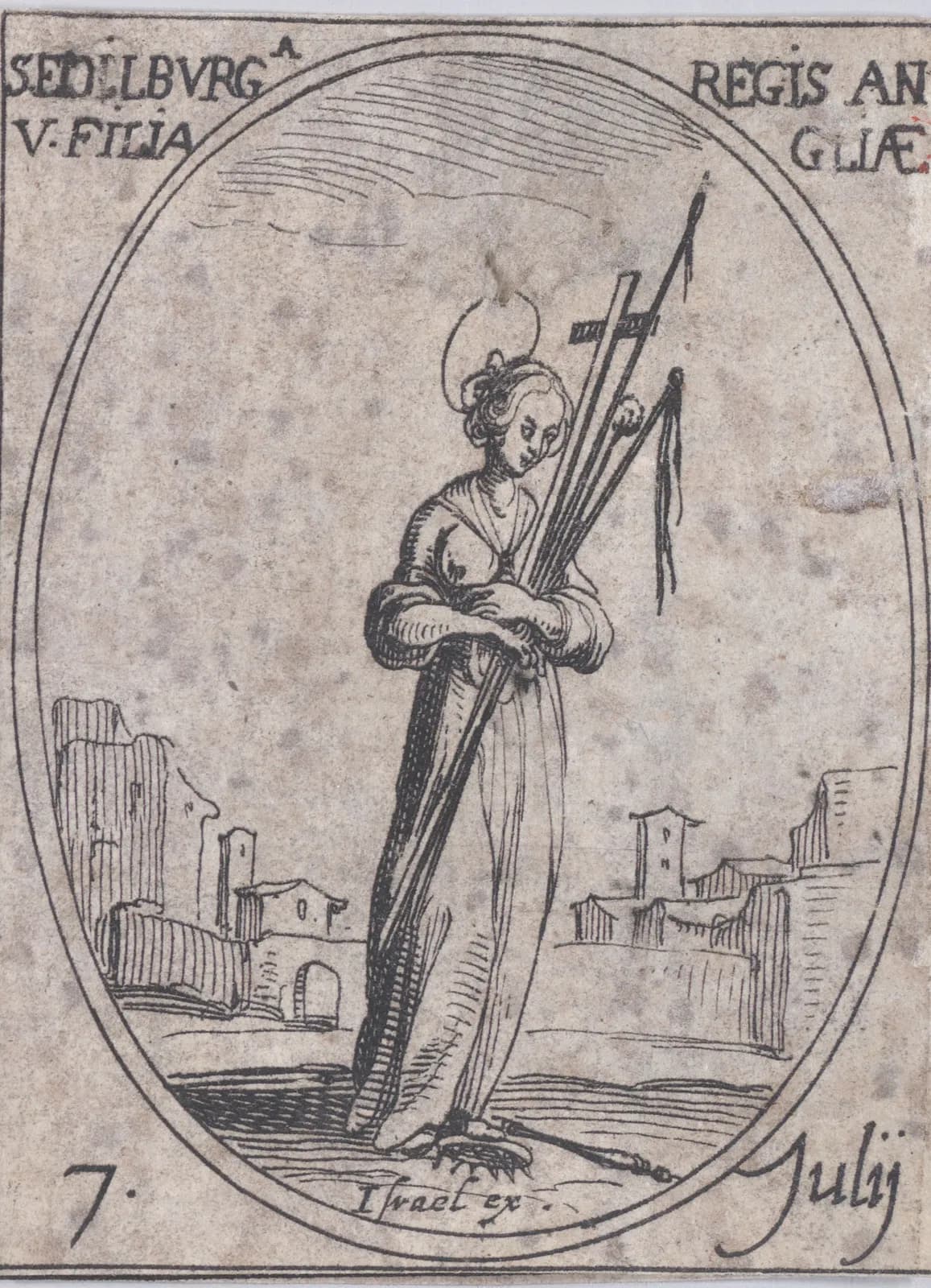
- Emblem
- An abbess's staff and the instruments of the Passion 1
Saint Ethelburga was a daughter of Anna, king of the East Angles, who went to Gaul to become a nun at Faremoutiers in Brie and died there as its abbess. 12 Bede says she began a church in honor of all the apostles and did not live to finish it, and that when her grave was opened seven years later her body was found incorrupt. 2 She is one of four sisters, all daughters of Anna, whom the Church venerates as saints. 15
A daughter of King Anna
Ethelburga was one of the daughters of Anna, king of the East Angles. 125 Her sisters included Saint Etheldreda, abbess of Ely; Saint Sexburga, who married King Earconbert of Kent; and Saint Withburga. 15 Arthur Barnes, in the 1912 Catholic Encyclopedia's article on Sexburga, writes that "her sisters, Sts. Ethelburga and Saethrid, were both Abbesses of Faremontier in Brie." 5
The sources describe her parentage differently. Bede, in his Ecclesiastical History, calls Sethrid the "daughter of the wife of Anna" and Ethelburga the "natural daughter of the same king." 2 The Norwegian bishops' saints database (katolsk.no) makes her the daughter of Anna and his second wife, Saewara, and Sethrid her half-sister through their mother. 1 It also warns that she is often confused with another Ethelburga, the abbess of Barking and sister of Saint Erconwald of London, who died in 678. 1
Why English princesses went to Brie
Bede explains why she crossed the sea. At that time, he says, "but few monasteries being built in the country of the Angles, many were wont, for the sake of monastic conversation, to repair to the monasteries of the Franks or Gauls," and families sent their daughters there to be instructed, "especially in the monasteries of Brie, of Chelles, and Andelys." 2 katolsk.no repeats his reason: there were still few convents in England. 1
The house at Brie was Faremoutiers. Bede says it was "built by a most noble abbess, called Fara." 2 Nominis, the French bishops' saints site, quoting the Diocese of Meaux, says Saint Fara founded it about 625 on the hill of Eboriacum, two leagues from Coulommiers, and the French text of the Roman Martyrology it prints says she governed the monastery for forty years and died in 657. 6 Nominis adds that she was the sister of Saint Faro, bishop of Meaux. 6
Ethelburga came with her half-sister Sethrid and with her niece Earcongota, the daughter of Sexburga and King Earconbert of Kent, katolsk.no says. 1 Bede counts Earcongota among the English girls at Brie and calls her "a most virtuous virgin, always serving God in a monastery in France." 2 Earconbert, Bede says, was "the first of the English kings that of his supreme authority commanded the idols, throughout his whole kingdom, to be forsaken and destroyed," and ordered the Lenten fast kept. 2
Abbess of Faremoutiers
Both sisters rose in the house. Bede says that Sethrid and Ethelburga, "though strangers, were for their virtue made abbesses of the monastery of Brie." 2 katolsk.no gives the order: Fara died in 657 and Sethrid succeeded her; Sethrid died about 660, and Ethelburga followed her. 1 The Roman Martyrology, as the Italian bishops print it, remembers her as the daughter of the king of the East Angles who gave glory to God by severe bodily abstinence and perpetual virginity. 3 The French text reads the same. 4
Bede tells one story of the community under her. Earcongota, he says, knew by revelation that she would soon die. 2 She went round the cells of the sick and the oldest servants of Christ and asked their prayers, and told them she had seen men in white come into the monastery, who said "they had been sent thither to carry away with them the gold medal that had been brought thither from Kent." 2 She died that night, and Bede reports that brethren in other houses heard angels singing and saw a great light come down from heaven. 2 She was buried in the church of Saint Stephen. 2
The unfinished church
Bede turns then to Ethelburga, who "preserved the glory so pleasing to God, of perpetual virginity, in great continency of body, but the extent of her virtue became more conspicuous after her death." 2 As abbess she began to build a church in the monastery "in honor of all the apostles," in which she wanted to be buried. 2 It was half built when she died, and she was buried where she had asked, in the unfinished church. 12
katolsk.no and Catholic.net's Spanish santoral date her death to 664. 17 The French Martyrology, as Nominis prints it, gives 695. 4
For seven years, Bede says, the work stood still while the community attended to other things. 2 Then they gave up the church "by reason of the greatness of the work," and decided to move the abbess's bones to a church that was finished and consecrated. 2 katolsk.no puts it more plainly: the nuns could not afford to finish it. 1 When they opened the tomb, Bede writes, "they found the body as free from decay as it had been from the corruption of carnal concupiscence." 2 They washed it, clothed it again, and carried it to the church of Saint Stephen, where Earcongota already lay. 12
Aubierge of the Brie
In France she is known as Aubierge. 14 Nominis records a local legend: when the river Aubetin ran dry, she struck the ground with her crosier and a spring flowed. 4 It says a chapel beside the washhouse that the spring now feeds, in the commune of Saint-Augustin in the diocese of Meaux, still holds her reliquary, and that a pilgrimage to Sainte Aubierge is made there on Easter Monday. 4
katolsk.no says her name stands in both English and French martyrologies. 1 She is shown as an abbess with a staff and with the instruments of Christ's Passion, a sign of her great devotion to the sufferings of the Lord. 1
What is Saint Ethelburga of Faremoutiers the patron saint of?
Saint Ethelburga's feast day
Praying with Saint Ethelburga
She left her country because there was nowhere at home yet to live the life she wanted, and she became, in Bede's word, a stranger who was made abbess for her virtue. 12
The thing she set out to build was too big. She died with the church half done, and the community that came after her decided it was beyond them. 2 Bede does not treat that as a failure; he says her virtue became plainer after her death than before it. 2
Her sisters ruled Ely and Minster and Faremoutiers, and her niece died beside her. 125 It was a family that gave its daughters away, and the Church keeps the memory of most of them.
Saint Ethelburga of Faremoutiers, pray for us.
Sources
- 1."Den hellige Ethelburga av Faremoutiers," Den katolske kirke (katolsk.no), Catholic Diocese of Oslo (in Norwegian).
- 2.Bede, The Ecclesiastical History of the English Nation, Book III, chapter 8, in the English translation (probably L. C. Jane, 1903) on the Internet Medieval Sourcebook, Fordham University.
- 3.Roman Martyrology, entry for July 7, "Santa Edilburga, badessa," as printed in "Santo del giorno," Conferenza Episcopale Italiana (in Italian).
- 4."Sainte Aubierge," Nominis, Conférence des évêques de France, with the Roman Martyrology (in French).
- 5.Arthur Barnes, "St. Sexburga," The Catholic Encyclopedia, Vol. 13 (New York: Robert Appleton Company, 1912).
- 6."Sainte Fare," Nominis, Conférence des évêques de France, quoting the Diocese of Meaux and the Roman Martyrology (in French).
- 7."Eteldreda de Ely, Santa," Santoral, Catholic.net (in Spanish).
Saints to turn to next
Others in this collection who are turned to for some of the same things.
- Saint Catherine of Sweden1331 or 1332 - March 24, 1381Marriage and familyPrayerDiscernment
- Saint Nicholas of FlüeMarch 21, 1417 - March 21, 1487PrayerDiscernmentMarriage and family
- Saint Aldegundc. 630 or c. 639 - 684DiscernmentPrayer
- Saint Catherine LabouréMay 2, 1806 - December 31, 1876PrayerDiscernment