Saint Catherine Labouré
May 2, 1806 - December 31, 1876
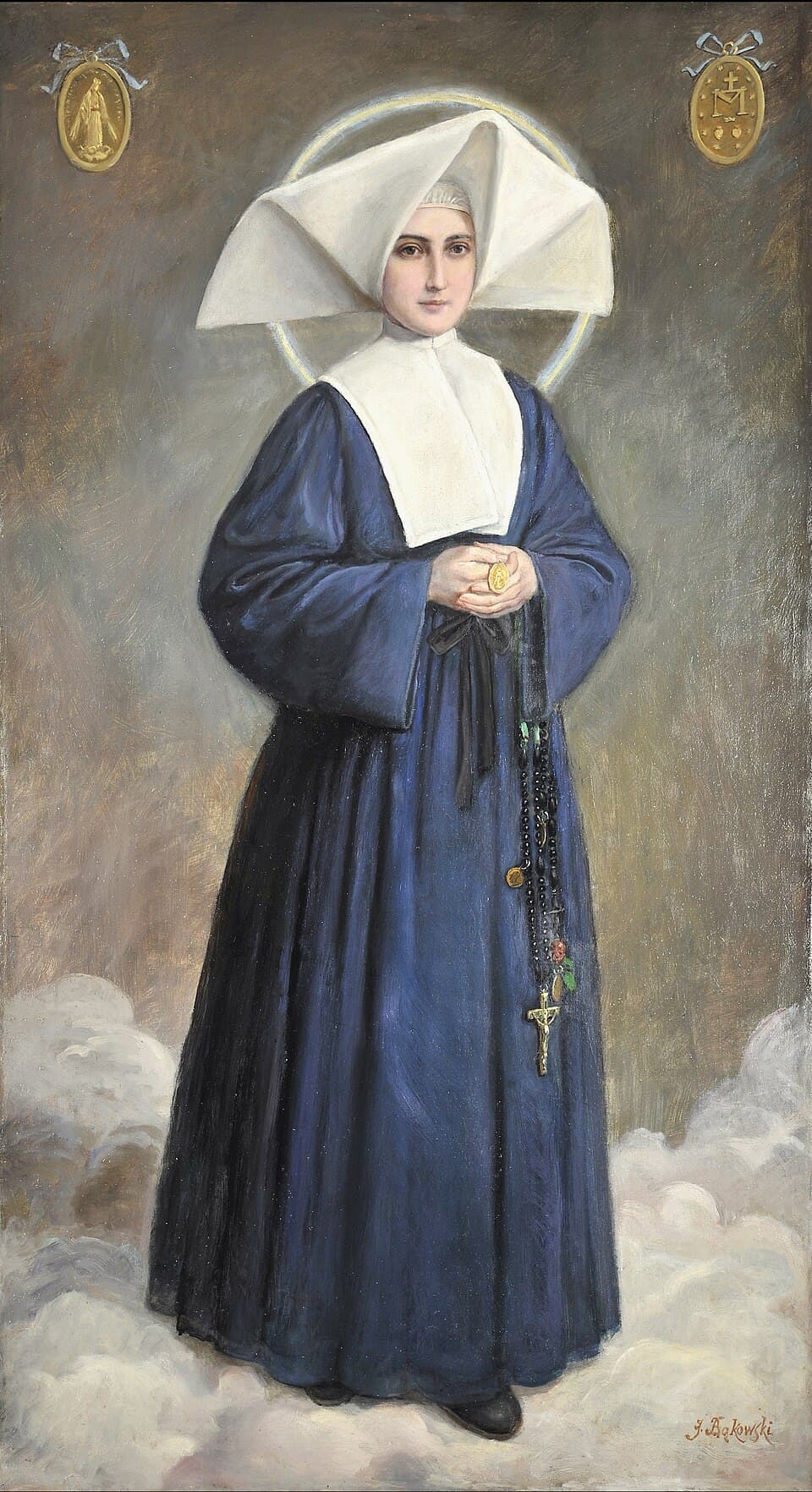
- Baptismal name
- Zoe 1
- Died
- Paris, December 31, 1876 5
- Community
- Daughters of Charity of St. Vincent de Paul 1
- Patron of
- The elderly, the infirm, and the Miraculous Medal 7
Saint Catherine Labouré was a farmer's daughter from Burgundy who, as a novice of the Daughters of Charity in Paris in 1830, saw the Virgin Mary and was told to have a medal struck, the medal now known everywhere as the Miraculous Medal. 13 She told her confessor and almost nobody else, and spent the rest of her life caring for old people in a Paris hospice, answering the door and keeping the hens. 36 Her name was not widely known until after she died. 56
A household in Burgundy
She was born into a large farming family in Burgundy. 3 Her given name was Zoe; Catherine was the name she took in religion. 1 Angelus gives her birth as May 2, 1806, and Vatican News gives the same year; the American province of her own congregation says "circa 1811." 358 The sources cannot agree on her place in the family either: the ninth of eleven children in Angelus, the eighth of ten for the Daughters of Charity, and the second to last of ten in L'Osservatore Romano. 258
Her mother died when she was a child, at 8 by one account and 9 by the other, and the household fell to her. 58 Pius XII, addressing pilgrims in Rome after her canonization, recalled that the death of her mother and the scattering of the older children had put the whole charge of the home on a child's shoulders. 4 Loyola Press says she kept her father's house for a decade. 6 The Daughters of Charity add that she made her First Communion at 11, on January 25, 1818, and from then on rose at four in the morning to walk several miles to Mass before the day's work. 8
A father who said no
An older sister, Louise, was already a Daughter of Charity, and Catherine came to know the sisters at the hospice of Moutiers-Saint-Jean. 8 When she told her father she wanted to join them he refused outright, and sent her to Paris to work in a restaurant in the hope she would change her mind. 8 She did not, and after much hesitation he gave his consent. 8 Pius XII spoke of the strange roads she had to travel to answer her vocation and overcome her father's opposition. 4
Loyola Press says she joined the community at Châtillon-sur-Seine in 1830. 6 On April 21 of that year she began her novitiate at the motherhouse on the Rue du Bac in Paris. 8 Vatican News says she was 23 when she entered; L'Osservatore Romano says 24. 23
The chapel on the Rue du Bac
On the night of July 18, 1830, by her own account, she was woken by "a child radiant with light" who told her to come at once to the chapel, where "the Blessed Virgin was waiting." 2 The Daughters of Charity note that it was the eve of the feast of Saint Vincent de Paul, and that she had been praying to him that she might see the Mother of God with her own eyes. 8 Loyola Press, which dates the night to July 31, says Mary spoke with her for two hours and told her she would have a difficult task to carry out. 6
The second apparition came on November 27. 1 As the encyclopedia summarizes her account, Mary appeared standing on a globe and holding a globe in her hands, with dazzling rays of light coming from rings set with precious stones on her fingers; these, Catherine said, were symbols of the graces given to all who ask for them. 1 Around the figure was an oval frame lettered in gold: "O Mary, conceived without sin, pray for us who have recourse to thee." 1 On the reverse she saw the letter M surmounted by a cross with a bar beneath it, and under it the Hearts of Jesus and Mary, one crowned with thorns and the other pierced by a sword. 1
She was told to have a medal struck on this model. Loyola Press prints her account of the words she heard: "Have a medal struck on this model. All those who wear it will receive great graces." 6 The encyclopedia counts three apparitions in 1830, the third a short time after the second, and says the command about the medal was given at both of the later ones. 1 L'Osservatore Romano speaks of two. 2
The medal
She told no one but her confessor and spiritual director, Father Aladel. 68 Angelus says it took her two years to convince him. 5 After careful investigation he obtained the approval of Archbishop de Quelen of Paris, and the first medals were struck on June 30, 1832. 1 Loyola Press puts the first run at 1,500; Angelus and the Daughters of Charity at 2,000. 568
They went quickly. Angelus says they were dispersed so fast and to such effect that it was considered miraculous, and Pius XII said it was the voice of the people that named it the miraculous medal, because of the healings and conversions attributed to it. 45 The most famous case in the encyclopedia is Alphonse Ratisbonne of Strasbourg, a Jewish man who agreed reluctantly to wear the medal, saw the Virgin as she appears on it in the Roman church of Sant'Andrea delle Fratte, and was soon after received into the Church. 16
In 1847 Pius IX allowed the Children of Mary to be founded in the schools of the Sisters of Charity, with the medal as their badge, and Pius XII counted that association as part of the mission Catherine was given. 14 In 1894 Leo XIII instituted a feast of the Manifestation of the Immaculate Virgin under the title of the Miraculous Medal, kept each year on November 27. 1
Forty-six years at Reuilly
In 1831 she was assigned to the hospice for the elderly at Enghien, in Reuilly, and she stayed there until she died. 38 The Daughters of Charity count forty-six years of service to the old people of the house; the Catholic Apostolate Center says forty; Pius XII spoke of nearly half a century. 478 Loyola Press describes the work: answering the door, raising poultry, and tending the sick. 6
Through all of it she kept the apparitions to herself. Loyola Press says she refused to appear before the archbishop's investigation of 1836, which declared the visions authentic. 6 Angelus says she told her superior only forty-five years after the event. 5 Pius XII opened his address in 1947 with two Latin words from the Imitation of Christ, Ama nesciri, love to be unknown, and said that her whole life was expressed in them. 4
Death, and the chapel today
She died in Paris on December 31, 1876. 5 Crowds came to her coffin in the days that followed, and both Vatican News and Loyola Press tell of a twelve-year-old, unable to walk from birth, who was healed at her coffin or her grave; Vatican News says it was a boy whose mother brought him in a box on wheels, Loyola Press says a girl. 36 Her body was exhumed in 1933 for her beatification and, according to the Daughters of Charity, found intact. 8 Pius XII canonized her in 1947. 25
She lies now in a glass shrine beside the altar of the chapel on the Rue du Bac, where L'Osservatore Romano found pilgrims kneeling with their faces to the floor, some for an hour or more, and the walls of the approach covered with marble plaques reading "Merci." 2 The sisters who sell medals at the exit remind buyers that the medals are copies with no miraculous power of their own. 2
What is Saint Catherine Labouré the patron saint of?
The Catholic Apostolate Center names Saint Catherine Labouré patron of the elderly and the infirm, and of the Miraculous Medal. 7 None of the other sources consulted names a patronage. The first of those fits the life: almost all of her years as a Daughter of Charity were spent in a house for old people. 38
Saint Catherine Labouré's feast day
Praying with Saint Catherine Labouré
The famous part of her life took a few months of 1830. 1 The rest was more than four decades in the same house, minding a door and an infirmary and a henhouse, with the apparitions known to one priest. 68 Pius XII credited the medal's effect as much to the way she lived those years as to her faithfulness in passing on the message. 4
She did not campaign for the medal or explain it to the public. By the sources' account she told her confessor, kept telling him when he did nothing, and left the rest to him and the archbishop. 15 When the archbishop held an inquiry she stayed away. 6 She remained an ordinary member of her community with an extraordinary thing in her keeping.
Her own account of November 27 turns on asking: the rays from Mary's hands were the graces given to those who ask for them. 1 At the Rue du Bac today the sisters who sell the medal tell buyers not to expect miracles from the object itself, while the people kneeling a few yards away bring requests of every size, for a father's illness, a family scattered by war, a daughter's exams. 2
Saint Catherine Labouré, pray for us.
Sources
- 1.Joseph Glass, "Miraculous Medal," The Catholic Encyclopedia, vol. 10 (New York: Robert Appleton Company, 1911).
- 2.Federica Re David, "Caterina's discreet reminder," Women Church World, L'Osservatore Romano, May 16, 2026.
- 3.Catherine Aubin, "Histoires de sainteté: sainte Catherine Labouré," Vatican News (French), November 25, 2018.
- 4.Pius XII, Discours aux pèlerins réunis à Rome pour la canonisation de sainte Catherine Labouré, July 28, 1947 (French).
- 5."Saint of the day: Catherine Labouré," Angelus, Archdiocese of Los Angeles.
- 6."Saint Catherine Labouré," Saints Stories for All Ages, Loyola Press.
- 7."St. Catherine Labouré," Feast Days, Catholic Apostolate Center.
- 8."St. Catherine Labouré and the Miraculous Medal," Daughters of Charity, Province of St. Elizabeth Ann Seton.
Saints to turn to next
Others in this collection who are turned to for some of the same things.
- Saint Benedict of Nursiac. 480 - March 21, 547PrayerWork and vocationDiscernment
- Saint Francis de SalesAugust 21, 1567 - December 28, 1622PrayerDiscernmentWork and vocation
- Saint Ignatius of Loyola1491 - July 31, 1556DiscernmentPrayerWork and vocation
- Saint Pio of PietrelcinaMay 25, 1887 - September 23, 1968PrayerDiscernment