Saint Nicholas Pieck and the Martyrs of Gorkum
Died July 9, 1572
- Who they were
- Nineteen priests and religious: eleven Franciscans, four diocesan priests, two Norbertines, an Augustinian canon and a Dominican 124
- The nineteen
- Franciscans Nicholas Pieck, Jerome of Weert, Theodore van der Eem, Nicasius of Heeze, Willehad of Denmark, Godfrey of Melveren, Anthony of Weert, Anthony of Hoornaar, Francis de Roye, Peter of Assche and Cornelius of Wijk; diocesan priests Leonard van Veghel, Nicholas Poppel, Godfrey van Duynen and Andrew Wouters; John of Oisterwijk, Augustinian; John of Cologne, Dominican; Adrian of Hilvarenbeek and James Lacops, Norbertines 124
- Canonized
- June 29, 1867, by Pope Pius IX, according to katolsk.no and the shrine at Brielle; the 1909 Catholic Encyclopedia prints 1865 124
- Relics
- In a reliquary of 1923 in the pilgrimage church at Brielle 6
- Patrons of
- The Dutch province of the Franciscans, since its restoration in 1853 2
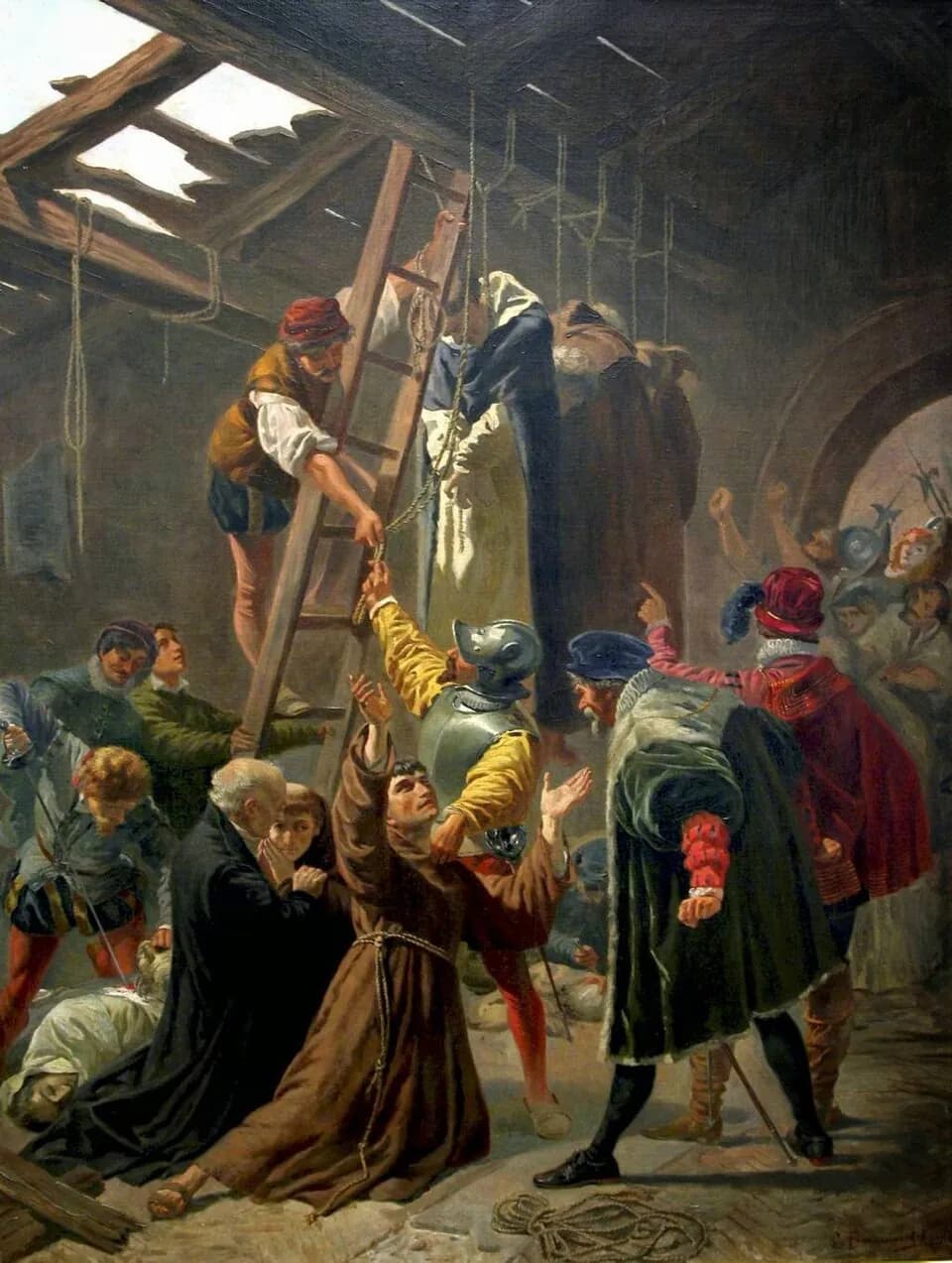
The Martyrs of Gorkum were nineteen priests and religious of the Low Countries, eleven of them Franciscans, who were hanged from the beams of a turf shed outside Brielle in the night of July 9, 1572. 123 Their captors, the Calvinist Sea Beggars, asked each of them to give up two things, belief in the Blessed Sacrament and the authority of the pope, and all nineteen refused. 1 The Church names the group for the first to die, Nicholas Pieck, guardian of the Franciscan house at Gorkum. 12 Pius IX canonized them together, and their feast is July 9. 245
Holland in 1572
The story belongs to the first months of the Dutch revolt against Spain. The shrine at Brielle sets it after the iconoclasm of 1566 and the Duke of Alva's hated Council of Troubles of 1567. 3 On April 1, 1572, the Watergeuzen, the Sea Beggars, took the port of Brielle under their commander Lumey, and the revolt had a foothold in the north. 13
The clergy were the particular target. Monasteries were closed, and in several places priests and religious were killed. 3 Town after town in Holland opened its gates to the Beggars that June, and Dordrecht fell on June 25. 12
Gorkum, a day's journey inland, came next. Katolsk.no, the website of the Catholic Church in Norway, says the town had twenty soldiers. 2 On Thursday, June 26, the magistrates surrendered, and the clergy who had taken refuge in the citadel held out with its garrison until the Beggars' captain, Marijn Brant, swore that everyone inside would go free. 2 The promise was not kept for the priests. 2
Who the nineteen were
Eleven were Franciscans of the friary at Gorkum, nine priests and two lay brothers. 12 Nicholas Pieck, their guardian, was born in the town in 1534 and had led the house since about 1568. 2 His vicar was Jerome of Weert. 1 The oldest of the friars, Willehad of Denmark, had been born in 1482 and had fled the Reformation in one country after another before he reached Gorkum; he was ninety. 2 The youngest, Francis de Roye of Brussels, was twenty-three. 2
With them were taken the town's secular clergy. Leonard van Veghel, whom the 1909 Catholic Encyclopedia calls "the learned parish priest of Gorkum," had studied at Louvain and had been pastor since 1566. 12 Nicholas Poppel was his assistant. 1 Godfrey van Duynen was an old priest living in retirement in his native town, and katolsk.no says his mind was failing. 12 John of Oisterwijk, an Augustinian canon, was chaplain to a convent of nuns there. 12
Four more joined them. John of Cologne, a Dominican and pastor of the nearby village of Hoornaar, kept coming into Gorkum to baptize and anoint the dying once its own priests were locked up, until he was arrested too. 12 Two Norbertines, Adrian of Hilvarenbeek and James Lacops, were seized at their parish of Monster, and Andrew Wouters, the pastor of Heinenoord, was taken in another raid. 12
The sources do not pretend that all nineteen had been model priests. The encyclopedia says Lacops had led "a frivolous life, being disobedient to his order, and neglectful of his religious duties," before he reformed. 1 Katolsk.no is more specific: he had left the Norbertines, preached as a Calvinist and written a pamphlet against the veneration of the saints, then come back within months and burned it with his own hands. 2 Of Wouters the encyclopedia says his conduct "was not edifying up to the time of his arrest, but who made ample amends by his martyrdom." 1 Katolsk.no says he had been living with a woman. 2
Ten days in the citadel
The first fifteen were held in the citadel at Gorkum from June 26 until early July. 12 According to katolsk.no the soldiers were after two things, the hiding place of the church silver and a denial of the faith, and the ordeal went on for nine nights. 2 Pieck was singled out on the second day and tortured until he lost consciousness. When he could speak again he told the others that dying on the gallows did not seem as hard as he had thought. 2
Some of them could have walked out. Pieck's two brothers worked without rest for his release and urged him to renounce the pope. 2 He answered that he would not leave the prison unless every one of his brethren left with him, down to the least of them. 2
Down the river to Brielle
Around midnight on July 5 the prisoners were stripped of their outer clothes and put into the hold of a barge. 23 At Dordrecht, the encyclopedia says, they were "exhibited for money to the curious." 1 They reached Brielle early on July 7, where Lumey was waiting for them. 23 The encyclopedia prints July 13 for the arrival, which cannot stand beside its own date for their death. 1
With the four priests brought from elsewhere, there were now twenty-three. 23 Lumey had them questioned, and the terms were simple: "It was exacted of each that he abandon his belief in the Blessed Sacrament and in papal supremacy." 1 Katolsk.no records that the preacher set to argue with them was himself a former priest, and that Pieck asked him from whom he had received the Gospels, and who had taught him that one was written by Matthew and another by John. 2 Two of the twenty-three gave way under questioning. 23
Meanwhile the magistrates of Gorkum had protested that the arrests broke the terms of surrender, and a letter came from William of Orange which, in the encyclopedia's words, "enjoined all those in authority to leave priests and religious unmolested." 12 Lumey ignored it. 12
The turf shed at Rugge
After midnight on July 8 the prisoners were led to Rugge, just outside Brielle, to a monastery the Beggars had closed and plundered in April. 23 There they were hanged from the beams of its turf shed, "amid cruel mutilations," the encyclopedia says. 13
Pieck went first and Jerome of Weert second. 2 Two more of the company failed at the foot of the ladder, one of them a Franciscan novice of sixteen named Hendrik. 23 The executioners were moved to spare old Godfrey van Duynen as well, and he climbed on, asking them to hurry and let him join his brothers. 2 Fifteen hung from the large beam and three from the small one, and when there was no room left James Lacops was hanged from the ladder. 2
The bodies were thrown into two trenches dug under the beams. 2 Much of the detail survives because of the men who did not die. Katolsk.no says a canon of Gorkum, Pontus de Huyter, and the novice Hendrik both repented and gave their testimony, and that Pieck's nephew Rutger van Est collected every account he could find. Rutger's brother, the Douai theologian Willem Estius, published the standard history in 1603. 23
Relics, canonization and the shrine
Katolsk.no reports that two Franciscans exhumed the remains in 1616, during the Twelve Years' Truce, and that they were carried in secret to Brussels and enshrined in the church of the Recollect Franciscans in 1618. 2 The beatification followed in November 1675 under Clement X. The encyclopedia and the shrine date it to November 14; katolsk.no gives that date to the brief and November 24 to the ceremony. 124
Pius IX canonized the nineteen on June 29, 1867, as both katolsk.no and the shrine have it; the encyclopedia prints 1865. 124
In the nineteenth century Catholics bought the ground at Brielle and built a wooden chapel and a courtyard, the martyrs' field. 3 The pilgrimage church holds a reliquary made in 1923, decorated on one side with the symbols of the Eucharist and on the other with those of the papacy, and a candle burns before it for each of the nineteen. 36
What are the Martyrs of Gorkum the patron saints of?
No source consulted names a general patronage for the Martyrs of Gorkum. 123 Katolsk.no records two particular ones: they were proclaimed patrons of the Dutch province of the Franciscans when it was restored in 1853, and they are patrons of a mission society at Weert. 2 It also says that many cures, of hernia especially, were attributed to their intercession. 2
The Martyrs of Gorkum's feast day
The feast of the Martyrs of Gorkum is July 9, the anniversary of their death. 25 The shrine at Brielle holds its national pilgrimage each year on the Saturday just before or after that date, and the Roman Martyrology enters them on it at Brielle on the Meuse as Nicholas Pieck, priest, and his companions. 25
Praying with the Martyrs of Gorkum
What was asked of them was narrow. They were to say that the bread on the altar was bread and that the bishop of Rome had no claim on them, and they would have gone home. 12 The reliquary at Brielle carries exactly those two things on its sides, the Eucharist and the papacy. 6
They were not a chosen band. A friar of ninety and another of twenty-three, a scholar from Louvain and an old man whose mind was going, a priest who had already left the Church once and returned, and another whose life the encyclopedia declines to call edifying. 12 The shrine observes that they encouraged and comforted one another when the violence came. 4
And four of the twenty-three did not hold. 23 A boy of sixteen stood under the beam where his guardian was hanging and could not do it, and katolsk.no says he spent the rest of his life in penance and died in the Church. 2 What is known of the others' last night is known partly from him. 2
The shrine's own page says that martyrdom in the Church does not seek itself, and that these nineteen bear witness to a Lord who overcomes evil and death through love and forgiveness. 4 One of the last things reported of Godfrey van Duynen, on the ladder, is a prayer that God would forgive him if he had ever wronged anyone. 2
Saint Nicholas Pieck and the Martyrs of Gorkum, pray for us.
Sources
- 1.Petrus Henricus Albers, "The Martyrs of Gorkum," The Catholic Encyclopedia, Vol. 6 (New York: Robert Appleton Company, 1909).
- 2.Per Einar Odden, "De nitten hellige Gorkum-martyrene (d. 1572)," Den katolske kirke (the Catholic Church in Norway), created October 12, 2001 (in Norwegian).
- 3."De geschiedenis," Heiligdom van de heilige Martelaren van Gorcum, Bisschoppelijke Brielse Commissie, Diocese of Rotterdam (in Dutch).
- 4."19 martelaren van Gorcum," Heiligdom van de heilige Martelaren van Gorcum, Bisschoppelijke Brielse Commissie, Diocese of Rotterdam (in Dutch).
- 5."Plan uw bedevaart," Heiligdom van de heilige Martelaren van Gorcum, Bisschoppelijke Brielse Commissie, Diocese of Rotterdam (in Dutch).
- 6."De reliekschrijn in Brielle," Heiligdom van de heilige Martelaren van Gorcum, Bisschoppelijke Brielse Commissie, Diocese of Rotterdam (in Dutch).
Saints to turn to next
Others in this collection who are turned to for some of the same things.