Saint Nicholas
Fourth century
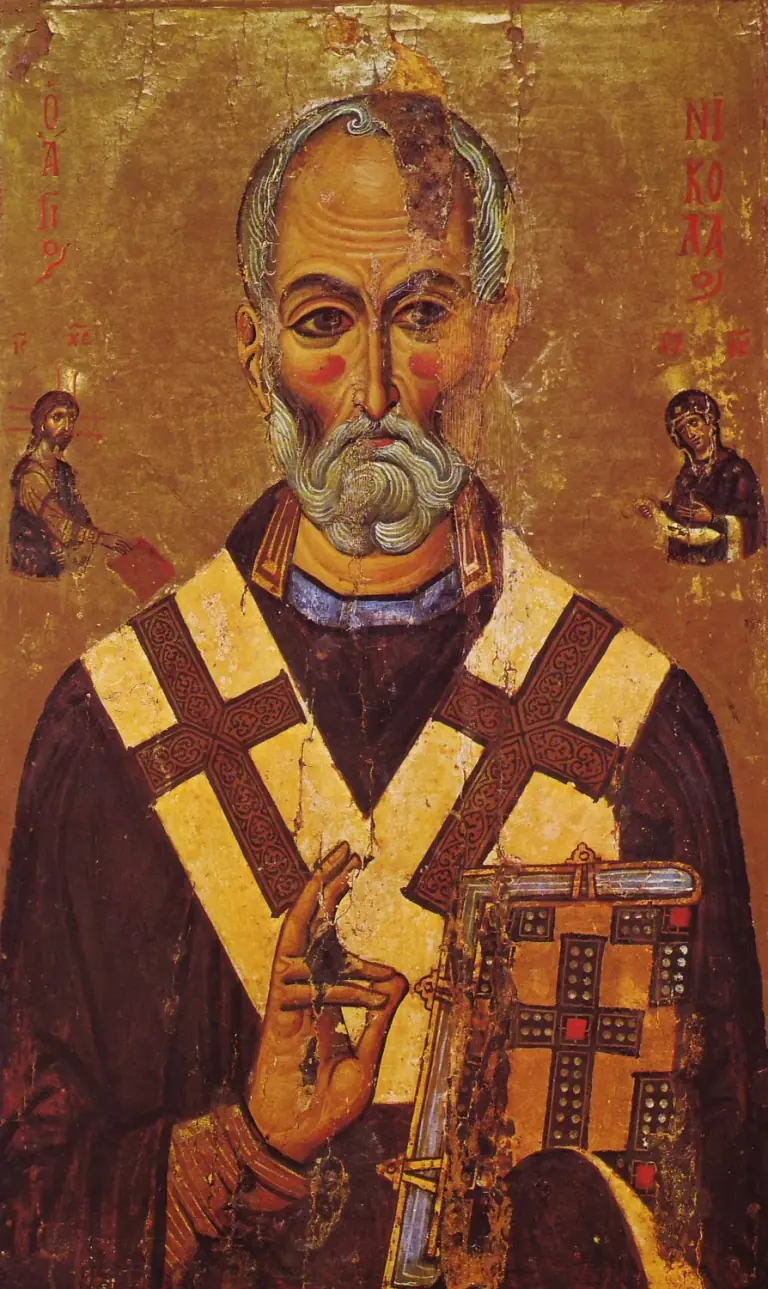
- Office
- Bishop of Myra in Lycia, in the fourth century 1
- Relics
- Taken from Myra to Bari by Italian merchants in 1087 1
- Also known as
- Santa Claus, by way of the Dutch Sinterklaas 2
Saint Nicholas is the most famous saint in the world and one of the least documented. He was Bishop of Myra in the fourth century, and after that the record thins out almost immediately. What survived instead of a biography was a reputation for giving things away in secret - which, over sixteen hundred years and a mangling of his Dutch name, turned into Santa Claus.
What is actually known
Nicholas was Bishop of Myra in Lycia, in what is now Turkey, during the fourth century. 1 The 1913 Catholic Encyclopedia is unusually direct about the rest: despite his enormous popularity, "there is scarcely anything historically certain about him except that he was Bishop of Myra in the fourth century." 1
That is worth sitting with rather than hurrying past. The best-loved saint in Christendom is known almost entirely by the devotion he generated rather than by anything recorded about him.
What is reported
He is said to have been imprisoned during the persecution under Diocletian and released after the accession of Constantine. 1 He is also said to have attended the Council of Nicaea, though the encyclopedia notes there is reason to doubt it, since his name appears in none of the old lists of bishops who were there. 1
The story everybody actually knows - the three daughters with no dowries, and the bags of gold left in secret - does not appear in that article at all, and so it is not told here as fact. It is the origin of the gift-giving, and it is a tradition rather than a record.
Bari
In 1087, Italian merchants took his body from Myra and brought it to Bari in Italy 1, where it remains. The blunt verb in the encyclopedia is "stole." The relics of the patron of merchants were removed by merchants, which the sources report without comment.
How Nicholas became Santa Claus
Franciscan Media traces the line plainly: "In the English-speaking countries, Saint Nicholas became, by a twist of the tongue, Santa Claus - further expanding the example of generosity portrayed by this holy bishop." 2 The route runs through the Dutch Sinterklaas and into American English.
It is easy to be sniffy about this. Franciscan Media is not, and neither is this page: the figure who gives to children in secret is a genuine descendant of the bishop, however far the sleigh has traveled from Myra.
What is Saint Nicholas the patron saint of?
Saint Nicholas' feast day
Praying with Saint Nicholas
Almost nothing about Nicholas can be established. The 1913 encyclopedia says as much in about as many words. 1 He is beloved anyway, which is its own small lesson about the difference between being known accurately and being loved.
What survived instead of a biography was a reputation for giving things away quietly. That is a hard practice, because the whole appeal of generosity is usually that somebody notices.
Franciscan Media suggests using him to reconsider our relationship with material goods at Christmas, and to find real ways to help people in genuine hardship. 2 The bishop is a useful corrective to the version of him that sells things.
He is patron of children and of travelers. 12 Parents have been handing their children to him for sixteen centuries, and the shape of it is worth noticing: not a saint who lectures them, but one who leaves something and is gone before he can be thanked.
Saint Nicholas, pray for us.
Sources
Saints to turn to next
Others in this collection who are turned to for some of the same things.
- Saint Alexius of RomeFifth century, by traditionPoverty and simplicityMarriage and family
- Saint CunegundeDied March 3, 1040Marriage and familyPoverty and simplicity
- Saint Elizabeth of Hungary1207 - November 17, 1231Poverty and simplicityMarriage and family
- Saint Gerard MajellaApril 1726 - October 16, 1755Marriage and familyPoverty and simplicity