Saint Nemesianus and Companions
d. 257
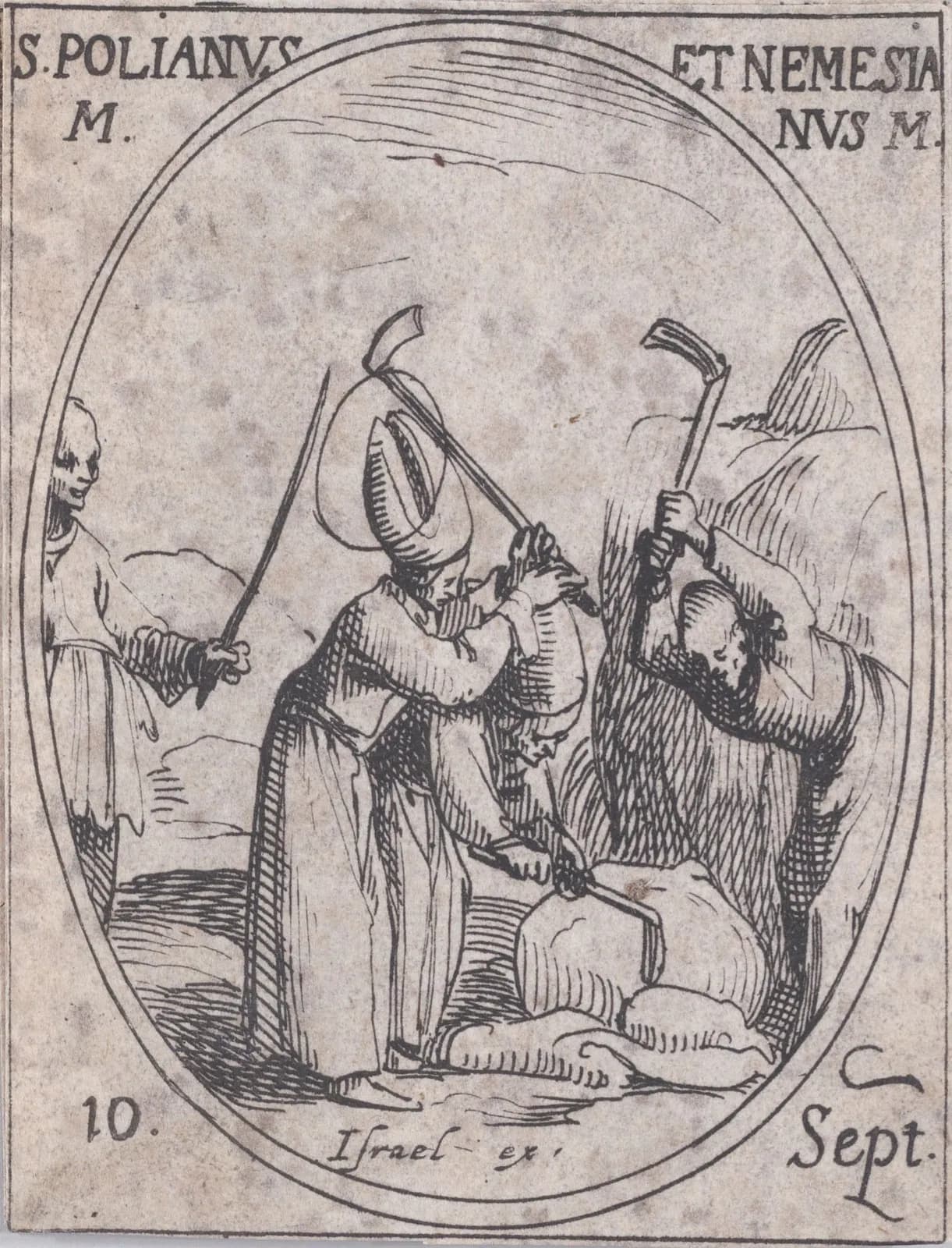
- Companions
- The bishops Felix, Lucius, another Felix, Litteus, Polianus, Victor, Jader and Dativus, with priests, deacons and lay people 18
- Died
- In the mines in 257, according to katolsk.no 7
Saint Nemesianus was bishop of Thubunae, on the edge of the Sahara in Roman North Africa, and in the persecution of Valerian he and eight other bishops were beaten, chained and sent to work in the mines. 168 Saint Cyprian of Carthage wrote to them from his own exile, and three of their replies survive, among them one from Nemesianus. 127
A bishop of Thubunae
Thubunae was a frontier town and a garrison post on the border of two African provinces, so that reference works put it sometimes in Numidia and sometimes in Mauretania. 6 Sophrone Pétridès, in the 1912 Catholic Encyclopedia, places its ruins at Tobna in Algeria, "at the gates of the Sahara," and notes that Saint Augustine and Saint Alypius later stayed there as guests of Count Boniface. 6 He names three known bishops of the town, and Nemesianus is the earliest. 6
He appears once in his own voice before the persecution. At the council Cyprian held at Carthage in 256 on whether heretics coming into the Church should be baptized, each bishop gave his opinion in turn, and "Nemesianus of Thubunae said: That the baptism which heretics and schismatics bestow is not the true one, is everywhere declared in the Holy Scriptures." 5 He went on with a run of texts from Proverbs and the Gospel of John, ending on the Spirit "which from the beginning was borne over the waters." 5 Pétridès notes his presence at the council and adds that Cyprian "often speaks of him in his letters." 6
Sent to the mines
The persecution began the next year. The Martyrology sets it in Africa under the emperors Valerian and Gallienus. 8 katolsk.no says it started in 257 and that some Christians were tortured and killed at once while others were first sent to forced labor in the mines. 7 Nemesianus and eight other bishops were among the second group: Felix, Lucius, a second Felix, Litteus, Polianus, Victor, Jader and Dativus. 18
They did not go alone. Cyprian's letter is addressed to them "also to his fellow presbyters and deacons, and the rest of the brethren in the mines," and he says that "a manifold portion of the people" had confessed with them and shared their sentence, virgins among them, and boys with "a courage greater than their age." 1 katolsk.no describes them as people of both sexes, every age and every station. 7
Cyprian's letter is also our best picture of the conditions. They had been "first severely beaten with clubs." 1 Their feet were in fetters. Their heads were half shaved, they could not wash, bread was scarce, and they shivered for lack of clothing. 1 And the priests among them had "no opportunity there to God's priests for offering and celebrating the divine sacrifices." 1
Cyprian's letter
Cyprian was in exile himself, at Curubis, and katolsk.no says he wrote to them from there. 7 He tells them he would come to embrace them "if the limits of the place appointed me did not restrain me, banished as I am for the sake of the confession of the Name." 1 What he sent instead was a letter.
He takes each hardship and turns it over. The clubs do not frighten a Christian, "seeing all its hope is in the Wood." 1 They have been sent as gold and silver vessels to "the mine that is the home of gold and silver." 1 On the fetters he writes a short litany: "Oh feet blessedly bound, which are loosed, not by the smith but by the Lord!" 1 As for the Mass they can no longer offer, he tells them they offer another sacrifice day and night, the "broken spirit" of the psalm, and their own bodies as "a living sacrifice." 1
He also says plainly that the sentence had already killed some of them. Some of their number, he writes, "have already gone before by the consummation of their martyrdom," while others "still abide in the dungeons of the prison, or in the mines and in chains." 1 He ends by asking for their prayers, since "now your word is more effectual in prayers." 1
The replies from the mines
Three answers came back. The first is from Nemesianus, Dativus, Felix and Victor. 2 They praise Cyprian for having spoken first before the proconsul, "as a good and true teacher," showing his disciples what to say before the governor. 2 His letter, they write, had "healed their limbs wounded with clubs," "smoothed the hair of their half-shorn head," "illuminated the darkness of the dungeon" and "brought down the mountains of the mine to a smooth surface." 2 katolsk.no summarizes it the same way, as thanks for a letter that had made it easier to bear the conditions and the torture. 7
Cyprian had sent money and supplies as well, together with gifts from a Christian named Quirinus, carried by the subdeacon Herennianus and the acolytes Lucian, Maximus and Amantius. 23 The bishops thank him for them, and close: "Let us, then, be in our prayers helpers of one another." 2
The second reply is from Lucius "and all the brethren who are with me," who say the letter reached them as "a relaxation in our bonds, a solace in our affliction, and a support in our necessity," and ask Cyprian to forward a letter they had written to Quirinus. 3 The third, from Felix, Jader and Polianus "together with the presbyters and all who are abiding with us at the mine of Sigua," is a few lines long and is signed in three hands: "I Felix wrote this; I Jader subscribed it; I Polianus read it." 4 The argument printed above the second letter in the Ante-Nicene translation reads the three separate answers as a sign that the bishops were held in different parts of the mines. 2
What became of them
None of the letters says how Nemesianus died. katolsk.no says all nine died in the mines in 257. 7 The Martyrology, more reserved, says that they were beaten, chained and sent to the mines, and that Cyprian with his letters urged them to bear their imprisonment firmly and keep the Lord's commands. 8 Pétridès records that an inscription shows his cult at Tixter in 360. 6
There is one complication. katolsk.no notes that some writers identify this group with Saint Nemesius, a martyr of Alexandria named on the same day in the ancient Hieronymian Martyrology. 7 The current Martyrology keeps both on September 10 as separate entries: Nemesius, burned with thieves at Alexandria under Decius, and Nemesianus and his companions, the bishops of the mines. 8
What is Saint Nemesianus the patron saint of?
Saint Nemesianus's feast day
Praying with Saint Nemesianus
The bishops in the mines were cut off from the thing a bishop exists to do. Cyprian names it without softening it: there was no chance there to offer the divine sacrifice. 1 What he offered them in its place was their own suffering, given to God as a broken spirit and a living sacrifice. 1
Their answers are not heroic speeches. They are thank-you notes, for a letter and for money and supplies, written by men in chains who still wanted to know that the letter they had written to Quirinus would be passed on. 23 One of them ends with three men each naming his part: Felix wrote it, Jader signed it, Polianus read it. 4
Cyprian asked for their prayers, and they asked for his. 12 Nemesianus's letter puts it in a sentence: "Let us, then, be in our prayers helpers of one another." 2
Saint Nemesianus and Companions, pray for us.
Sources
- 1.Cyprian of Carthage, Epistle 76, "To Nemesianus and Other Martyrs in the Mines," trans. Robert Ernest Wallis, Ante-Nicene Fathers, Vol. 5 (Buffalo, NY: Christian Literature Publishing Co., 1886), via New Advent.
- 2.Epistle 77, "The Reply of Nemesianus, Dativus, Felix, and Victor, to Cyprian," trans. Robert Ernest Wallis, Ante-Nicene Fathers, Vol. 5 (Buffalo, NY: Christian Literature Publishing Co., 1886), via New Advent.
- 3.Epistle 78, "The Reply to the Same of Lucius and the Rest of the Martyrs," trans. Robert Ernest Wallis, Ante-Nicene Fathers, Vol. 5 (Buffalo, NY: Christian Literature Publishing Co., 1886), via New Advent.
- 4.Epistle 79, "The Answer of Felix, Jader, Polianus, and the Rest of the Martyrs, to Cyprian," trans. Robert Ernest Wallis, Ante-Nicene Fathers, Vol. 5 (Buffalo, NY: Christian Literature Publishing Co., 1886), via New Advent.
- 5.The Seventh Council of Carthage under Cyprian (256), trans. Robert Ernest Wallis, Ante-Nicene Fathers, Vol. 5 (Buffalo, NY: Christian Literature Publishing Co., 1886), via New Advent.
- 6.Sophrone Pétridès, "Tubunae," The Catholic Encyclopedia, Vol. 15 (New York: Robert Appleton Company, 1912).
- 7."Ni biskoper av Numidia og ledsagere (d. 257)," Den katolske kirke (katolsk.no), Catholic Diocese of Oslo (in Norwegian).
- 8.Roman Martyrology, entry for September 10, "San Nemesiano e compagni," as printed in "Santo del giorno," Conferenza Episcopale Italiana (in Italian).
Saints to turn to next
Others in this collection who are turned to for some of the same things.
- Saint Bernardo TolomeiMay 10, 1272 - August 20, 1348PrayerCourageSuffering and illness
- Saints Carpus, Papylus and Agathonicad. c. 170 or 250CourageSuffering and illnessPrayer
- Saint Claude de la Colombiere1641 - February 15, 1682PrayerSuffering and illnessCourage
- Saint Dominic SavioApril 2, 1842 - March 9, 1857PrayerSuffering and illnessCourage