Saint Narcissus of Jerusalem
c. 100 - c. 215
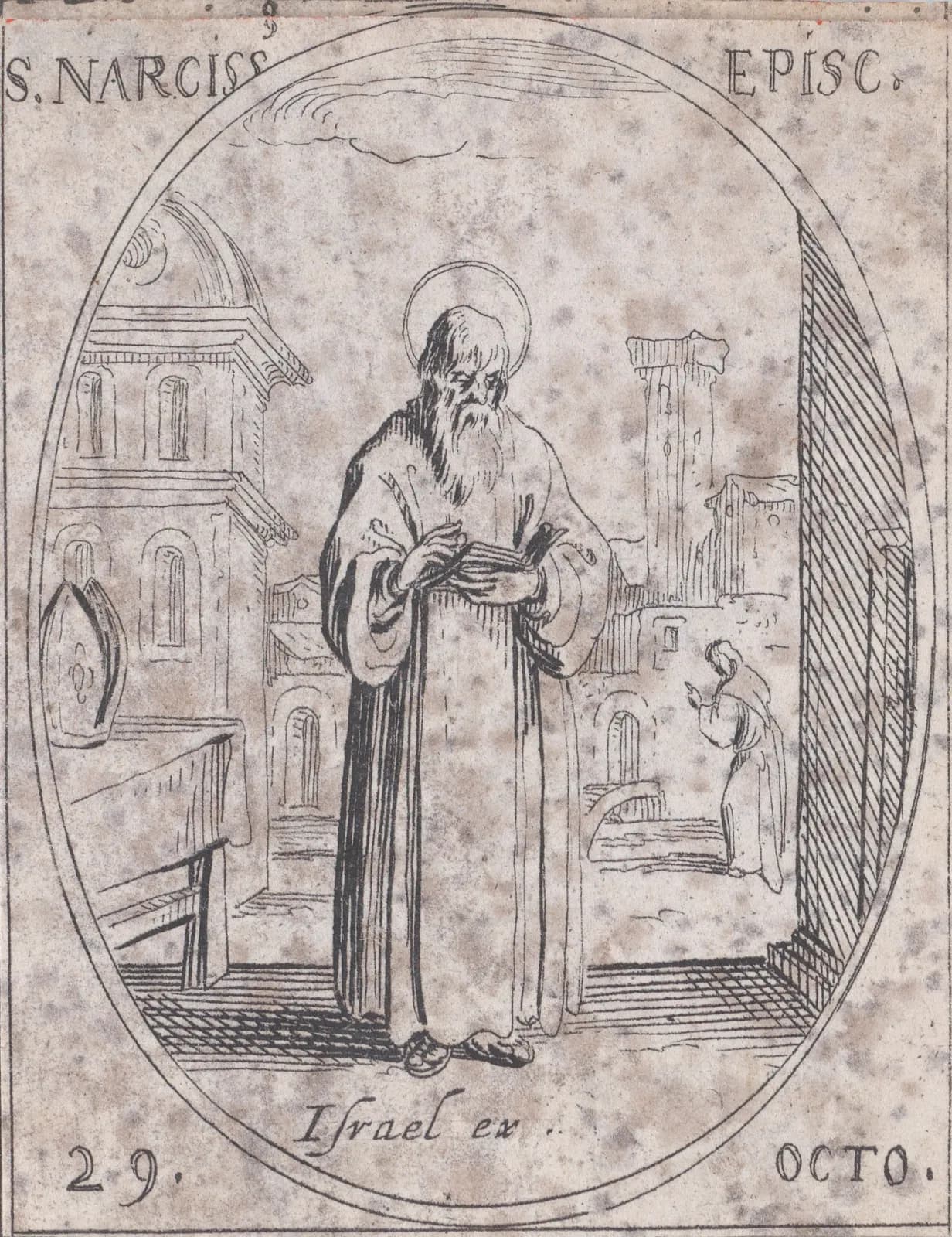
- Bishop of Jerusalem
- The thirtieth from the apostles 1; about 180 (Catholic Culture) 6 or about 190 (katolsk.no) 4
- Died
- About 215 (katolsk.no) 4; about 220-222 (Rabenstein) 6; at the age of 116, says the Martyrology 5
- Emblems
- A water jug (katolsk.no) 4; a blossoming thistle, a pitcher, an angel carrying his soul (Rabenstein) 6
- Patronage
- Against insect bites, according to Catholic Culture 6
Saint Narcissus was bishop of Jerusalem at the turn of the third century, and by every account an old man before he began. 147 Eusebius, writing a century later from what the church of Jerusalem remembered, tells of the oil he made from water at an Easter vigil, of three men who swore false oaths against him, and of the years he spent hidden in the desert before coming back "as if raised from the dead." 2 A letter of his coadjutor Saint Alexander gives his age as one hundred and sixteen. 2
An old man made bishop
Eusebius counts Narcissus "the thirtieth in regular succession from the apostles" in the church of Jerusalem, and the fifteenth since the siege under Hadrian, after which the church there was made up of Gentiles. 1 He adds that Narcissus "is celebrated by many to this day." 1 The Norwegian bishops' saints database (katolsk.no) says he was born about the year 100 and was a Greek; Alban Butler places his birth "towards the close of the first century." 47
He was made bishop late in life. Butler says he was "almost fourscore years old," and Katherine Rabenstein, on Catholic Culture's page for his feast, says he was at least eighty. 67 The two modern dates for his election differ: about 180 according to Catholic Culture, about 190 according to katolsk.no. 46 Rabenstein says that his age did not make him a weak bishop, and that he censured slackness among both laity and clergy. 6
Easter on a Sunday
In Narcissus's time the churches argued over the date of Easter. Eusebius explains that the churches of Asia ended the paschal fast on the fourteenth day of the moon, whatever day of the week it fell on, while the rest of the world kept it on the day of the Resurrection. 1 Synods met in many places, and all agreed "that the mystery of the resurrection of the Lord should be celebrated on no other but the Lord's day." 1 One of those synods met in Palestine under Theophilus, bishop of Caesarea, and Narcissus, bishop of Jerusalem. 1
Eusebius quotes the end of their letter, which asks that copies be sent to every church and adds that the church of Alexandria kept the feast on the same day as they did: "For letters are carried from us to them and from them to us, so that in the same manner and at the same time we keep the sacred day." 1 The current Roman Martyrology remembers him for exactly this: in full agreement with Pope Saint Victor, he held that the mystery of the Lord's Resurrection could be celebrated only on a Sunday. 5
Water into oil
Eusebius introduces the miracles carefully. "The citizens of that parish mention many other miracles of Narcissus," he writes, "on the tradition of the brethren who succeeded him." 2 The one he tells in full happened at the great paschal vigil, when the deacons ran out of oil for the lamps. 2 Narcissus had the men who tended the lights draw water and bring it to him, prayed over it, and told them to pour it into the lamps; "contrary to all expectation," Eusebius says, it turned to oil. 2 He adds that "a small portion of it has been preserved even to our day by many of the brethren there as a memento of the wonder." 2 katolsk.no says Narcissus is shown in art with a water jug for this reason. 4
Slander and the desert
The second story is darker. Certain men, Eusebius says, "being unable to endure the strength and firmness of his life, and fearing punishment for the many evil deeds of which they were conscious," spread a terrible accusation against him and swore to it. 2 One called down death by fire on himself if he lied, another a foul disease, the third blindness. 2 Eusebius does not say what the charge was, as Butler points out, and he says the faithful did not believe it, "because the continence and virtuous life of Narcissus were well known to all." 27
Narcissus left anyway. Eusebius says that "he could not in any wise endure the wickedness of these men," and since he had long followed a life of philosophy, "he fled from the whole body of the Church, and hid himself in desert and secret places, and remained there many years." 2 katolsk.no and Butler both read it as the chance to live the solitary life he had always wanted. 47
The accusers met the ends they had sworn to. The first man's house caught fire from a single spark at night and he died with his whole family; the second was covered with disease from head to foot. 2 The third, seeing this, confessed publicly what they had plotted, and wept so long in his repentance that he lost his sight. 2
Meanwhile the church needed a bishop. With no one knowing where Narcissus was, the bishops of the neighboring churches ordained Dius, who served briefly, then Germanio, then Gordius. 2 Butler gives the first name as Pius, and Rabenstein gives both. 67 In Gordius's time, Eusebius writes, "Narcissus appeared again, as if raised from the dead," and the brethren begged him to take up the office again, admiring him all the more "on account of his retirement and philosophy." 2 katolsk.no says he agreed to it against his will. 4
Alexander, and a hundred and sixteen years
In time Narcissus was too old to carry the office alone. 2 Eusebius says that Alexander, then a bishop in Cappadocia, was called by a vision in the night and made the journey to Jerusalem in fulfillment of a vow and to learn about the places there, and that the faithful there, warned by a revelation of their own to go outside the gates and meet the bishop God had chosen for them, would not let him leave. 2 Jerome tells it a little differently: it was revealed "to Narcissus and many of his clergy" that a bishop would enter the city the next morning, and Alexander took up the government of the church with all the bishops of Palestine gathered and "Narcissus himself being especially urgent." 3
katolsk.no notes that this is the first known case of a bishop moved from one see to another, and the first example of a coadjutor bishop. 4 Alexander himself recorded the arrangement in a letter to the Antinoites that Eusebius still had: "Narcissus salutes you, who held the episcopate here before me, and is now associated with me in prayers, being one hundred and sixteen years of age; and he exhorts you, as I do, to be of one mind." 2 Jerome gives the same greeting with the age as "about" a hundred and sixteen. 3 Butler calls the recipients the Arsinoites in Egypt. 7 katolsk.no and Rabenstein date the letter to 212. 46
His death
No source describes how he died. katolsk.no says there are no details, and dates the death about 215; Catholic Culture's heading gives 215 as well, while Rabenstein, on the same page, says it is believed to have come about 220-222. 46 The Martyrology says he went to the Lord at the venerable age of a hundred and sixteen. 5 Catholic Culture's summary says he died "bishop to the last." 6
What is Saint Narcissus the patron saint of?
Saint Narcissus's feast day
Saint Narcissus's feast day is October 29. 45 The current Roman Martyrology commemorates him on that day as bishop of Jerusalem, exemplary for his holiness, patience and faith. 5 The date is not new: Butler's older text already says that "the Roman Martyrology honours his memory on the 29th of October." 7
Praying with Saint Narcissus
The Martyrology singles out three things in him: holiness, patience and faith. 5 Patience is the one his story tests hardest. He was accused of something nobody believed and still could not stay, and he went away for years rather than go on living beside the men who had said it. 2
Eusebius does not present the flight as a failure. He gives it the same word he uses for the life Narcissus had always lived, philosophy, and says the people loved him more for it. 2 It is a story about a man who withdrew when he could bear no more, and was wanted back.
He came back old, and grew older, and let a younger man share the work. 23 The last words recorded from him are a greeting at the end of someone else's letter, asking a distant church to be of one mind. 2
Saint Narcissus of Jerusalem, pray for us.
Sources
- 1.Eusebius of Caesarea, Church History, Book V, chapters 12, 22, 23 and 25, trans. Arthur Cushman McGiffert, Nicene and Post-Nicene Fathers, Second Series, Vol. 1 (Buffalo, NY: Christian Literature Publishing Co., 1890), via New Advent.
- 2.Eusebius of Caesarea, Church History, Book VI, chapters 8-11, trans. Arthur Cushman McGiffert, Nicene and Post-Nicene Fathers, Second Series, Vol. 1 (Buffalo, NY: Christian Literature Publishing Co., 1890), via New Advent.
- 3.Jerome, Lives of Illustrious Men, ch. 62, trans. Ernest Cushing Richardson, Nicene and Post-Nicene Fathers, Second Series, Vol. 3 (Buffalo, NY: Christian Literature Publishing Co., 1892), via New Advent.
- 4."Den hellige Narcissus av Jerusalem (~100-~215)," Den katolske kirke (katolsk.no), Catholic Diocese of Oslo (in Norwegian).
- 5.Roman Martyrology, entry for October 29, "San Narciso, vescovo," as printed in "Santo del giorno," Conferenza Episcopale Italiana (in Italian).
- 6."October 29," Liturgical Year calendar, Catholic Culture (Trinity Communications), with an excerpt from Katherine Rabenstein, Saints of the Day.
- 7.Alban Butler, "St Narcissus, Bishop of Jerusalem," The Lives of the Fathers, Martyrs and Other Principal Saints, Vol. III, as published by EWTN.
Saints to turn to next
Others in this collection who are turned to for some of the same things.
- Saint Bernardo TolomeiMay 10, 1272 - August 20, 1348PrayerCourageSuffering and illness
- Saints Carpus, Papylus and Agathonicad. c. 170 or 250CourageSuffering and illnessPrayer
- Saint Claude de la Colombiere1641 - February 15, 1682PrayerSuffering and illnessCourage
- Saint Dominic SavioApril 2, 1842 - March 9, 1857PrayerSuffering and illnessCourage