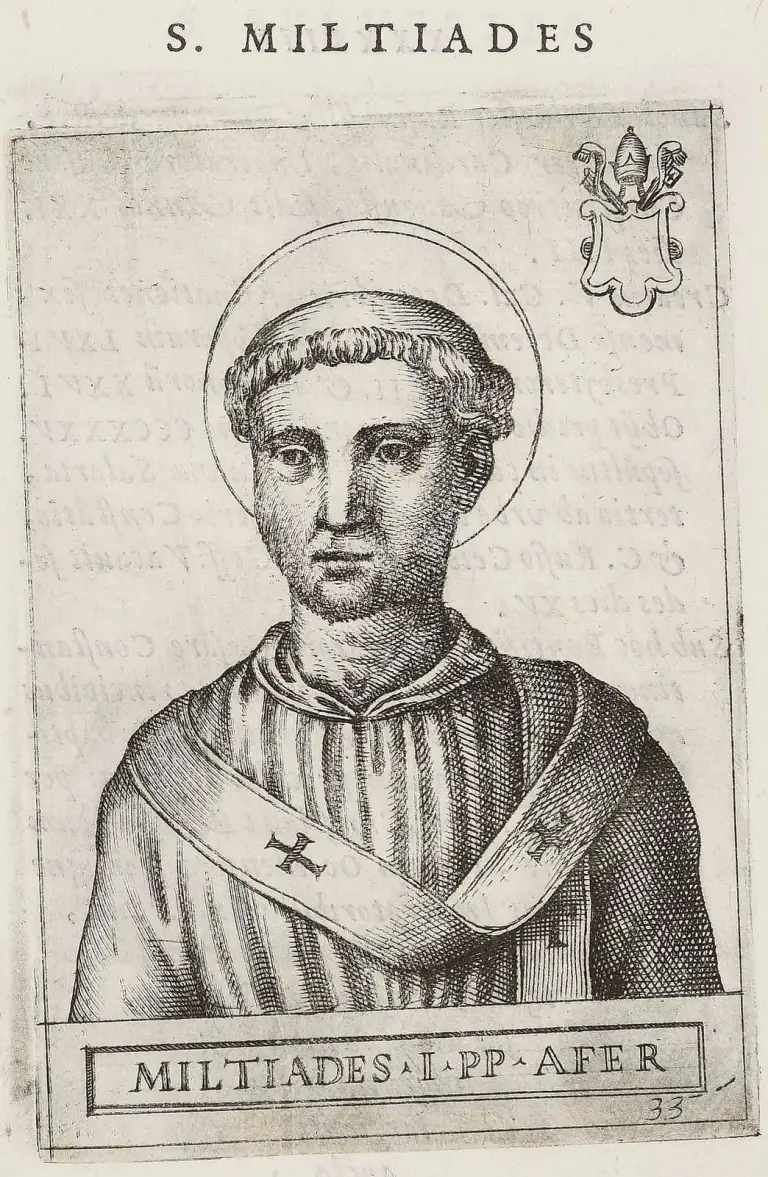
Saint Miltiades
Died January 10 or 11, 314
- Born
- Date unknown; an African, says the Liber Pontificalis 7; more probably a Roman, says katolsk.no 3
- Pope
- From July 2, 311 (or 310) to January 314 1
Saint Miltiades, also written Melchiades, was bishop of Rome from 311 to 314, the years in which the last great persecution ended and Constantine took the city. 1 In October 313, at the emperor's request, he presided over a synod in the Lateran that heard the first case of the Donatist schism and cleared Caecilian, bishop of Carthage. 14 Saint Augustine called him "son of Christian peace, father of the Christian people." 6 His feast is January 10. 2
Elected as the persecution ended
Nothing is known of his birth. 1 The Liber Pontificalis calls him "by nationality an African." 7 The Norwegian bishops' saints database (katolsk.no) thinks it more likely that he was a Roman, and says he had been a priest under Pope Marcellinus. 3
His predecessor Eusebius had been banished, and the Roman see stood empty for some time, Johann Peter Kirsch suggests in the Catholic Encyclopedia because the quarrel over Christians who had lapsed in the persecution was still unsettled. 1 Miltiades was raised to the papacy on July 2, 311 or 310. The old catalog of the popes gives 311 but then counts a reign too long to fit, and Kirsch thinks a copyist slipped and that 311 is "most probably" right. 1 katolsk.no puts the vacancy at one, two or three years, depending on when Eusebius died. 3
Around the time of his election an edict of toleration, issued in the names of Galerius, Licinius and Constantine, stopped the persecution, and Christians were allowed to rebuild their places of worship. 1 Only in the East under Maximinus Daia did it go on. 1
The churches given back
Property seized from the Church was now to be returned, and in Rome the pope was given the right to receive it back through the prefect of the city. 1 Kirsch, citing Augustine, says Miltiades sent two deacons, Strato and Cassianus, to deal with the prefect and take the buildings over. 1 katolsk.no gives the order to the emperor Maxentius, who still held Rome, and says it covered land and buildings confiscated when Diocletian's persecution began in 303. As a result the Roman Church could keep Easter on April 13, 312, in safety and in its own holy places for the first time since the persecution began. 3
Miltiades also brought the body of his predecessor home. Eusebius had been banished to Sicily, and the new pope had his remains brought back and buried in a crypt in the Catacomb of Callistus. 1 Louise Ropes Loomis, in her notes to the Liber Pontificalis, says the tomb is in a chamber of its own, at some distance from the large chamber of the third-century popes. 7
Constantine and the Lateran
The next year Constantine defeated Maxentius at the Milvian Bridge and entered Rome. Kirsch dates the battle to October 27, 312; katolsk.no to October 28. 13 Miltiades was the first pope to see the Church not only tolerated by Roman authority but actively favored by it. 3
At some point the emperor gave the Roman Church the Lateran Palace, which became the pope's residence and the seat of the Church's administration, and the basilica beside it became the principal church of Rome. 1 katolsk.no identifies the palace as that of the empress Fausta on the Caelian Hill, which had belonged to the family of the Laterani until Nero confiscated it. 3
The case of Caecilian
In 312 the Church of Carthage split over who should succeed its bishop Mensurius. katolsk.no tells the story briefly: most chose Caecilian, a minority chose Majorinus, and Caecilian's opponents held that his consecration was void because one of the bishops who consecrated him, Felix of Aptunga, had handed over the sacred books in the persecution. 3 By the summer of 313 Donatus had succeeded Majorinus, and the movement took his name. 3
The dissidents petitioned Constantine. Optatus of Milevis, writing against them half a century later, copied out their request for "judges from Gaul," on the ground that Gaul had been spared the persecution. 4 Constantine answered by writing to Miltiades. Eusebius of Caesarea preserved the letter in his Church History: Caecilian was to sail to Rome with ten of his accusers and ten of his own choosing, and be heard "in the presence of yourselves and of Retecius and Maternus and Marinus, your colleagues," three bishops of Gaul whom the emperor was sending. 5 "I have such reverence for the legitimate Catholic Church," the emperor wrote, "that I do not wish you to leave schism or division in any place." 5 katolsk.no calls it the first letter of its kind a pope ever received. 3
The synod in the house of Fausta
Miltiades did not keep it to the commission the emperor had named. katolsk.no says he turned it into a proper church synod by calling in Italian bishops of his own. 3 Optatus gives the result: the three bishops from Gaul and fifteen Italians met "in the House of Fausta on the Lateran, on the second of October which was a Friday," in 313. 4 Kirsch says they considered the case for three days. 1
Donatus was condemned on his own admission that he had rebaptized and had laid hands in penance on bishops who had lapsed. 4 His witnesses, Optatus writes, "admitted that they had nothing of which they could accuse Caecilian." 4 The pope closed the matter with a short sentence, which Optatus preserves: since the accusers had failed to make their case and Donatus had not proved Caecilian guilty of anything, "I judge that, according to his deserts, he be maintained in the communion of the Church, continuing to hold his position unimpaired." 4
What Augustine admired, more than eighty years later, was what Miltiades did next. He "did not presume to depose from his own rank those peers against whom nothing had been proved"; he laid the blame chiefly on Donatus and offered everyone else restoration, ready to send letters of communion even to bishops ordained by Majorinus. Where a town had two bishops, the one ordained first would keep the see and a new congregation would be found for the other. 6 "O excellent man!" Augustine wrote. "O son of Christian peace, father of the Christian people!" 6 katolsk.no adds that the synod did not take up the charge against Felix of Aptunga at all, since in the Roman view a sacrament did not depend on the worthiness of the minister. 3
An appeal he did not live to see
The decision did not end the schism. Donatus appealed to the emperor, and Optatus records Constantine's exasperation: "Oh, mad daring of their fury! A Bishop has thought fit to appeal to us, as is done in the lawsuits of the Pagans." 4 Augustine says the case was examined again at Arles and then by Constantine himself, and that Caecilian was cleared each time. 6
The council of Arles met on August 1, 314. 3 By then Miltiades was dead. katolsk.no notes that the Donatists, disappointed in him, later spread scandalous stories about his conduct in the persecution, though no such charge seems to have been made while he lived. 3
What the Liber Pontificalis credits to him
The Liber Pontificalis, the old collection of papal lives, says he forbade the faithful to fast on Sunday or Thursday "because the pagans celebrated those days as a sacred fast," that he discovered Manicheans in Rome, and that he had portions of the bread consecrated at the bishop's Mass sent out to the churches of the city, "these are called the leaven." 7
Kirsch is cautious about all of it. Manicheans in Rome at that date were "quite possible." 1 The fasting decree he thinks most likely the author's own: a Roman custom of the writer's day, traced back to Miltiades. 1 The custom of sending the consecrated bread to the city's churches did exist, but "there is nothing definite to show that it was introduced by Miltiades." 1
Death and burial
Miltiades died on January 10 or 11, 314; the two oldest lists of the Roman bishops differ by a day. 1 katolsk.no gives January 11. 3 He was buried in the Catacomb of Callistus on the Via Appia and venerated as a saint. 12 Kirsch reports that the archaeologist De Rossi thought it highly probable he had found the burial chamber; katolsk.no says the grave has still not been found, and that he was the last pope to be buried in a catacomb. 13 Some places count him a martyr because of what he suffered in the persecution, though he did not die for the faith. 3
What is Saint Miltiades the patron saint of?
Saint Miltiades's feast day
Saint Miltiades's feast day is January 10. The Roman Martyrology, in the text published by the Italian bishops, enters him on that day: at Rome, in the cemetery of Callistus on the Via Appia, Saint Miltiades, pope, a native of Africa, who saw the peace given back to the Church by Constantine and, though strongly opposed by the Donatists, worked wisely for reconciliation. 2 Vatican News lists him on January 10 as well. 8
The date is old. Kirsch says the Martyrologium Hieronymianum already kept his feast on January 10 in the fourth century. 1 But the Roman Martyrology of Kirsch's own day had him on December 10, the date the Liber Pontificalis gives for his burial, and katolsk.no still gives December 10 as his memorial. 137
Praying with Saint Miltiades
Miltiades held the see for less than three years, and almost everything that is known of him comes from one week in October. 14 He left no letters. What survives is a single sentence of judgment, and a description of what he did with it. 46
The sentence is plain. The accusers had not proved their case, so the accused would keep his place. 4 What followed was harder. A schism had split the churches of Africa, there were towns with two bishops each, and Miltiades could have deposed everyone on the losing side. He condemned the one man he found responsible and left the door open to the rest. 6 Augustine, who spent years arguing with the Donatists, still found that act worth praising: clemency had not wronged justice, he wrote, "nor has justice been at variance with clemency." 6
It did not work. The dissidents appealed, the schism lasted for generations, and the pope who had tried to make peace was later slandered by the people he had offered peace to. 36 The Martyrology remembers him for the attempt anyway, as a pope who worked wisely for reconciliation. 2
Saint Miltiades, pray for us.
Sources
- 1.Johann Peter Kirsch, "Pope St. Miltiades," The Catholic Encyclopedia, vol. 10 (New York: Robert Appleton Company, 1911).
- 2.Roman Martyrology, entry for January 10, "San Milziade, papa," as printed in "Santo del giorno," Conferenza Episcopale Italiana (in Italian).
- 3."Den hellige pave Miltiades ( - 314)," Den katolske kirke (katolsk.no), Catholic Diocese of Oslo (in Norwegian).
- 4.Optatus of Milevis, Against the Donatists, Book I, chapters 22 to 25, trans. O. R. Vassall-Phillips (London: Longmans, Green, 1917), transcribed by Roger Pearse.
- 5.Eusebius of Caesarea, Church History, Book X, chapter 5, trans. Arthur Cushman McGiffert, Nicene and Post-Nicene Fathers, Second Series, vol. 1 (Buffalo: Christian Literature Publishing Co., 1890), as hosted by New Advent.
- 6.Saint Augustine, Letter 43, trans. J.G. Cunningham, Nicene and Post-Nicene Fathers, First Series, vol. 1 (Buffalo: Christian Literature Publishing Co., 1886), as hosted by New Advent.
- 7.The Book of the Popes (Liber Pontificalis), I: To the Pontificate of Gregory I, trans. Louise Ropes Loomis (New York: Columbia University Press, 1916), XXXII, "Eusebius," and XXXIII, "Miltiades," with the translator's notes, Internet Archive.
- 8."Santo del día, 10 enero: s. Milciades, papa," Vatican News (in Spanish).
Saints to turn to next
Others in this collection who are turned to for some of the same things.