Saint Micah
Eighth century BC
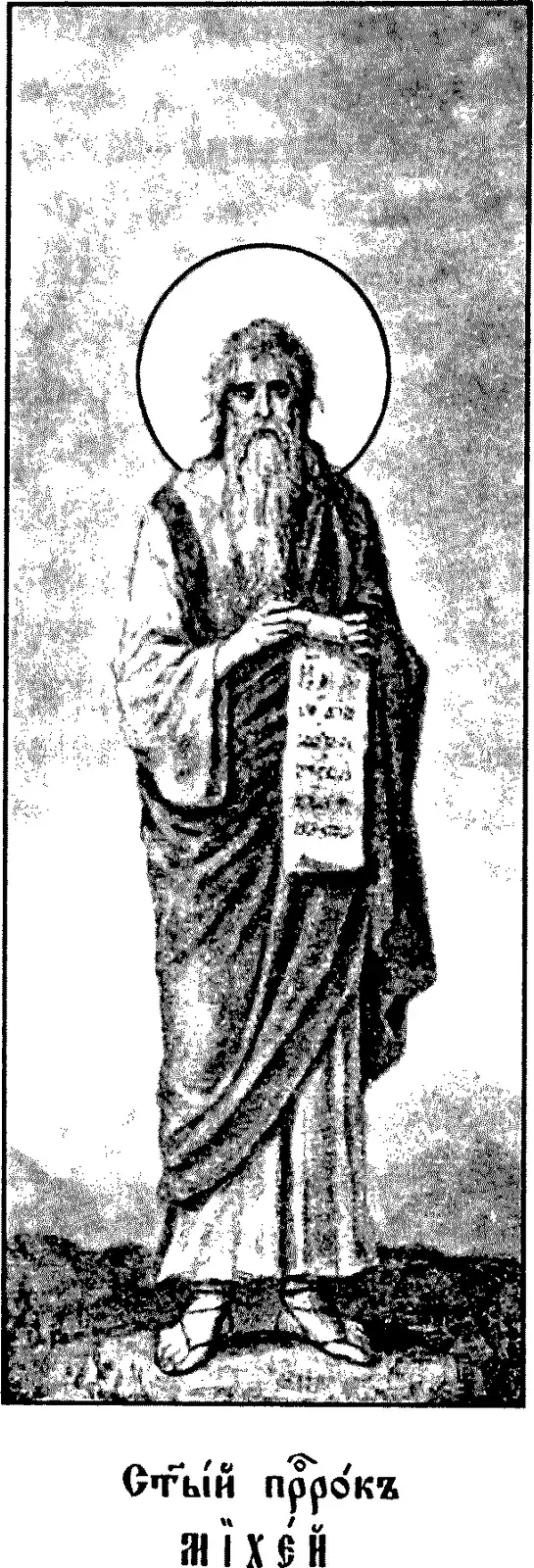
- Prophesied
- In Jerusalem under Jotham, Ahaz and Hezekiah, kings of Judah, in the later eighth century BC 124
- Not to be confused with
- Micaiah (Micheas) son of Imlah, who prophesied to King Ahab 17
Saint Micah was a prophet from the small town of Moresheth in Judah who preached in Jerusalem in the eighth century before Christ, at the same time as Isaiah. 1 He told its rulers that Zion would be plowed like a field for their injustice, and he named Bethlehem as the town from which the ruler of Israel would come, the verse the chief priests quoted to Herod when the Magi arrived. 6812 The Church commemorates him on December 21. 2
Who was the prophet Micah?
His book opens with a single line of biography: "The word of the Lord that came to Micheas the Morasthite, in the days of Joathan, Achaz, and Ezechias, kings of Juda: which he saw concerning Samaria and Jerusalem." 4 Albin Van Hoonacker, writing in the Catholic Encyclopedia in 1911, places Moresheth not far from Gath, the Philistine town, and dates the three kings roughly from 740 to 698 BC. 1 Jerusalem was where he preached, though Van Hoonacker thinks none of the speeches that survive come from before Hezekiah's reign. 1
Vatican News, in its calendar of saints, says he was born near Jerusalem and calls him a farmer whom God called to be a prophet. 3 The Byzantine Catholic Menaion makes him a man of the tribe of Judah from the village of Morasth, and a contemporary of Isaiah, Amos and Hosea. 16 Van Hoonacker names only Isaiah. 1
His book is the sixth of the twelve minor prophets. 1 Van Hoonacker divides it into three parts: threats against Samaria and Jerusalem in chapters 1 to 3, a vision of the messianic peace in chapters 4 and 5, and a dramatic dispute between God and his people in chapters 6 and 7. 1 Critics of his day doubted that the later parts were Micah's own; Van Hoonacker found their arguments unconvincing. 1
Not Micaiah son of Imlah
Another prophet shares his name, and the Catholic Encyclopedia calls both men Micheas. 117 Micaiah son of Imlah prophesied in the northern kingdom in the days of Elijah and Elisha, and stood before King Ahab of Israel to foretell, against four hundred other prophets, that Ahab would be defeated at Ramoth-Gilead. 17 Ahab reigned more than a century before Hezekiah, and the encyclopedia gives Micaiah an article of his own. 117 The prophet of this page is Micah of Moresheth. 1
"Sion shall be ploughed as a field"
Micah begins with Samaria, the capital of the northern kingdom: "I will make Samaria as a heap of stones in the field." 4 Then the threat turns south. "It is come even to Juda, it hath touched the gate of my people even to Jerusalem." 4 Van Hoonacker thinks these first chapters were written shortly before the Assyrians destroyed Samaria in 722 BC. 1
The charge he brings is injustice. "They have coveted fields, and taken them by violence, and houses they have forcibly taken away: and oppressed a man and his house, a man and his inheritance." 5 The prophets of his day, he says, "preach peace" to whoever feeds them and declare war on whoever does not. 6 Against them he sets his own commission: "But yet I am filled with the strength of the spirit of the Lord, with judgment, and power: to declare unto Jacob his wickedness, and to Israel his sin." 6
The chapter ends with a sentence on the whole city. "Her princes have judged for bribes, and her priests have taught for hire, and her prophets divined for money." 6 "Therefore, because of you, Sion shall be ploughed as a field, and Jerusalem shall be as a heap of stones." 6
Vatican News sums up his preaching in the same terms: he denounced the exploitation of the poor and the injustice of corrupt men in power, and condemned idolatry. 3 The current Martyrology says that he defended the oppressed. 2
A prophecy remembered a century later
Micah's warning was still remembered in Jerusalem a hundred years on. When Jeremiah foretold the ruin of the Temple, the priests and prophets demanded his death. 11 Some of the elders of the land stood up and quoted Micah word for word: "Micheas of Morasthi was a prophet in the days of Ezechias king of Juda, and he spoke to all the people of Juda, saying: Thus saith the Lord of hosts: Sion shall be ploughed like a field." 11
Their argument was that nobody had killed Micah for saying it. "Did Ezechias king of Juda, and all Juda, condemn him to death? did they not fear the Lord, and beseech the face of the Lord: and the Lord repented of the evil that he had spoken against them?" 11 Jeremiah was spared. 11 Van Hoonacker takes it that Hezekiah and the people did penance and the threat was withdrawn. 1
Swords into plowshares
The second part of the book turns from judgment to promise. 1 "In the last days" the mountain of the Lord's house will rise above the hills, and many nations will come to it to be taught: "for the law shall go forth out of Sion, and the word of the Lord out of Jerusalem." 7 Then "they shall beat their swords into ploughshares, and their spears into spades: nation shall not take sword against nation: neither shall they learn war any more." 7
Van Hoonacker reads these chapters as a discourse on the conversion of the nations and the messianic peace, written soon after Samaria fell, when the Assyrian army withdrew without attacking Jerusalem; they keep, he says, "an echo of the joy" of that deliverance. 1
Bethlehem Ephrata
In the middle of that promise comes the verse for which Micah is best known. "And thou, Bethlehem Ephrata, art a little one among the thousands of Juda: out of thee shall he come forth unto me that is to be the ruler in Israel: and his going forth is from the beginning, from the days of eternity." 8 The ruler will "feed in the strength of the Lord," he will "be magnified even to the ends of the earth," and "this man shall be our peace." 8
Seven centuries later, when the Magi came to Jerusalem asking where the king of the Jews had been born, Herod called the chief priests and scribes. "In Bethlehem of Juda," they told him. "For so it is written by the prophet: And thou Bethlehem the land of Juda art not the least among the princes of Juda: for out of thee shall come forth the captain that shall rule my people Israel." 12
Benedict XVI took up the same verse at the Angelus on the Fourth Sunday of Advent in 2009, quoting it in the New American Bible, where it is numbered 5:1 and Bethlehem is "too small to be among the clans of Judah." 13 He recalled that Bethlehem had given birth to King David a thousand years before Christ, and dwelt on the ruler who "shall be peace." 13 "Christmas is not a fairy-tale for children," he said, "but God's response to the drama of humanity in search of true peace." 13
"What the Lord requireth of thee"
The last two chapters are a lawsuit. God calls the mountains to witness and speaks to his people directly: "O my people, what have I done to thee, or in what have I molested thee? answer thou me." 9 The people ask what they could offer to make amends. 9 The prophet answers, "I will shew thee, O man, what is good, and what the Lord requireth of thee: Verily, to do judgment, and to love mercy, and to walk solicitous with thy God." 9 Van Hoonacker reads it as God claiming the moral law rather than sacrifices. 1
The last chapter begins in desolation and turns into a prayer, which Van Hoonacker puts in the mouth of a fallen city, more likely Samaria than Jerusalem in his reading. 110 "Rejoice not, thou, my enemy, over me, because I am fallen: I shall arise, when I sit in darkness, the Lord is my light." 10 The book closes on a God who forgives: "Who is a God like to thee, who takest away iniquity, and passest by the sin of the remnant of thy inheritance?" and who "will cast all our sins into the bottom of the sea." 10
His tomb
Scripture says nothing of how Micah died, and none of the sources consulted for this page supplies an account. The Menaion says he was buried in his own village. 16 In the reign of Theodosius the Great, according to the historian Sozomen, God revealed the burial places of Habakkuk and Micah in a dream to Zebennus, bishop of Eleutheropolis. 14 Micah's tomb was found about ten stadia from Cela, at a place called Berathsatia, which the people of the country, Sozomen says, "ignorantly styled" the tomb of the faithful. 14 The older Roman Martyrology records the same finding. 15
What is Saint Micah the patron saint of?
Saint Micah's feast day
Saint Micah's feast day is December 21. The Roman Martyrology, in the text published by the Italian bishops, commemorates him on that day as the prophet who defended the oppressed, condemned idols and injustice, and foretold that the promised king would be born in Bethlehem, to shepherd Israel in the strength of the Lord. 2 Vatican News lists him on the same date. 3
The older Roman Martyrology kept him on January 15, together with Habakkuk: the 1897 English edition commemorates "the holy prophets Habacuc and Michaeas" on that day, in Judea, for the finding of their bodies. 15 In the Byzantine calendar he is kept on August 14, the forefeast of the Dormition, as the Menaion of the Byzantine Catholic Archeparchy of Pittsburgh records. 16
Praying with Saint Micah
Micah came from a small town and spoke to the capital about the people its powerful men were pushing off their land. 15 He said plainly that the prophets around him preached peace for pay, and he claimed nothing for himself except the spirit of the Lord and the strength to name sin. 6
His harshest prophecy was not fulfilled in his lifetime. A hundred years later the elders of Judah remembered that the king had listened, and the people had repented, and the threat had been withdrawn, and they used that memory to save another prophet's life. 11
In his sixth chapter the people ask what they could bring to God that would be enough, and offer more each time they ask: calves, thousands of rams, their firstborn. 9 The answer names no offering at all. It asks for justice, mercy and a careful walk with God. 9
He also named the smallest of the clans of Judah as the place the ruler would come from, and the Church reads that verse in Advent as it waits for Christmas. 813 Benedict XVI heard in it a promise of peace that is still being sought in Bethlehem itself. 13
Saint Micah, pray for us.
Sources
- 1.Albin Van Hoonacker, "Book of Micheas," The Catholic Encyclopedia, vol. 10 (New York: Robert Appleton Company, 1911).
- 2.Roman Martyrology, entry for December 21, "San Michea, profeta," Santo del giorno, Conferenza Episcopale Italiana (in Italian).
- 3."San Michea, profeta," Santo del giorno, 21 dicembre, Vatican News (in Italian).
- 4.Micah (Micheas) 1, Douay-Rheims Bible, Challoner revision, as hosted by drbo.org.
- 5.Micah (Micheas) 2, Douay-Rheims Bible, Challoner revision, as hosted by drbo.org.
- 6.Micah (Micheas) 3, Douay-Rheims Bible, Challoner revision, as hosted by drbo.org.
- 7.Micah (Micheas) 4, Douay-Rheims Bible, Challoner revision, as hosted by drbo.org.
- 8.Micah (Micheas) 5, Douay-Rheims Bible, Challoner revision, as hosted by drbo.org.
- 9.Micah (Micheas) 6, Douay-Rheims Bible, Challoner revision, as hosted by drbo.org.
- 10.Micah (Micheas) 7, Douay-Rheims Bible, Challoner revision, as hosted by drbo.org.
- 11.Jeremiah (Jeremias) 26, Douay-Rheims Bible, Challoner revision, as hosted by drbo.org.
- 12.Matthew 2, Douay-Rheims Bible, Challoner revision, as hosted by drbo.org.
- 13.Benedict XVI, Angelus, Fourth Sunday of Advent, December 20, 2009, Libreria Editrice Vaticana.
- 14.Sozomen, Ecclesiastical History, Book VII, chapter 29, trans. Chester D. Hartranft, Nicene and Post-Nicene Fathers, Second Series, vol. 2 (Buffalo: Christian Literature Publishing Co., 1890), as revised by New Advent.
- 15.The Roman Martyrology, January 15 (Baltimore: John Murphy & Co., 1897), Internet Archive.
- 16."Menaion - August 14," Metropolitan Cantor Institute, Byzantine Catholic Archeparchy of Pittsburgh.
- 17.Albin Van Hoonacker, "Micheas, Son of Jemla," The Catholic Encyclopedia, vol. 10 (New York: Robert Appleton Company, 1911).
Saints to turn to next
Others in this collection who are turned to for some of the same things.